49 works in this view — arrow keys or swipe to move between them.
Dance in Art
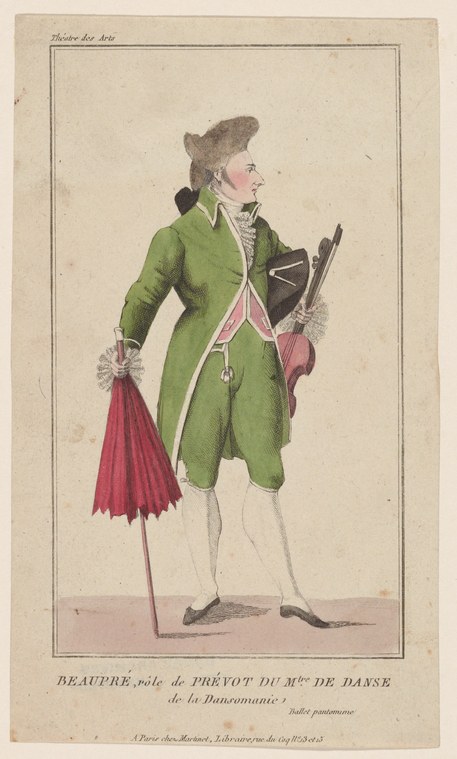
Beaupré, rôle de Prévot du mtre. de danse de La dansomanie, ballet pantomime
Unknown artist
- Collection:
- Prints depicting dance
- Source:
- New York Public Library
- Rights:
- Public domain — free to use, share and adapt.
- Recorded as:
- Public Domain
This print documents the visual language of 18th-century theatrical dance and the social satire directed at dance professionals. For historians, it offers concrete evidence of how ballroom deportment was performed, how it was perceived as affected or ridiculous, and how these attitudes were circulated through popular prints.
What you are looking at
A single male figure stands in three-quarter profile against a plain background, dressed in the height of 18th-century fashion. He wears a bright lime-green coat with a curved front, buttoned with large buttons, over a pink silk waistcoat embroidered or patterned in white, and cream breeches that extend to the knee. His stockings are white, his shoes black with buckles. A black hat with a curved brim sits atop his head, angled fashionably. In his left hand he holds a red parasol or umbrella; his right arm extends slightly back, suggesting motion. The figure's posture is elegant but tense, with a pronounced forward tilt from the hips and an exaggerated S-curve to the spine—the characteristic stance of ballroom deportment of the period. His face is shown in profile, with a prominent nose and chin typical of the caricaturing tendency of the era. The composition is a simple theatrical character portrait, likely a costume design or performance record.
The dancing
The single figure displays the characteristic frame of formal courtly dance: an arched back, chest lifted, hips thrust forward, and legs extended with pointed feet. The weight appears forward over a small base. His right arm is extended back with the hand open, while his left arm bends to hold the parasol—a pose suggesting either preparation for or recovery from a turning movement. The exaggerated spinal curve and the tension in the limbs suggest a moment caught mid-motion rather than at rest, though the parasol hints at a more theatrical or character-driven pose than pure ballroom technique.
The dance depicted
This is a costume portrait of a character role from *La Dansomanie* (The Dancing Mania), a ballet pantomime, where the figure plays Beaupré, the master of dancing. The title indicates a comic or satirical work centered on dance and those who teach it. The costume—the fashionable coat, the affected posture, and the parasol as an accessory—suggests caricature: the figure embodies the stereotype of an affected dancing master of the period, all affectation and artifice. The dance content is formal 18th-century ballroom or theatrical dance, performed in the court style with emphasis on turned-out legs, lifted posture, and refined gesture. The work documents both a specific performance role and the visual conventions of how dancing masters were satirized in period entertainment.
How it was made
This is a hand-colored etching or engraving, as indicated by the precision of the line work and the flatness of the applied watercolor. The inscription in French below the figure and the formal frame suggest a print intended for circulation, likely a souvenir of a Paris theatrical production. The technique allowed for multiple copies to be distributed to audiences or collectors, making this both a record of a specific performance and a commodity within the culture of printmaking and theater documentation of the 1780s. The hand-coloring is selective and bright, focusing attention on the costume rather than background detail.
About this work
This is a hand-colored theatrical print documenting a character role from *La Dansomanie*, a satirical ballet pantomime performed in Paris in the late 18th century. The figure of Beaupré, master of dance, is presented as a caricature of the affected dancing master: stylishly dressed in fashionable green and pink, posed in the exaggerated courtly frame of the ballroom, holding a red parasol as though it were a badge of office. The work belongs to a tradition of theatrical character portraiture that combined performance documentation with social satire, recording not only how a role was danced but how dance and dancing masters were perceived and mocked by the period's audiences. It is a valuable witness to the intersection of theatrical performance, ballroom style, and print culture in the age of neoclassical ballet.
How to look at it
Attend to the posture: the extreme arch of the back, the forward thrust of the hips, and the angle of the head are all exaggerations of the correct ballroom stance of the period. The artist has captured the formal technique accurately in order to mock it—the comedy lies in the intensity of the curve, the tautness of the frame, and the overall stiffness. The parasol is the key prop: it is not a dance implement but a fashion accessory, signaling that this is a character critique, not a technical demonstration. Notice how the figure's weight is forward and precariously balanced, intensifying the impression of artificial tension.
The period
The late 18th century saw a flourishing of comic and satirical ballets at the Paris Opéra and in popular theaters. *La Dansomanie* (also known as *La Manie de la Danse*) belongs to this tradition of works that used dance as a vehicle for social commentary, often targeting the vanity and pretension of nobles, musicians, and dance professionals. The neoclassical reform of ballet under Noverre and others elevated dance's intellectual status, but popular entertainment simultaneously mocked the affectations of both dancers and dancing masters. The exaggerated posture and costume of this character would have read as both recognizably 'danced' and unmistakably comic to a period audience. Hand-colored prints like this were a major medium for circulating images of theatrical stars and characters, functioning as early celebrity merchandise.
Where it lives
This print is held in the New York Public Library's collection of dance-related prints. It is a hand-colored engraving or etching, likely published in Paris in the 1780s–1790s, intended as a theatrical souvenir or popular print documenting a specific performance and role.
Dance in this work
Questions about this work
What was *La Dansomanie*?
*La Dansomanie* (The Dancing Mania) was a satirical ballet pantomime performed at the Paris Opéra or in popular theaters in the late 18th century. It used dance as the vehicle for social satire, mocking the vanity and pretension of dance enthusiasts, nobles, and professionals. The plot centered on an epidemic of dance madness afflicting various social types, each portrayed with comic exaggeration.
Who was Beaupré?
Beaupré was a character role—a dancing master—in *La Dansomanie*. The title 'Prévot du mtre. de danse' identifies him as the provost or senior figure among dancing masters, suggesting a satirical commentary on professional dance hierarchy and pretension. This print records the character's costume and stylized movement as performed in the production.
Why does the figure have such an exaggerated posture?
The extreme arch and forward tilt are both accurate to the ballroom deportment of the 18th century and exaggerated for comic effect. The artist has amplified the formal technique in order to satirize it, making the refined and correct stance appear ridiculous through overstatement. This is a form of visual caricature specific to the period.
What does the red parasol mean?
The parasol is a fashion accessory and a prop signaling the character's vanity and affectation. It is not a dance implement but rather a symbol of social pretension—a marker that this figure is a dandy or social climber as much as a dancing master. It grounds the satire in social commentary rather than pure movement.
More dance artwork





