49 works in this view — arrow keys or swipe to move between them.
Dance in Art
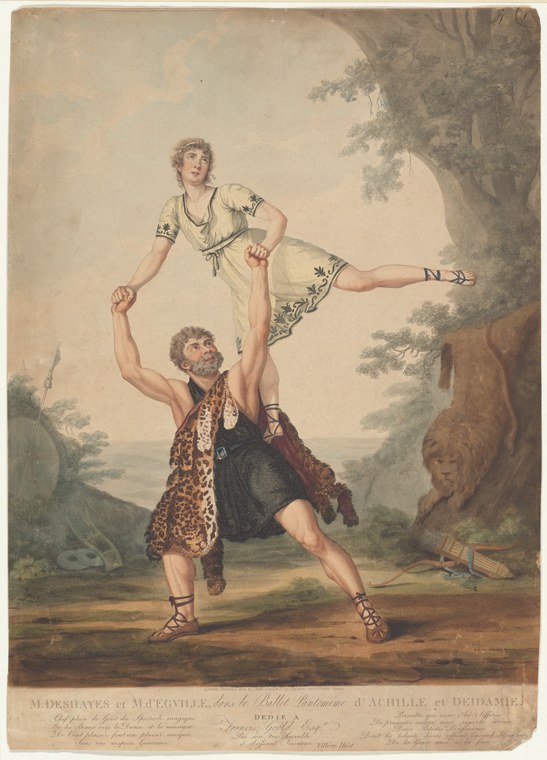
M. Deshayes et M. d'Egville, dans le ballet pantomime d'Achille et Déidamie
Unknown artist
- Collection:
- Prints depicting dance
- Source:
- New York Public Library
- Rights:
- Public domain — free to use, share and adapt.
- Recorded as:
- Public Domain
This image documents the theatrical practice and physical capabilities of professional male dancers in the 18th-century ballet world, showing that acrobatic partner work and dramatic lifting were integral to spectacle, not later innovations. The specificity of the dancers' names and the ballet title anchors the image as a historical document of a particular performance tradition, making it invaluable for reconstructing the actual physical and narrative content of historic stage works.
What you are looking at
A hand-colored engraving depicting two male dancers in a woodland setting framed by large trees. The figure in the foreground, wearing a leopard-skin costume and dark breeches, lifts his partner—a younger man in a pale tunic with embroidered skirt—high above his shoulders in a dramatic acrobatic pose. The lifted dancer extends one leg horizontally while the supporting dancer maintains a deep plié, his musculature and exertion clearly rendered. The composition frames this moment of extreme lift against a misty landscape background, with classical drapery and props (including what appears to be a shield or armor) scattered at ground level to suggest an ancient mythological setting. The light is warm and even, typical of 18th-century hand-coloring, and the figures occupy the full height of the composition.
The dancing
The supporting dancer stands in a pronounced plié with his weight centered, his torso upright and arms positioned to stabilize the lift. His partner is held aloft in an extended arabesque-like position, one leg stretched horizontally while the other bends, arms relaxed or extended for counterbalance. Both dancers display the turned-out legs and elongated port de bras characteristic of formal court dance training. The age and size difference between the two men is deliberately emphasized—the older, more muscular dancer supporting a smaller, younger, more delicately built partner.
The dance depicted
This is a scene from the pantomime ballet *Achille et Déidamie* (Achilles and Deidamia), featuring the dancers Deshayes and d'Egville as named in the caption. The image captures a moment of theatrical spectacle that goes beyond conventional balletic movement into acrobatic display—a partner lift or adagio element performed in a theatrical context. The costumes (one classical, one mythological-exotic) and the narrative framing suggest this is a moment of dramatic tension or physical prowess within a story ballet. The style and subject matter place this firmly within 18th-century theatrical ballet, likely French or Italian in production.
How it was made
This is a hand-colored engraving, established by the fine linear detail, the parallel-line shading, and the evidence of hand application of watercolor or gouache over the printed base. The technique allowed for wide circulation of theatrical imagery throughout Europe—engravings of celebrated dancers and scenes were popular commodities sold to the theater-going public. The hand-coloring adds immediacy and specificity, while the formal engraving process lent authority and permanence to the record of an ephemeral performance.
About this work
This engraving documents a moment from an 18th-century theatrical ballet featuring two celebrated male dancers performing an acrobatic lift in a classical mythological context. The work combines balletic training (evident in the turned-out positions and formal épaulement) with physical acrobatics and theatrical spectacle, capturing a peak moment of difficulty and display. As a prints-for-public-consumption record of a live performance, it stands as evidence of what audiences expected from professional male dancers of the period: technical refinement, physical power, and the capacity to perform dangerous feats.
How to look at it
Notice the precision of the weight distribution in the supporting dancer's plié—the engraver has rendered the muscular engagement and the angle of descent with anatomical care. The extended leg of the lifted dancer describes a clean horizontal line, held without visible strain, suggesting the moment is one of controlled display rather than struggle. The theatrical framing—the drapery, the armor, the woodland setting—situates this moment as climactic and narratively significant, not a casual transition. The formality of the poses and the clarity of the line-work emphasize the technical mastery required, making the feat legible as an achievement.
The period
The late 18th century saw the development of narrative pantomime ballets with increasingly elaborate technical vocabulary, especially at major European courts and commercial theaters. Male dancers held prominent roles and were expected to combine balletic elegance with acrobatic prowess; the partnership between an older, stronger dancer and a younger partner was a stock configuration. The taste for classical mythology as subject matter, combined with theatrical spectacle, drove the creation of full-evening ballets that pushed physical boundaries. Engravings and prints documenting celebrated dancers and scenes were crucial to the circulation of theatrical fashion and served as souvenirs for audiences.
Where it lives
The work is held in the New York Public Library's collection of prints depicting dance. It is a commercial print, originally intended for purchase by theatergoers and collectors interested in recording celebrated performances and dancers.
Dance in this work
Questions about this work
Who were Deshayes and d'Egville?
The engraving names them as the performers in this scene from *Achille et Déidamie*, but the print does not provide biographical information. Both names are consistent with professional ballet dancers active in late 18th-century European theaters; further identification would require consultation of theater records and dance history sources.
Was this lift common in 18th-century ballet?
Acrobatic lifts and adagio work were part of the vocabulary of theatrical ballet in this period, particularly as ballet became more ambitious in its physical demands. However, the dramatic height and extension shown here represent an exceptional feat of strength and control, suggesting this moment was designed to dazzle and was likely a set-piece moment in the ballet's narrative.
Why are both dancers male?
In 18th-century ballet, male dancers regularly performed both leading and supporting roles, including prominent partnering and lifting. The age and size difference between the dancers here may suggest a specific narrative relationship or simply reflect the available personnel in the company.
How reliable is this image as a record of the actual performance?
Theatrical prints were created with an eye to capturing recognizable moments and the physical types of celebrated dancers, but they were also stylized and sometimes took compositional liberties. This image likely depicts an actual moment and dancers recognizable to contemporary audiences, but the precision and idealization of the line-work should not be taken as photographic documentation.
More dance artwork





