49 works in this view — arrow keys or swipe to move between them.
Dance in Art
Les festes de l'Amour et de Bachus
Unknown artist
- Collection:
- Prints depicting dance
- Source:
- New York Public Library
- Rights:
- Public domain — free to use, share and adapt.
- Recorded as:
- Public Domain
This work is valuable evidence of what baroque court spectacle looked like and how it was recorded and circulated. For historians of dance, it shows the visual language and framing devices—the architectural setting, the mythological justification, the hierarchy of performer and audience—through which dances were presented and understood. The prominence of the lyre and the relative immobility of the figures also documents the period's assumption that music and verse were the primary arts, with dance as a supporting spectacle.
What you are looking at
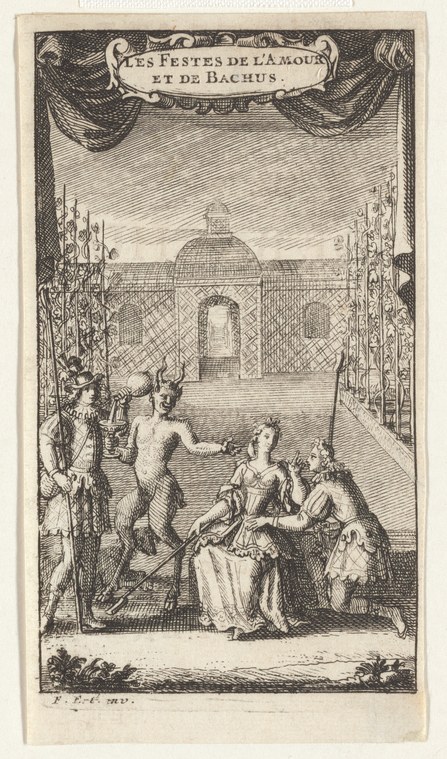
A theatrical garden pavilion scene with a domed structure in the background frames an elegant outdoor entertainment. In the foreground, three figures in classical drapery occupy the immediate space: a semi-nude male youth holds a lyre, while two seated women in flowing robes recline and gesture—one gestures toward the musician with an attitude of command or invitation. A third standing figure in darker dress, possibly attendant or companion, occupies the middle distance. The setting is bounded by classical colonnades and latticed screens; light streams across the scene from the upper left in parallel lines, creating an atmosphere of divine or theatrical illumination. The composition is strictly framed within an architectural stage-set, emphasizing artifice and courtly spectacle rather than naturalism.
The dancing
The bodies are posed rather than captured in motion—this is a moment of social arrangement, not active dance. The lyre-player stands in classical contrapposto, weight shifted to one leg, the other relaxed; his torso turns slightly to face the seated women. The seated figures recline in attitudes of leisure, with one raising an arm in an elegant gesture of acknowledgment or command toward the musician. The standing attendant figure watches from the margin. The grouping suggests hierarchy and decorum rather than mutual participation; the bodies are articulated through the vocabulary of classical statuary and courtly etiquette.
The dance depicted
This is not a depiction of active dancing but of courtly or theatrical entertainment in the mode of baroque spectacle—the fêtes galantes or allegorical entertainments that dominated European court culture in the 17th century. The title invokes the classical deities of love (Amour/Cupid) and wine (Bacchus), suggesting this represents an idealized mythological celebration in which music and verse might accompany dancing, rather than a specific dance technique. The lyre signals the primacy of music and poetry over choreography; any dance would be secondary to these arts. The work documents the social framework and visual spectacle of courtly performance rather than the mechanics of a particular dance style.
How it was made
This is an engraving, executed in fine lines with careful attention to parallel hatching for tone and shadow—a technique that allowed for precise reproduction and wide circulation among collectors and scholars. The linear clarity and formal composition suggest it served a documentary function, recording a court spectacle or theatrical production for audiences beyond the original venue. Engravings of this type were typically bound into volumes of festival designs, court spectacles, or allegorical treatises, making them instruments of cultural memory and courtly display.
About this work
This engraving records a moment from the visual and literary culture of 17th-century court entertainment, specifically the baroque fêtes galantes in which music, poetry, mythological allegory, and dance were woven together into unified spectacles. The work is titled to invoke classical authorities (Cupid and Bacchus) while depicting a thoroughly contemporary scene of aristocratic leisure and cultural refinement. It belongs in a dance archive not because it depicts an active dance, but because it documents the social and theatrical world in which dances were performed, the hierarchy of courtly entertainments, and the integration of dancing into a larger apparatus of courtly display. The image preserves the aesthetic ideals and visual conventions through which early modern elites imagined and legitimized pleasure, sensuality, and performance.
How to look at it
Attend to the formal geometry of the composition: the way the figures are arranged in a shallow stage-like space, the clarity of the architectural framing, and the light that models the bodies. This is not a snapshot but a carefully designed tableau in which every figure occupies an assigned place and role. The engraver's choice to freeze the moment at this point of social arrangement—with music offered and attention directed toward the musician—suggests that the spectacle is one of social decorum and cultural display rather than unbounded bodily expression. The precision of the line work invites close viewing and reveals the courtly ideal of elegant, measured, and refined pleasure.
The period
This engraving belongs to the late 17th-century culture of the fêtes galantes and courtly spectacle that flourished in France and Italy. Following the court ballets of the 16th and 17th centuries (in which even kings danced), aristocratic entertainment increasingly took the form of staged tableaux, garden entertainments, and allegorical narratives in which professional performers and musicians were employed to create elaborate sensory experiences. The classical architectural setting and mythological framing reflect the humanist education of the aristocracy and their claim to taste and refinement. The visual documentation of these events—through engravings, etchings, and printed librettos—was itself an important part of courtly patronage and reputation.
Where it lives
The work is held in the New York Public Library's collection of prints depicting dance, part of a larger archive of visual documentation of performance and entertainment.
Dance in this work
Questions about this work
Is this actually showing a dance?
Not an active dance, but the social and theatrical context in which dances occurred. The title references a courtly fête or entertainment in which music, poetry, and dance would have been performed. The figure with the lyre is the primary performer; any dancing would follow or accompany the music. The engraving documents the aesthetic and social framework rather than a specific choreography.
What does the title mean?
The title invokes the classical deities of love (Amour) and wine (Bacchus), situating this entertainment within a tradition of mythological allegory. Such titles were conventional for courtly spectacles, which often justified pleasure and sensuality through classical reference. The actual historical event, if one existed, is not identified in the record.
Who were the performers?
The record does not identify the performers or the original occasion. In the culture of baroque court spectacle, professional musicians and dancers were often employed for such events, though court members might also participate. The engraving itself served to disseminate the aesthetic ideals of such performances to a wider audience of educated collectors and courtiers.
More dance artwork





