49 works in this view — arrow keys or swipe to move between them.
Dance in Art
Mlle. Sallé.
Unknown artist
- Collection:
- Prints depicting dance
- Source:
- New York Public Library
- Rights:
- Public domain — free to use, share and adapt.
- Recorded as:
- Public Domain
Sallé was a transformative figure in dance history, and her influence extended beyond her lifetime. This engraving is evidence of how she was celebrated and how her innovations in costume and style—her move toward simpler dress and more naturalistic movement—were recorded and disseminated. For historians of dance and dress, this image is a primary source for understanding the aesthetics and performance norms of the early 18th-century stage.
What you are looking at
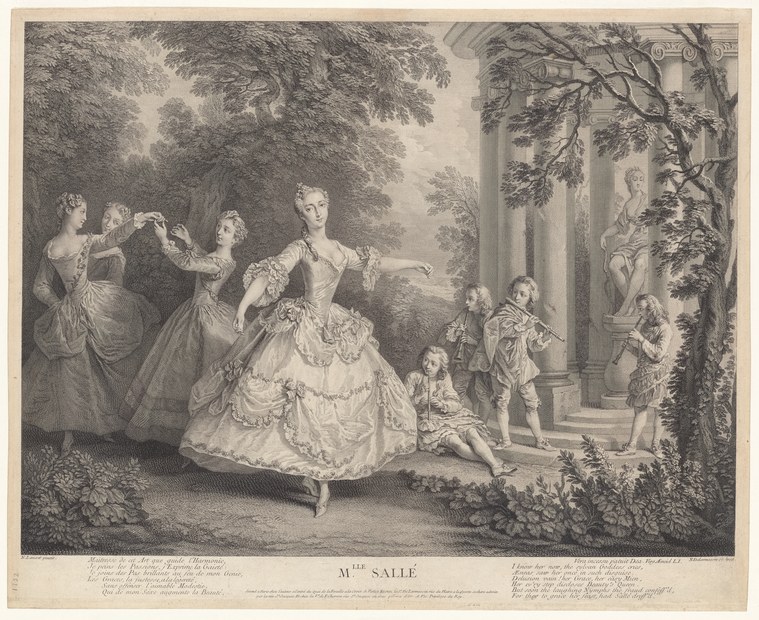
A woman in an elaborate pale silk gown stands in the center of a classical garden or terrace, captured mid-movement in a graceful pose. She wears a full skirt with deep pleats and draped fabric caught up at the sides, and her arms are extended in an open, expressive gesture. Around her, three attendant figures in similar period dress support or accompany her: two women flank her (one adjusting or holding fabric, another with raised arms), while a male figure in breeches stands to the left. A row of classical columns frames the right side of the composition, with ivy or greenery climbing them; tall trees arch overhead on the left. Two smaller cherub-like figures sit or recline in the lower foreground. The whole scene is rendered in careful tonal gradations characteristic of an 18th-century engraving or print, with strong contrasts between light and shadow. The mood is one of refined grace and theatrical display.
The dancing
The central female figure stands with weight on one leg in a poised, upright carriage, her arms open and extended in a gesture of invitation or salutation rather than technical ballet alignment. The attendants do not form any closed holds; instead, they gesture freely and seem to be attending her in a social rather than partnered capacity. Her body is presented frontally to the viewer, with a slight twist at the torso. The posture suggests the elongated, graceful frame of 18th-century courtly deportment rather than the turned-out placement that would define later classical ballet.
The dance depicted
This is almost certainly a record of Marie Sallé (1707–56), one of the most celebrated dancers of the early 18th century and a pioneer of balletic reform. The title alone identifies her, and the dress, the garden setting, and the attendant figures are consistent with the theatrical and courtly contexts in which she danced. Sallé was known for her expressive, lithe style and her willingness to break with convention—most famously by performing in simple drapery rather than the ornate costume typical of her time. The pose here captures the kind of open, gestural elegance that characterized her approach to movement, emphasizing fluidity and emotional expression over technical display.
How it was made
This is an engraving, executed with fine parallel lines and careful cross-hatching to create tonal depth and model form. The technique is consistent with French 18th-century commercial printmaking, where such images circulated as mementos of celebrated performers and as records of theatrical fashion. The print medium allowed the image to be reproduced and distributed widely, making Sallé's likeness and reputation accessible beyond those who had seen her perform live. Engravings of this kind served as both artistic records and promotional objects.
About this work
This print documents Marie Sallé, one of the 18th century's most innovative dancers, in a carefully composed moment that emphasizes her signature style: graceful, expressive, and refined rather than technically virtuosic in the later balletic sense. The engraving captures her in a garden or theatrical garden setting, attended by companions who frame and support her central figure. It is both a portrait of a historical performer and a record of how early-18th-century dance was seen and valued—as an art of deportment, gesture, and emotional expression within a courtly or semi-theatrical context. The work belongs in a gallery of dance imagery because it documents not only a major historical figure but also a pivotal moment in the development of European theatrical dance, when reform and individual artistry were beginning to reshape the form.
How to look at it
Note the openness of the pose: the dancer's arms are not held in any rigid position, but rather extended in a gesture that suggests emotional expression or social warmth. The composition places her as the clear focal point, with attendants arranged to support and frame her. Observe the treatment of her gown—the way the fabric is caught and draped to suggest movement without being turbulent or undignified. The classical setting (columns, garden, harmonious composition) places the dancer in a realm of idealized grace, consistent with how the 18th century aestheticized theatrical performance. The small cherub figures are a rococo convention, adding playfulness and a sense of divine approval to the scene.
The artist
The artist is not recorded, but the print is almost certainly a French commercial product, likely issued in Paris or London during or shortly after Sallé's active performing years (roughly 1720s–1750s). Such theatrical prints were a standard product of the period, created to capitalize on the fame of celebrated performers. The engraver's identity was often secondary to the marketability of the subject.
The period
This engraving dates to the early–mid 18th century, a period of significant change in European dance and theatre. Sallé's career coincided with a gradual shift away from the rigid formality and ornamental style of French court ballet toward a more expressive, naturalistic approach. Her contemporary was Jean-Georges Noverre, who would theorize this reform movement in his *Lettres sur la danse* (1760). In the visual arts, the rococo aesthetic—with its emphasis on grace, movement, and sensibility—was dominant, and theatrical imagery was a major subject of printmaking. Engravings and etchings of celebrated dancers were luxury goods and souvenirs, circulating among collectors and theatregoers.
Where it lives
The work is held in the New York Public Library's prints collection, described as depicting dance. It is part of a broad documentary archive of theatrical and performance imagery from the 18th and early 19th centuries.
Dance in this work
Questions about this work
Who was Marie Sallé?
Marie Sallé (1707–56) was a French dancer and choreographer who performed throughout Europe and was celebrated as one of the finest dancers of her age. She was known for her grace, expressiveness, and willingness to reform theatrical dance practice—notably by performing in simpler, more naturalistic costume and movement vocabulary than was conventional. She worked in Paris, London, and other major European centers and was a contemporary of other influential figures in the development of ballet.
What kind of dance is this?
This does not depict any specific named dance form (such as a minuet or courante), but rather a moment of theatrical display by a celebrated performer. It captures the general aesthetic of 18th-century courtly and stage dancing: refined, expressive, and emphasizing graceful deportment and gesture. The open posture and emotional quality are consistent with Sallé's reputation for expressiveness rather than technical display.
Why would an engraving like this have been made?
Engravings of celebrated performers were a standard commercial product in 18th-century Europe, sold to theatregoers, collectors, and admirers as mementos and records of famous artists. They served a function similar to modern photographs or posters of performers. The print preserved and circulated the image of a celebrated dancer beyond those who had seen her live, and it was often sold with a caption or text providing biographical or contextual information.
What does the garden setting mean?
The classical garden setting with columns and trees was a convention of theatrical and courtly imagery in this period. It placed the dancer in an idealized, harmonious realm associated with refinement and grace. Such settings were often used in prints, paintings, and theatrical design to elevate the subject and to suggest that dance belonged to a world of beauty, nature, and social cultivation rather than vulgar entertainment.
More dance artwork





