49 works in this view — arrow keys or swipe to move between them.
Dance in Art
Mlle. Camargo
Unknown artist
- Collection:
- Prints depicting dance
- Source:
- New York Public Library
- Rights:
- Public domain — free to use, share and adapt.
- Recorded as:
- Public Domain
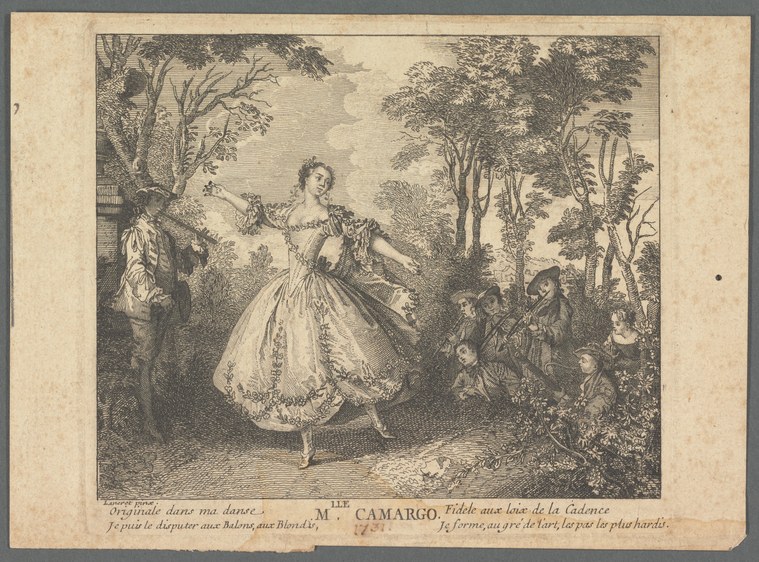
Camargo was a historical innovator in dance technique and costume, and this engraving is evidence of her celebrity and the visual culture that surrounded her. The image shows us how early theatrical ballet was imagined and valued—as an art of line, elevation, and refined movement—and captures the aesthetic of a performer whose career shaped the development of ballet. For dancers and historians, it is a primary document of an influential performer and the stage conventions of her era.
What you are looking at
A young female dancer in an ornate embroidered gown stands in a formal garden setting, captured mid-performance or mid-pose. She wears an elaborate dress with a fitted bodice and full skirt decorated with delicate patterns, and her arms are raised in a graceful frame. The setting is a wooded park or formal garden with tall trees framing the composition on both sides, creating a theatrical backdrop. To the right, several figures—both men and women in period dress—watch from beneath the trees, suggesting an audience or courtly gathering. The lighting is dappled and atmospheric, characteristic of Rococo theatrical imagery. The engraving's fine hatching and line work create depth and movement, capturing a moment of elevated, refined performance before an intimate court audience.
The dancing
The central dancer holds an upright, elongated frame with both arms raised in a characteristic eighteenth-century port de bras—soft, rounded arms rather than sharply geometric. Her weight appears poised on one leg with the other leg extended or lifted, suggesting a rising or turning movement. Her torso is held in elegant extension. The watching figures to the right are rendered in smaller scale and softer focus, emphasizing the dancer at center; their postures indicate rapt attention. The overall carriage speaks of trained balletic movement, with emphasis on verticality, lightness, and refinement of line.
The dance depicted
This depicts a solo danced by a professional or court performer in the mid-eighteenth century, most likely a theatrical or court dance in the French balletic idiom. The figure's training, dress, and framing suggest a dancer such as Camargo herself—the title identifies her. The moment chosen emphasizes the quality of line and the elevated, ethereal bearing central to early theatrical ballet. The garden setting and outdoor performance space situate this within the aristocratic or high-theatrical context where such dancers performed. The engraving preserves the memory of a specific celebrated performer and the aesthetic values of her art.
How it was made
This is a fine copperplate engraving with careful parallel hatching to model form and create atmospheric depth. The technique allows intricate rendering of fabric detail—the embroidery and folds of the gown—and the play of light across the garden. Engravings of this quality were expensive and relatively limited in circulation; they served educated audiences in aristocratic or wealthy merchant households, functioning as both artistic objects and records of celebrated performers. The inscription at the bottom confirms this was a named commemorative print, designed to preserve and distribute the image of a famous dancer to an audience that valued both the visual arts and the spectacle of courtly performance.
About this work
This engraving documents a moment of early theatrical ballet, likely from the 1730s-1740s, showing a celebrated female dancer in the refined aesthetic of the pre-Romantic era. Mademoiselle Camargo was a real and famous performer of the period, known for her technical innovation and her introduction of shortened skirts that allowed greater visibility of footwork—a revolution in dance costume. The print commemorates her practice and her fame, circulating her image among the cultured audiences who followed theatrical and balletic life. The work sits at the intersection of dance history, theatrical practice, and Rococo visual culture, documenting not only a person but a moment in the professionalization and aestheticization of dance.
How to look at it
Attend to the dancer's frame and carriage—the raised arms, the length of line through the torso, the sense of lightness and elevation. This is not the dramatic, exaggerated movement of popular spectacle, but the refined aesthetic of courtly and early theatrical ballet. Notice the care with which the engraver rendered the fabric of her dress and the delicate line of her limbs; the technical virtuosity of the print itself mirrors the technical refinement the image celebrates. The garden setting and the watching audience suggest this is a performance within a social ritual, not a spectacle for a paying public—a distinction that shaped how such dance was made and valued.
The artist
The artist is not recorded in the catalogue. The engraving's quality and style suggest it was made by a skilled reproductive engraver working in the Rococo period, likely based on a painting or drawing now lost. The inscription—crediting Camargo and identifying the image as hers—suggests the print was made with her permission or to celebrate her fame, a common practice for celebrated performers. Such commemorative engravings were often made and distributed during or shortly after a performer's active years.
The period
This engraving belongs to the mid-eighteenth century, a moment of rapid change in both dance and its visual representation. Camargo was a real dancer active from the 1730s onwards, known for technical innovations—particularly her shorter skirt (the 'Camargo skirt'), which freed her legs and allowed greater display of footwork and elevated technique. This was also the period of Rococo dominance in the visual arts, with its emphasis on grace, lightness, and theatrical subjects. Engravings of famous performers became a significant visual genre, allowing the public to own images of celebrated artists and to participate in the celebrity culture surrounding them. The garden setting reflects Rococo taste for natural, pastoral settings, even in the context of a formal performance.
Where it lives
This is held in the New York Public Library's collection of prints depicting dance. It is an eighteenth-century copperplate engraving, likely a commemorative print made and circulated during or shortly after Camargo's dancing career. The inscription identifies both the subject and appears to credit the artistic source or conception.
Dance in this work
Questions about this work
Who was Mademoiselle Camargo?
Marie-Anne de Cupis de Camargo (1710–1770) was a celebrated French-Italian dancer who performed at the Paris Opéra and in other major European courts. She was known for her technical skill, her innovation in shortening her skirt to show her footwork and technique more clearly, and her celebrity status in aristocratic and theatrical circles. She was one of the first female dancers to achieve widespread fame and to be extensively documented in visual media such as engravings.
Why is this garden setting significant?
The garden setting reflects both Rococo aesthetic taste and the social world in which aristocratic dance performances took place. Many court performances occurred in gardens or park settings rather than in formal theaters. The garden also evokes ideals of natural grace and beauty central to Rococo art—the dancer is presented not as a spectacle but as a figure of natural refinement placed in a refined natural setting.
What does the engraving technique tell us?
The fine copperplate engraving was an expensive, labor-intensive process that produced objects for a wealthy, educated audience. This level of finish and circulation indicates that Camargo was a significant cultural figure whose image was valuable enough to justify the cost of a fine print. It also shows how dance was valued by the visual arts establishment—serious enough to document through a refined artistic medium.
What is the dancer wearing, and why does it matter?
She wears an elaborate embroidered gown with a full skirt, typical of the period. What is significant is the skirt length—shorter than earlier court dances required, revealing more of the leg and foot. This was Camargo's innovation, which allowed audiences to see the footwork and technical skill that earlier, floor-length skirts had concealed. Her costume thus documents a pivotal change in dance aesthetics and performance practice.
More dance artwork





