49 works in this view — arrow keys or swipe to move between them.
Dance in Art
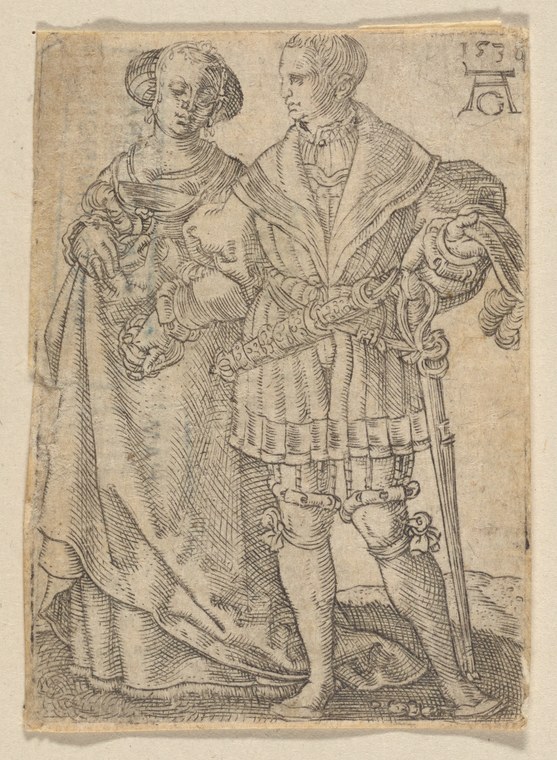
Dancing Couple
Unknown artist
- Medium:
- Source:
- New York Public Library
- Rights:
- Public domain — free to use, share and adapt.
- Recorded as:
- public_domain
This engraving offers a rare glimpse of how Renaissance and early modern courtship and social interaction were actually conducted and dressed—not through historical description, but through a contemporary image made to circulate. For dancers interested in period style and context, it documents the carriage, costume, and spatial relationships that governed formal social movement before the codification of ballet. The work also demonstrates that dance history includes moments that do not depict active steps but rather the social rituals and visual conventions within which dance occurred.
What you are looking at
A man and woman face each other in an intimate moment of courtship or early dance, rendered in a delicate pen-and-ink engraving. The woman stands to the left in an elegant gown with voluminous skirts and puffed sleeves, her elaborate headdress and jewelry marking her as fashionable and of high status. The man to the right wears a richly patterned doublet and hose, with a jeweled sword at his side; he gazes toward the woman with evident attention. They do not touch, but the spatial relationship and their mutual regard suggest flirtation or a formal social dance. The background is plain, focusing attention entirely on the figures and their dress. The woman's left hand rests against her body with fingers extended; her posture is composed and upright. The man's weight appears shifted slightly toward her, his posture attentive. The engraving style is precise and detailed, with fine parallel lines building form and fabric texture throughout.
The dancing
The two figures stand at a conversational distance, not in a closed dance hold. The woman's posture is formal and reserved, with her body upright and her gaze directed at the man; her extended fingers suggest grace and refinement. The man leans slightly forward, his body language more animated and engaged than hers. Neither figure appears to be in active movement or a recognizable dance position; rather, they occupy a moment of social interaction frozen in time. The asymmetry in their bearing—her restraint, his forward inclination—captures a moment of courtship negotiation rather than synchronized stepping.
The dance depicted
This is not a depiction of active dance steps, but rather of courtship ritual or the prelude to dance—a social moment of the kind that would precede formal dancing at court or in aristocratic gatherings. The dress and setting are consistent with Renaissance or early modern court culture (roughly 1500–1600), when elaborate clothing and formal social interaction were performances in themselves. The engraving documents the aesthetic and behavioral conventions governing male-female interaction in elite society. Whether this represents a specific dance or a generalized moment of social courtship cannot be determined from the image alone; the work is valuable as a window into the material culture and body language of the period rather than as a record of choreographic practice.
How it was made
This is a woodcut or engraving, rendered in black ink on paper, with no evidence of hand coloring. The technique employs fine parallel lines and cross-hatching to build volume, shadow, and the rich texture of fabric—the patterned doublet and the woman's elaborate dress are conveyed entirely through linear mark-making. The precision and delicacy of the line work suggest a skilled artisan working from a prepared block or plate. The circulation and audience for such prints was broad: they were produced in quantity, relatively affordable, and widely distributed in Europe as images of fashion, manners, and ideal behavior. The work is a documentary artifact as much as an artwork, recording how the elite dressed and conducted themselves.
About this work
This engraving documents a moment of courtship or formal social interaction between two fashionably dressed figures of the Renaissance or early modern period. The precision of the line work and the care lavished on depicting elaborate costume and jewelry suggest that the image circulated as a model of elite behavior and taste. The work sits at the intersection of dance, fashion, and social history: it shows us not steps but the material and behavioral context in which courtly dance took place—the dress, the posture, the conventions of male and female deportment that framed formal movement. For dancers and historians, it is valuable not as a record of choreography but as evidence of how the body was presented and how interaction was staged in aristocratic culture.
How to look at it
Attend first to the relationship between the two bodies: how they are positioned relative to each other, where each gaze is directed, which figure is more animated and which more reserved. This spatial and postural asymmetry is the content of the image. Then examine the dress in detail—the texture and pattern of the doublet, the volume and movement implied in the woman's skirts, the careful rendering of jewelry and headdresses. The engraver has chosen to depict a moment before or outside formal dance, but the precision and formality of the dress and bearing tell us everything about the culture in which dance took place. The image is a record of social choreography: how the body was presented, how distance was managed, how male and female roles were expressed through posture and material display.
The artist
The artist is not recorded. The engraving is consistent with the Northern European or German-speaking tradition of the 16th century, when such prints were produced in quantity as windows into aristocratic life, fashion, and behavior. Prints in this tradition were often made without attribution or with attributions that did not survive; they functioned as practical images for circulation rather than as signed artworks.
The period
In the 16th century, as courtly culture became increasingly formalized across Europe, dances like the pavane and galliard were codified and taught as marks of gentility. Before or alongside such dances came the rituals of courtship and social greeting documented here—moments of spatial negotiation between men and women governed by strict rules of decorum. The elaborate dress depicted here—the woman's headdress, jewels, and skirts, the man's jeweled sword and patterned doublet—was not merely decoration but a performance of status and breeding. Engravings and woodcuts that recorded these moments in contemporary dress were popular across Europe, circulating both as fashion documentation and as moral or instructional images.
Where it lives
The work is held in the New York Public Library collection and is catalogued there as a print of unknown date and artist. The source indicates it was identified as a 'Dancing Couple,' a title that describes the figures but may not fully capture the social moment being depicted.
Dance in this work
Questions about this work
Is this a depiction of an actual dance?
Not in the sense of choreographed steps or a formal dance pattern. The image shows a moment of courtship or social greeting between two fashionably dressed figures—the prelude to or context of dance, rather than dance itself. The engraver's attention is on dress, carriage, and social interaction rather than on movement or footwork.
When was this made, and how do we know?
The catalogue record does not give a date, but the style of dress, the woman's headdress, the man's doublet and sword, and the engraving technique are all consistent with the 16th century, likely the middle decades. The artist is unknown. Without archival evidence or a signature, a precise date cannot be established from the image alone.
What does the woman's hand position mean?
Her left hand is extended with fingers open, resting lightly against her body or skirt. This gesture was conventional in Renaissance portraiture and fashion prints, signaling grace, refinement, and an awareness of being observed. It is not a dance position but part of the repertoire of aristocratic bearing.
Why was this print made?
Prints documenting contemporary aristocratic dress and social behavior circulated widely in 16th-century Europe as models of courtly taste and conduct. They served documentary, instructional, and aspirational purposes—showing how the elite dressed, how they carried themselves, and how men and women interacted in formal settings. The image would have been purchased and kept as a reference for fashion or behavior.
More dance artwork