49 works in this view — arrow keys or swipe to move between them.
Dance in Art
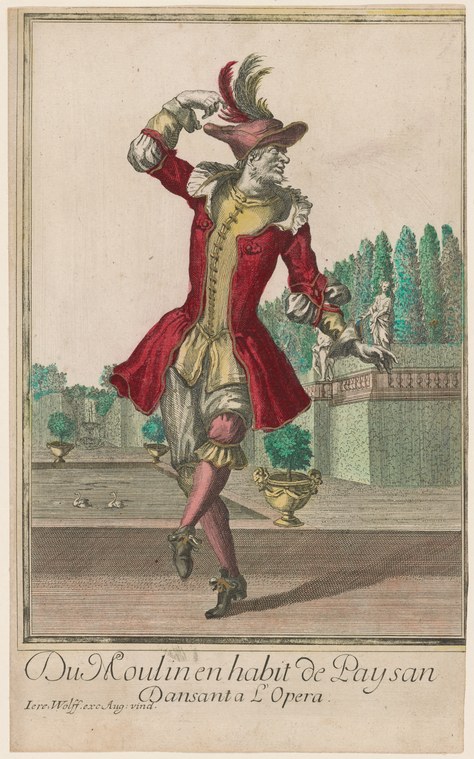
Du Moulin en habit de Paysan Dansant a l'Opera
Unknown artist
- Collection:
- Prints depicting dance
- Source:
- New York Public Library
- Rights:
- Public domain — free to use, share and adapt.
- Recorded as:
- Public Domain
This print is evidence of how male dancers in the early 18th century were celebrated as virtuoso athletes and entertainers, and of how the Paris Opera constructed and marketed the image of the dancing body through print. The specificity—naming Du Moulin and situating him at the Opera—reveals that individual dancers had recognizable personae and fan bases, and that their performances were documented and merchandised. For historians of ballet technique and male dancing, the print captures the balletic line and leap of the era before Noverre's reforms.
What you are looking at
A single male dancer dominates the composition, captured mid-leap in an exuberant pose of barely contained energy. He wears a red coat with gold frogging and a cream waistcoat, his left leg kicked high and his right arm raised to adjust a feathered hat perched at a jaunty angle. His right leg is planted, supporting the jump; his posture conveys playfulness and virtuosity. The ground beneath him is a paved courtyard or terrace; to his right, a formal garden recedes with tall cypress trees and a balustrade, while attendants or onlookers stand at a distance. The print is hand-coloured in subtle greens and flesh tones, with fine line work defining the figure's musculature and the texture of the fabrics.
The dancing
A single dancer, evidently male, executes a high-kicked jump with the supporting leg extended or about to plant. His body is held with balletic uprightness—the torso erect, the neck long, the gesture arm extended with control. The leap itself is vertically emphatic, with both legs and arms articulating the space around him in exaggerated arcs. There is no partner or ensemble; the focus is entirely on displaying the solo dancer's agility and elegance. The footwork and frame suggest trained technique, not folk improvisation.
The dance depicted
The French title—*Du Moulin en habit de Paysan Dansant à l'Opéra* ('Du Moulin in peasant dress dancing at the Opera')—identifies both the dancer and the venue. Du Moulin was a celebrated dancer of the late 17th or early 18th century Opera of Paris. The image represents a stage figure or *entrée* from a court ballet or opera ballet, likely a comical or burlesque character piece in which a fashionable dancer performs in rustic or exaggerated costume. The leap, the carriage, and the setting all point to the *ballet de cour* or early operatic ballet tradition. The "peasant" dress is evidently a theatrical conceit—the quality of the costume and the formality of the leap contradict any genuine rusticity.
How it was made
This is a hand-coloured engraving, identifiable by the fine parallel lines describing form and the precision of the plate work. The artist has employed sophisticated parallel hatching to suggest musculature in the leg and modelling on the face; the colour—applied after printing—is restrained, using soft greens for the garden and warm flesh tones. Engravings of this type were produced in Paris in quantity and circulated as single prints and in bound collections of dance scenes. The technique allowed for fine detail and wide distribution, making such images affordable to wealthy amateurs, dancers, and theatre patrons. The print format suggests this was a commercial image, likely sold separately or as part of a series documenting notable performers and dances of the era.
About this work
This is a print record of a celebrated Paris Opera dancer performing a character role in the early 18th-century operatic ballet tradition. Du Moulin leaps in the foreground, dressed in stage costume and caught in a moment of balletic display. The image is part of a long tradition of dance prints that documented notable performers and dances for circulation among the elite and the theatre-going public. It testifies to the athleticism and technical accomplishment expected of male dancers in the operatic ballet, and to the genre of the character or comic *entrée* in which trained dancers performed in peasant or exotic dress to amuse the court.
How to look at it
Look at the moment the engraver chose: the leap at its height, with both legs and arms articulate and the body fully extended. This is not a naturalistic representation of a jump, but an idealized display of balletic form—the verticality, the turnout, the elegance of the gesture. The setting (the formal garden, the distant onlookers) frames the dancer as a centrepiece of courtly entertainment. The peasant costume is a foil: the finer the dancer, the more absurd and charming the rustic dress becomes. Pay attention to the control of the body even at the moment of maximum extension; this is the signature of trained technique.
The artist
The artist is unknown, which is typical for commercial dance prints of this period. Such prints were often produced by specialist printshops in Paris, sometimes in collaboration with travelling performers or theatre impresarios. The engraver may have worked from a sketch or notation made at a performance, or from a theatrical design. The style and inscription suggest a Parisian production, likely early 18th century, when the documentation of ballet and opera performers through print was becoming a standard commercial practice.
The period
In the early 18th century, ballet was transitioning from court spectacle to public theatrical entertainment, centered increasingly on the Paris Opera and the fair theatres. Male dancers were celebrated virtuosi, expected to display both balletic form and comic or character performance. The costume of the dancer—the fine coat and the feathered hat—reflects the fashion of an aristocratic amateur, not a peasant; the conceit of the print is the contrast between the elegant, trained body and the rustic costume. This was the era before Marie-Anne de Camargo's innovations in costume (lower heels, shorter skirts) and before the rise of the ballerina as the dominant figure in ballet. Du Moulin belonged to the tradition of the male dancing master and professional performer, celebrated for his technique and his presence on stage.
Where it lives
The print is held in the New York Public Library's collection of prints depicting dance. It is a single-sheet hand-coloured engraving, the kind produced commercially in Paris in the early 18th century and sold individually or in sets.
Dance in this work
Questions about this work
Who was Du Moulin?
Du Moulin was a male dancer of some renown at the Paris Opera in the late 17th or early 18th century. Beyond his name and association with the Opera, little is documented. This print is one of the few records of his image and performance that survives. Male dancers of the period were expected to be virtuosi in both balletic and comic performance; the title suggests Du Moulin excelled in character roles.
What is a 'ballet de cour'?
A court ballet was a spectacular theatrical and choreographic performance, typically produced for a royal or aristocratic patron, blending dance, music, poetry, and visual spectacle. In France, court ballets declined after the 1670s, but the tradition influenced the ballet d'action and opera-ballet that emerged in the early 18th century. Du Moulin's performance at the Opera suggests he was part of the public, commercial ballet that succeeded the court tradition.
What technique is he using?
Du Moulin is performing a high-kicked leap, likely an assemblé or jeté. The balletic posture—the upright torso, the turnout, the extended arm—suggests training in the French style of dancing, which dominated European ballet until the Romantic era. The print preserves something of the physicality of early 18th-century dance training, before pointe shoes and Romantic aesthetics transformed ballet.
Why is he wearing peasant dress?
The costume is a theatrical conceit, part of the character or entertainment value of the performance. In the era of Louis XIV and XV, it was fashionable for trained dancers to perform in exotic, rustic, or comical dress; the contrast between the elegant body and the rusticity of the costume was the joke and the appeal. This print advertises Du Moulin's versatility and his ability to entertain in costume.
More dance artwork





