49 works in this view — arrow keys or swipe to move between them.
Dance in Art
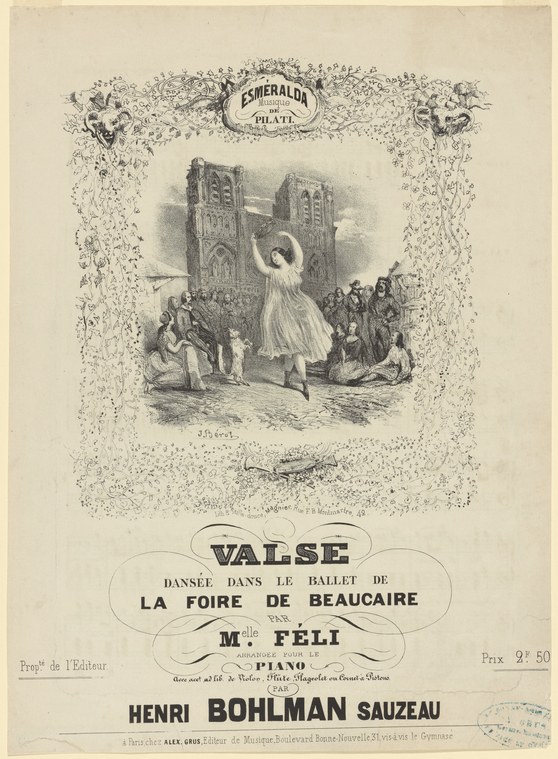
Esméralda, musique de Pilati. Valse dansée dans le ballet de La Foire de Beaucaire par Melle. Féli
Unknown artist
- Collection:
- Prints depicting dance
- Source:
- New York Public Library
- Rights:
- Public domain — free to use, share and adapt.
- Recorded as:
- Public Domain
This image is crucial for understanding the theatrical waltz in the Romantic ballet era: it shows that the waltz—typically a couple's social dance—was performed as a virtuosic solo turn by trained ballet dancers, and that such performances were considered significant enough to be recorded and sold as prints. The work also documents a named female dancer (Mlle. Féli) and preserves evidence of a now-lost ballet, making it valuable for reconstructing 19th-century performance history.
What you are looking at
A young woman in a pale, voluminous skirt dances alone in the center of an ornate architectural setting, her body caught in an expansive turning motion with one arm raised. She is flanked by an audience of formally dressed figures in dark coats and hats—men and women both seated and standing—who watch intently from the sides and background. The setting appears to be inside a grand building with tall decorated doors or panels behind the dancer, suggesting a theater or ballroom. The engraving is surrounded by an elaborate decorative border of scrollwork and flourishes, with the title "ESMÉRALDA" at the top in a ribbon cartouche and credits below. The overall composition emphasizes the dancer's isolation and the formality of her presentation to an assembled crowd.
The dancing
The dancer occupies a solo, vertically centered position with her body in a dynamic spiral—her torso lifted, one arm extended upward and outward, her other arm at her side or slightly forward, and her skirt flaring with the momentum of rotation. Her posture is upright and controlled, conveying trained technique rather than casual motion. The onlookers form a static frame around her: a row of seated spectators in the foreground and standing figures clustered at the sides and rear, all oriented toward the central dancer. The contrast between the dancer's energy and the stillness of the audience is the engraving's central formal strategy.
The dance depicted
This is a waltz or similar turning dance from the mid-19th-century theatrical ballet tradition. The title and inscription indicate this is Mlle. Féli performing a solo waltz from the ballet *La Foire de Beaucaire* (The Fair of Beaucaire), with music by Pilati. The moment captured shows the extended rotational turn that was a signature figure of the waltz, performed here in a formal theatrical context before an assembly of spectators rather than as a social couple dance. The costume, the solitary virtuosity, and the proscenium-like framing all confirm this is a staged performance piece rather than a ballroom scene.
How it was made
This is an engraving, identifiable by the fine line work, tonal variation achieved through parallel hatching and cross-hatching, and the characteristic clarity and precision of the medium. The ornamental border suggests it was intended for publication as a print, likely as a souvenir or advertisement for the ballet performance. The technique allowed wide circulation and would have reached audiences beyond those who attended the actual performance. The formal, detailed rendering and the elaborate decorative surround indicate this was a quality production, probably issued by a commercial print publisher in Paris or another European cultural center.
About this work
This engraving documents a moment from a mid-19th-century theatrical ballet, capturing Mlle. Féli performing a solo waltz turn in *La Foire de Beaucaire*. The print serves as both a record of a specific performance and a work of visual art in its own right, combining the dancer's virtuosity with the formal conventions of both ballet and printmaking. It belongs in a dance gallery as evidence of how waltz was transformed from social dance into theatrical spectacle, and as a artifact of how ballet companies promoted their stars to the public through engravings.
How to look at it
Attend to the moment of the turn: the artist has frozen the dancer at the height of rotation, with her skirt lifted and her frame fully extended, capturing the centrifugal energy of the movement. The surrounding audience creates a formal frame that emphasizes the dancer's isolation and the theatrical nature of the performance—this is not a social dance but a display of trained technique before witnesses. The delicate line work and the careful attention to the folds and volume of her skirt show how the engraver rendered the ephemeral quality of movement in a static medium.
The period
This engraving dates to the mid-19th century, a period when the waltz had recently become central to both ballroom culture and theatrical ballet. Romantic ballet was at its height, with ballets often featuring elaborate narrative scenarios (such as *La Foire de Beaucaire*) and showcasing the technical achievements of celebrated female dancers. The commercial distribution of engravings depicting famous dancers and scenes from successful ballets was a standard industry practice, functioning as advertising, souvenir, and art object simultaneously. The formal presentation of a solo female dancer turning in ethereal costume reflects both the aesthetics of Romantic ballet and the mid-century fascination with recording and celebrating theatrical performance.
Where it lives
This engraving is held in the New York Public Library's prints collection, which specializes in visual documentation of theatrical and social life. It is catalogued as a dance-related print from their broader holdings on performing arts imagery.
Dance in this work
Questions about this work
What is *La Foire de Beaucaire* and when was it performed?
La Foire de Beaucaire was a theatrical ballet featuring music by Pilati and choreography that included this solo waltz. The precise dates and full cast are not recorded in the present catalogue, but the style and printing technique suggest a mid-19th-century production, likely from the 1840s–1860s. The ballet has not survived in the modern repertory, making this engraving one of the few visual documents of its existence.
Why would a waltz be performed as a solo in a ballet?
By the mid-19th century, the waltz had become a virtuosic ballet figure as well as a social dance. Trained dancers performed elaborate solo waltz turns in theatrical ballets to showcase their technique and to appeal to audiences familiar with the dance from ballrooms. The rotational turn seen here—extended and perfected through training—was a spectacular display of balance, control, and grace that could not be achieved by untrained social dancers.
Who was Mlle. Féli?
Mlle. Féli was a theatrical dancer prominent enough to have her performances recorded in engravings, but detailed biographical information about her does not survive in standard dance histories. The inscription confirms she was the featured performer in this ballet, which suggests she was a celebrated dancer of her era. Many such dancers are now known only through prints like this one.
How was this engraving used and distributed?
Engravings of this type were sold as prints to the public, functioning as souvenirs of successful ballet performances and as advertisements for the dancers and companies. They were distributed through print shops and sometimes sold at or near theaters. Collectors and dance enthusiasts would purchase them to document celebrated performances and to display in their homes or studios.
More dance artwork





