49 works in this view — arrow keys or swipe to move between them.
Dance in Art
Dance prints from L'Illustration
Unknown artist
- Collection:
- Prints depicting dance
- Source:
- New York Public Library
- Rights:
- Public domain — free to use, share and adapt.
- Recorded as:
- Public Domain
For dance historians, this print documents how stage dance was perceived and satirized in its own time—what audiences found ridiculous, impressive, or transgressive about theatrical movement. For art historians, it exemplifies the visual strategies of mid-19th-century French satirical print culture and the role of periodical illustration in shaping public opinion about performance. The work reveals the anxieties and pleasures that surrounded professional dance, particularly female performers, during a period of rapid social change.
What you are looking at
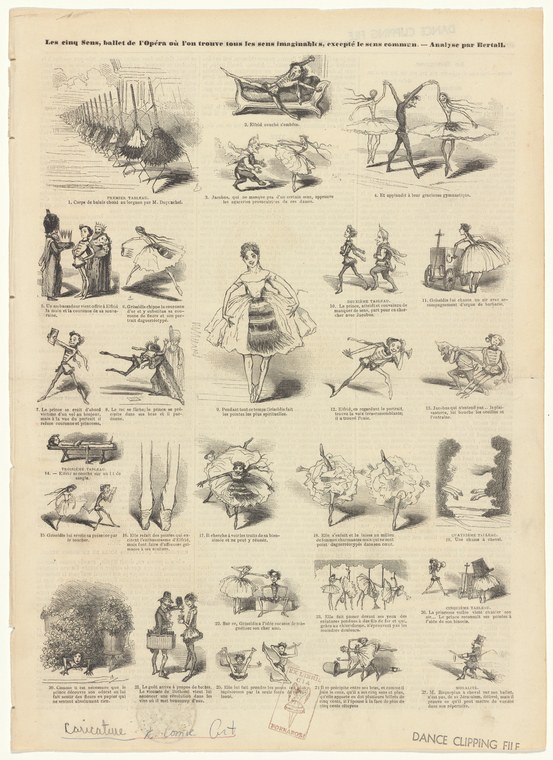
This is a composite satirical print depicting stage dance and theatrical movement of the mid-to-late 19th century, organized as a grid of small vignettes rather than a single scene. The print shows dancers in various poses and interactions: women in short skirts typical of ballet costume, men in formal dress and tights, acrobatic positions, and exaggerated theatrical gestures. The settings are minimal—mostly bare stages suggested by simple lines—allowing focus on the figures themselves. The drawing style is sketch-like and caricatural, with particular emphasis on absurd or ungainly positions: legs at awkward angles, bodies contorted, arms flailing. Several panels show interaction between male and female dancers in close proximity, some appearing to depict courtship or flirtation through dance. The overall tone is humorous and mocking, suggesting this is social commentary on stage dance conventions rather than celebration of them. Inscriptions in French accompany each small scene, indicating the print's origin and its function as illustrated satire or critique.
The dancing
The dancers are rendered with exaggerated proportions and awkward postures designed for comic effect. Many show women in the shallow, high-kicking poses associated with 19th-century stage dance, their skirts catching and flying; men are shown supporting them, often in positions that emphasize strain or instability. Some figures appear mid-leap or mid-contortion, with limbs extended at extreme angles. The relationships between dancers vary: some stand close in partnered positions, others execute solo turns or kicks. The artist demonstrates anatomical knowledge but deliberately distorts it for satirical purposes—joints bend in exaggerated ways, bodies lean at precarious angles, and the weight distribution often appears deliberately unnatural.
The dance depicted
This appears to be 19th-century French theatrical dance, most likely depicting the ballet and music-hall dance of the Second Empire or early Third Republic (1850s–1880s). The costumes—short skirts, tights, heeled slippers—and the predominantly female performers suggest ballet or the lighter theatrical forms that emerged from it. However, the satirical treatment and the inscribed commentary indicate this is not straightforward documentation but rather social critique of stage dance performance and its conventions. The image captures a moment when theatrical dance was becoming increasingly acrobatic and visually spectacular, and when it was also becoming a subject of popular humor and cultural anxiety about propriety and female performers.
How it was made
This is an engraving or etching on paper, produced for mass circulation in a periodical or as a broadside print. The medium allowed for fine linear detail and the layering of multiple small scenes within a single compositional field. The sketch-like quality and the use of hatching for shading are consistent with wood engraving or steel engraving of the 1860s–1880s. The technique permitted both the precision needed for the architectural framing of each vignette and the expressive exaggeration of the figures within them. As a reproductive medium distributed through print culture, this work reached a general public far beyond the theater, making it a form of social commentary accessible to readers of illustrated newspapers and periodicals.
About this work
This is a mid-19th-century French satirical print depicting stage dance in multiple vignettes. Rather than showing a single dance scene, the artist has assembled a grid of small theatrical moments—solos, partnerships, acrobatic feats, and interactions—all rendered in an exaggerated, mocking style. The work belongs to a tradition of social satire about theatrical performance, using visual humor to comment on the conventions, physicality, and perceived absurdity of professional stage dance as it was practiced and consumed in the mid-Victorian period. The print circulated through the illustrated press and would have been recognized by Parisian audiences familiar with both the ballet stage and the burgeoning culture of visual satire in newspapers and periodicals.
As a historical document, the print is valuable not because it faithfully records how dancers actually moved, but because it reveals how stage dance was perceived, mocked, and culturally positioned. It captures a moment when ballet was becoming increasingly technical and acrobatic, when female dancers' bodies were objects of both admiration and suspicion, and when theatrical spectacle was a subject of popular commentary and humor. The work sits at the intersection of dance history, print culture, and 19th-century urban social critique.
How to look at it
Approach this print as you would a modern editorial cartoon—the exaggeration is the point, not a flaw. Notice which poses the artist emphasizes and repeats: high kicks, backward arches, strained partnering. The repetition signals what was perceived as characteristic or ridiculous about stage dance. Observe the relationship between the male and female figures in the paired scenes—the artist is often commenting on the politics of the male gaze and female display. Pay attention to the costume details: the short skirts, the heeled shoes, the tights—these were themselves subjects of social debate and satire. Finally, read the French inscriptions if you can; they provide direct commentary on each scene and reveal what specific behaviors or practices the satirist found worthy of mockery.
The artist
The print is attributed to L'Illustration, a major French weekly magazine founded in 1843 that pioneered the integration of wood-engraved illustrations with text. L'Illustration's visual satirists were among the most influential shapers of public opinion in mid-19th-century France. The magazine employed multiple engravers and illustrators; the specific artist of this dance satire is not recorded in the catalogue. The style and approach are consistent with the house style of L'Illustration's theatrical and social commentary, which frequently used exaggeration and caricature to critique contemporary customs and fashions.
The period
This print dates from the mid-to-late 19th century, a period of profound change in theatrical dance. The Romantic ballet of the early 1800s—emphasizing ethereal, otherworldly movement and female dancers—was giving way to a more acrobatic, spectacular style influenced by music-hall and popular theater. The Second Empire and early Third Republic saw the rise of the Opéra as a site of spectacle and social mixing, where dance was increasingly combined with elaborate scenery, machinery, and a proliferation of female performers. Simultaneously, the growth of illustrated periodicals like L'Illustration meant that theatrical performance became a subject of mass visual commentary. This print reflects a moment of cultural anxiety about the increasingly athletic, exposed, and commercialized nature of stage dance, particularly its appeal to male audiences and its association with female sexuality and labor.
Where it lives
The print is held by the New York Public Library and is part of a collection of dance-related prints. The notation 'L'Illustration' on the print indicates it was published in that periodical, likely as a full-page or double-page spread. The title 'Dance Clipping File' suggests it was clipped from the periodical and organized thematically in an archive or collection.
Dance in this work
Questions about this work
Is this meant to be funny?
Yes. This is satirical commentary on stage dance, designed to amuse readers by exaggerating and mocking the conventions of theatrical performance. The artist is not celebrating these dances but critiquing them—poking fun at the acrobatics, the revealing costumes, the artificial poses, and the whole spectacle of professional stage dance. This kind of visual satire was a major form of social commentary in 19th-century French periodicals.
What kind of dance is shown here?
Primarily ballet and music-hall dance of the Second Empire and early Third Republic (roughly 1850s–1880s). The costumes, the predominance of female dancers, and the acrobatic style are all consistent with 19th-century theatrical dance. However, the satirical framing means this is not a straightforward record of how dancers actually moved, but rather a commentary on how theatrical dance was perceived—as spectacular, athletic, slightly ridiculous, and fascinating to audiences.
Why are the women shown with such short skirts?
Because 19th-century theatrical costume, particularly in ballet, featured short tutus and tights that were themselves controversial and scandalous. The exposure of the female leg was a subject of moral anxiety and public debate. By emphasizing and exaggerating the costume, the satirist is commenting on the visual spectacle of female performers and the social anxieties it provoked. The short skirt was both an essential element of the theatrical illusion and a marker of the performer's status as a woman on public display.
How was this print made and distributed?
This is a wood engraving or steel engraving, produced for mass reproduction and distribution through L'Illustration, a major weekly periodical with a circulation of hundreds of thousands. The print would have been created by a professional engraver working from a drawing or design, then printed along with text and other illustrations in the magazine. Readers encountered it as part of the weekly issue, alongside news, advertisements, and other visual commentary on contemporary life.
More dance artwork





