49 works in this view — arrow keys or swipe to move between them.
Dance in Art
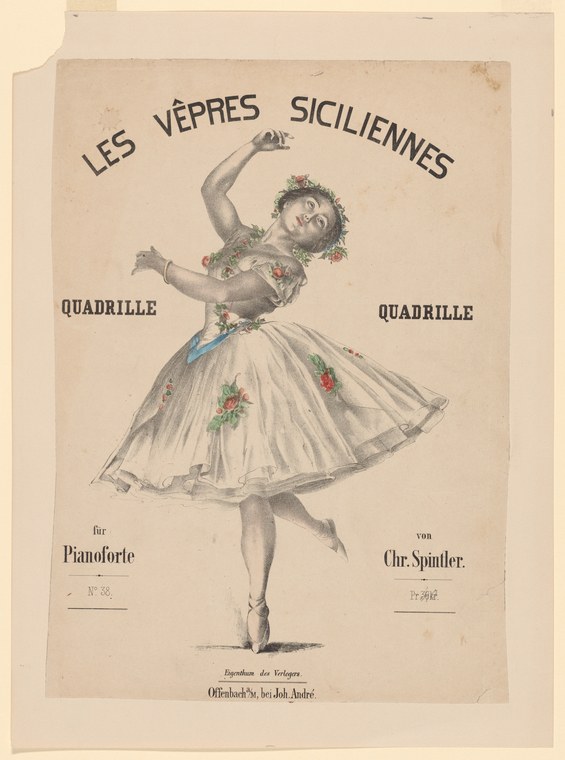
Les vêpres siciliennes: quadrille für pianoforte
Unknown artist
- Collection:
- Prints depicting dance
- Source:
- New York Public Library
- Rights:
- Public domain — free to use, share and adapt.
- Recorded as:
- Public Domain
This object shows how ballet aesthetics came to dominate the visual representation of dance in the 19th century, even on covers of music written for social dancing. It also documents the quadrille's persistence as a popular form and the way composers and publishers capitalized on operatic celebrity—Verdi's work was still fresh cultural currency when this was produced. For historians of dance and print culture, it reveals the gap between what a dance form actually was (a structured group dance) and how it was marketed to buyers (as elite, individual, theatrical spectacle).
What you are looking at
A young ballerina in mid-pirouette dominates the composition, her body captured in a moment of exuberant rotation. She wears a full white tulle skirt with a fitted bodice and short sleeves, her hair adorned with flowers or ornaments. Her left arm is raised expressively while the right extends outward; she stands en pointe on her right leg, the left lifted and bent. The skirt billows outward from the spin, creating a dramatic silhouette. The figure is isolated against a plain background, rendered in black ink with selective hand-coloring—the flesh tones are naturalistic, and the skirt is delicately shaded in gray and blue, with red flowers scattered across it. The image is a printed sheet music cover, with the title in large letters at the top and publication details at the bottom.
The dancing
A single dancer, captured mid-rotation. She stands on one pointe shoe with controlled alignment; her supporting leg appears straight and engaged. The raised arm position suggests the épaulement and port de bras typical of academic ballet, with the gesture opening toward the audience rather than closing inward. Her free leg bends in what could be retiré (retired) position, though the angle is difficult to determine precisely. The overall carriage is upright and noble, with the head tilted expressively upward, meeting the conventions of Romantic-era ballet portraiture.
The dance depicted
This is sheet music for a quadrille—a structured ballroom dance in four sections—based on themes from Verdi's opera *Les Vêpres Siciliennes* (The Sicilian Vespers), composed for piano by Chr. Spindler. The quadrille was the dominant social dance form in European ballrooms from the 1830s through the 1880s, performed by sets of couples in squares or longways formations. Yet this cover image depicts a solitary ballet dancer rather than a quadrille ensemble, suggesting the music may have been arranged for theatrical performance or that the publisher chose a ballet figure to represent fashionable entertainment and elegance to potential buyers. The ballet vocabulary visible here—the pointe work, the tutus, the theatrical presentation—was the visual language of 1860s–1880s dance spectacle.
How it was made
This is a lithographic print, identifiable by the crisp black outlines and the specific texture of the halftone shading, particularly in the skirt. The composition combines printed text and imagery with hand-applied watercolor or gouache tinting—note the carefully graded blue and gray wash on the tulle and the individually painted red flowers. This mixed-media approach was standard for sheet music covers of the period, allowing for efficient mass production of the text and musical notation while permitting individualized artistic finishing. The technique implies a mid-to-upper-middle-class audience: people who could afford illustrated sheet music and a piano to play it on.
About this work
This is a lithographed sheet music cover for a quadrille based on Verdi's opera, published in the 1870s–1880s (the exact date is unknown). Rather than depicting the social dance form its title describes, the cover features a Romantic ballet figure—a technique common in popular sheet music to associate music with theatrical glamour and contemporary taste. The work sits at an intersection of ballroom and theatrical dance culture, a moment when the two were mutually influential and when a single image could invoke both. It belongs in a dance gallery as evidence of how dance imagery was used in commercial design and how the vocabulary of ballet had become the primary visual shorthand for dance itself in this period.
How to look at it
Observe the moment the artist chose to freeze: not a formal beginning position, but the dynamic middle of a pirouette, with the skirt fanned outward and the dancer's gaze lifted. This is theatrical painting convention, showing maximum movement and grace in a single frame. Notice also the deliberate contrast between the precision of ballet (en pointe, upright carriage, controlled arm) and the soft, romantic femininity of the costume (flowers, billowing tulle, delicate features). The composition isolates the dancer completely, elevating her as an aesthetic object rather than as a participant in a social dance. This was how 19th-century ballroom music wanted to imagine itself: not as a fun group activity, but as a window into theatrical elegance and individual artistry.
The artist
Chr. Spindler (full name and dates not confirmed in the record) was a composer and arranger of popular salon and dance music in the mid-19th century. Little is documented about his life, but his output suggests he worked in the commercial music publishing trade, arranging well-known operatic and symphonic themes into forms suitable for amateur pianists and ballroom musicians. The quadrille arrangements were a staple product of this trade: composers could multiply revenue from a single successful opera by packaging its melodies in different dance and musical forms. Spindler's name appears on numerous quadrille covers of the 1860s–1880s.
The period
The quadrille was at the height of its dominance in European ballroom life from the 1850s through the 1880s, though it was beginning to decline relative to the waltz and new forms like the polka. Operatic quadrilles were a fashionable sub-genre: publishers capitalized on recent opera premieres by issuing dance arrangements within months of a work's debut. Simultaneously, ballet was entering its Romantic phase (or, by the 1870s–80s, its late Romantic and early classical codification phase), characterized by ethereal, ethereal white-clad ballerinas, pointe work, and storytelling. The visual language of ballet—the tutu, the pointe shoe, the lifted leg, the expressive arm—had become so dominant in entertainment culture that it appeared naturally on covers of music that had nothing to do with ballet. This print is evidence of that cultural hegemony.
Where it lives
Held by the New York Public Library in its Prints collection, catalogued as dance-related material. The object is a commercial sheet music cover from the mid-to-late 19th century, a mass-produced item designed to attract buyers to a piano score. The catalogue record contains minimal metadata, typical of cover art of this era, which were often uncredited and undated at the time of publication.
Dance in this work
Questions about this work
Why does the cover show a ballet dancer if the music is for a quadrille?
This was deliberate marketing. Ballet imagery had become synonymous with elegance, femininity, and theatrical sophistication in the popular imagination. Publishers used ballet figures to make sheet music visually appealing and to associate the product with fashionable entertainment, regardless of whether the music was actually for ballroom or theatrical use. A piano buyer in the 1870s would recognize the ballet aesthetic as a sign of cultural status.
What is a quadrille?
A quadrille is a ballroom dance performed by four couples arranged in a square, with five distinct sections or 'figures.' Each section has its own musical and choreographic phrase. It was the most popular formal dance in European and American ballrooms from roughly 1820 to 1880, though it began to decline in favor of the waltz in the later decades.
Why would an opera by Verdi be arranged as a quadrille?
Operatic quadrilles were a major commercial product for music publishers. A successful opera premiere meant that people wanted to hear, play, and dance to its themes. Publishers could produce multiple arrangements—quadrilles, waltzes, piano reductions, variations—from a single opera's score, each format reaching a different market. This was efficient commercial strategy and a form of cultural metabolism.
Is there any signature or credit on the cover?
The cover credits Chr. Spindler as the arranger and lists a publisher (Ofilsbach'sche Buchh. in Bad Andorf, based on the visible text), but there is no visible signature or credit for the artist who created the image. This was common for commercial sheet music covers of the period, which were often unsigned and treated as functional rather than fine art.
More dance artwork





