49 works in this view — arrow keys or swipe to move between them.
Dance in Art
Le diable a quatre.: Ballet d'Ad. Adam. Mazurka
Unknown artist
- Collection:
- Prints depicting dance
- Source:
- New York Public Library
- Rights:
- Public domain — free to use, share and adapt.
- Recorded as:
- Public Domain
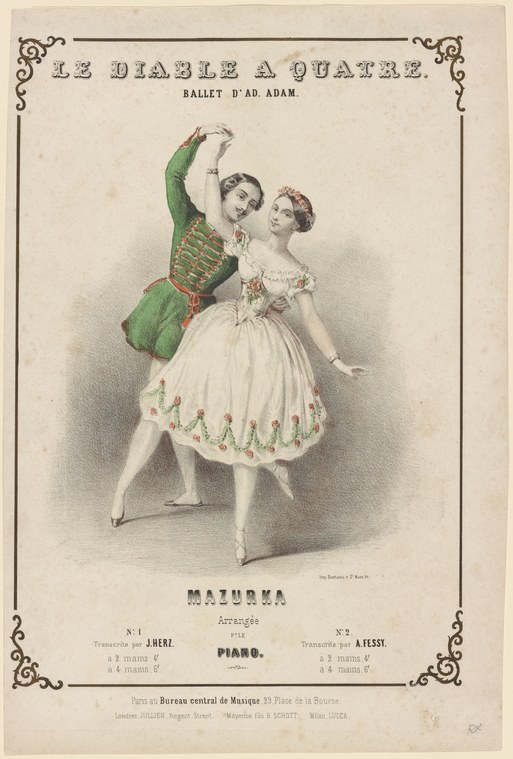
This image is a primary source for how Romantic-era ballet partnerships actually looked and how they were sold to the public. It documents the specific lift and frame vocabulary that made Romantic ballet distinctive, and it shows how that movement was considered beautiful and worthy of preservation through expensive hand-colored printing. For anyone studying the history of partnering in ballet, or the role of theatrical prints in shaping public taste, this is essential evidence.
What you are looking at
A male dancer in emerald-green costume with gold trim lifts and supports a female dancer in a white tulle skirt with floral decoration at the hem. The woman is captured mid-movement, her body arched backward in an elegant line, her right arm raised gracefully while her left steadies against her partner's shoulder. The man wears fitted breeches and a decorated jacket; the woman's dress is the standard Romantic-era ballet costume with a fitted bodice and full skirt that falls to mid-calf. The composition is set against a plain background, the figures rendered in soft modeling that emphasizes the theatrical lighting of the stage. The engraving captures a moment of intimate partnered support, the kind of lift and carry that became central to Romantic ballet vocabulary.
The dancing
The male dancer supports the female entirely; she is lifted and held in a supported arabesque or similar back-arching position, her weight transferred to him. His posture is upright and controlled, his legs appear straight beneath him to support the lift. Her body curves backward in an extended line from the hip, her free arm raised in the ethereal port de bras characteristic of the period. The hold is intimate and requires considerable strength and trust—the woman's torso is fully dependent on the man's arm and frame. This is the vocabulary of the adagio, the supported movement that defined male-female partnership in Romantic ballet.
The dance depicted
This is a moment from *Le Diable à quatre* (*The Devil to Pay*), a ballet choreographed by Adolphe Adam with music by the composer of the same name. The mazurka inscription at the foot suggests this may be a specific mazurka-time movement from the ballet, though the lift shown could equally belong to an adagio section. The work was part of the Romantic ballet repertory of the mid-19th century, and this print preserves a record of how that partnership looked in practice: the male dancer as support and frame, the female as the ethereal, weightless center of attention. The mazurka rhythm would have given this moment a characteristic bouncing quality even while suspended.
How it was made
This is a hand-colored engraving or lithograph, created from a musical score cover or theatrical program illustration. The soft tonal modeling, the careful attention to fabric texture (the tulle of the skirt, the silk of the jacket), and the delicate line work suggest a lithographic process, which allowed the artist to render subtle gradations of shade. The hand coloring—applied after printing—adds the jewel tones of stage costume: the emerald and gold of his coat, the pale pink and white of her dress. This was a standard format for circulating knowledge of celebrated dances and dancers to audiences who could not see performances in person, and the quality of the work suggests a well-known production intended for a literate, cultured audience.
About this work
This is a record of a moment from *Le Diable à quatre*, a mid-19th-century ballet that was part of the international Romantic ballet repertory. The image shows the characteristic vocabulary of Romantic-era partnered dancing: the lift, the curve, the male support, the female suspension. It is both a document of choreographic practice and a work of theatrical marketing—a beautiful object made to be owned and displayed, allowing those who could not attend the theatre to imagine what they had heard about. The print captures the very grammar of Romantic ballet partnership that persists, though evolved, in classical ballet today.
How to look at it
Notice the exact moment the artist chose: the woman at the peak of the lift, her back fully arched, suspended, weightless. The artist has frozen the moment of maximum extension and vulnerability—not the beginning or end of the lift, but its heart. Observe the frame: the man's body is nearly vertical, his strength invisible, which was exactly the Romantic ideal. The woman's arm positions and head tilt convey not effort but ease and grace. The costume itself carries meaning—the male dancer in the ornate, jeweled coat was often a supernatural being or a rival suitor, while the female's simple white tulle marked her as the virtuous heroine. The composition and the moment together tell a story about power, support, and theatrical beauty.
The artist
Not recorded. The print is credited to the ballet (credited to Adam, the composer) and to the arrangers of the piano reduction for the arrangement listed at the bottom, but the engraver or lithographer is not named. This was common practice in theatrical prints of the period, where the choreographer and composer took credit while the visual artist often remained anonymous or worked as part of an atelier.
The period
This dates to the high Romantic ballet period (circa 1840s–1850s), when the Romantic aesthetic—weightlessness, ethereality, the supernatural, the triumph of the female dancer—dominated European ballet. Adolphe Adam was one of the leading composers for ballet of the era, and *Le Diable à quatre* was among his successful works. The mazurka, a Polish folk dance in triple time with a characteristic accent pattern, was absorbed into the classical ballet vocabulary during this period and became a standard variation and ensemble dance form. This print would have been part of the merchandising apparatus that made ballet stars famous and kept recent Paris productions in the minds of audiences across Europe.
Where it lives
This is a hand-colored theatrical print held in the New York Public Library's collection of prints depicting dance. The source is a well-known collection of dance iconography, suggesting this work was significant enough to be preserved by a major cultural institution. Such prints were mass-produced for sale to theater-goers and dance enthusiasts as souvenirs and documents of celebrated performances.
Dance in this work
Questions about this work
What is *Le Diable à quatre*?
*Le Diable à quatre* (*The Devil to Pay*) was a mid-19th-century ballet with music by Adolphe Adam and choreography by the same artist. It was part of the international Romantic ballet repertory and was performed across Europe. The plot involved supernatural elements and featured both comic and romantic scenes, offering opportunities for the spectacular effects and the tender partnerships that Romantic ballet audiences loved.
What does the mazurka label mean?
The mazurka is a Polish folk dance in triple meter with a characteristic rhythmic accent. During the Romantic ballet era, the mazurka became a standard form for variations and ensemble scenes. The label on this print indicates that this specific lift and movement phrase occurs over mazurka rhythm, which would give it a bouncing, energetic quality even in a moment of apparent suspension.
Why was this printed and sold?
Theatrical prints like this were the primary way that celebrated dances and dancers became known to a wider public. Not everyone could attend the Paris Opera or other major venues, but literate, cultured audiences could own and study beautiful prints showing celebrated moments. They functioned as both souvenirs and as a form of cultural currency—a way of claiming taste and knowledge.
How does this compare to modern ballet?
The lift shown here is the ancestor of modern classical ballet partnering, though technique and strength have evolved significantly. The vocabulary—the supported arabesque, the male frame, the ethereal extension—persists, but modern dancers lift higher, move faster, and execute more complex transitions. This print shows the Romantic ideal; modern ballet has transformed it into something more demanding and athletic.
More dance artwork





