49 works in this view — arrow keys or swipe to move between them.
Dance in Art
Les étoiles: polka-mazurka, sur l'opéra-ballet de A. Pilati
Unknown artist
- Collection:
- Prints depicting dance
- Source:
- New York Public Library
- Rights:
- Public domain — free to use, share and adapt.
- Recorded as:
- Public Domain
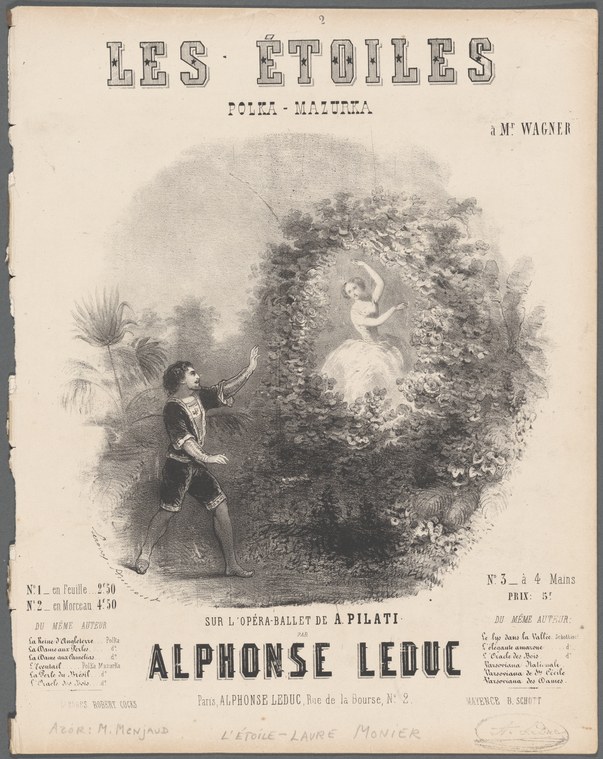
This work captures the theatrical framing of a popular social dance: the polka-mazurka was not only a ballroom form but a subject for opera-ballet and musical composition, connecting everyday dance practice to high theatrical spectacle. The image also reveals the role of visual marketing in circulating dance forms—the engraving made the music, the dance, and the fantasy scenario available to a mass audience at modest cost. It demonstrates how dance imagery was used to sell both music and dreams of romantic transcendence.
What you are looking at
A man in dark formal dress gestures toward a female figure who appears within or emerging from an elaborate architectural niche overgrown with climbing vines and flowers. The woman is rendered in pale, ethereal tones and wears a flowing white gown; her pose suggests graceful, upward-reaching movement. The setting is romantic and theatrical, with lush vegetation framing the encounter. The composition is vertically oriented, with the man positioned in the lower left, reaching or beckoning upward toward the woman in the shadowed alcove. The engraving employs soft stippled tones and atmospheric effects to create depth and a dreamlike quality. The overall mood is one of romantic yearning or supernatural encounter, enhanced by the contrast between the man's solid, earthbound presence and the woman's ethereal, floating quality.
The dancing
The man stands in a classical contrapposto stance, one arm raised in a gesture of supplication or invitation, his body angled to face the architectural recess. The woman's figure is rendered in a lighter, more delicate line, her pose suggesting an arabesque or similar extended, floating attitude—one arm curved overhead, the body elongated and ethereal. The vertical distance between them emphasizes emotional rather than physical proximity. Neither figure displays the closed or partnered hold typical of ballroom dance; instead, the gesture is one of solo performance or vision.
The dance depicted
The title identifies this as a polka-mazurka, a hybrid form combining the rhythmic energy of the Polish mazurka with the lighter, faster tempo of the polka. Both were fashionable in mid-nineteenth-century ballrooms. However, the image itself depicts not a social dance but a theatrical or fantastical moment—possibly a scene from the opera-ballet *A Pilati* mentioned in the title. The woman's floating, elongated pose and the supernatural aura suggested by her pale rendering and the overgrown setting suggest this is a moment of theatrical spectacle rather than social dancing. The polka-mazurka was danced by couples in closed or semi-closed holds; this image shows neither, implying it illustrates a moment of dramatic pause or transition within a larger theatrical work.
How it was made
This is an engraving—likely a wood or steel engraving given the fine parallel lines and stippled toning—made for mass circulation, probably as sheet music cover art or a theatre program illustration. The technique allowed soft atmospheric effects through careful tonal gradation and the layering of fine marks. The medium's circulation as a cheap print suggests this was promotional material for a popular opera-ballet, reaching a broad middle-class audience of music-lovers and theatre-goers. The delicate rendering of the woman's figure in light tones against darker background is characteristic of high-quality music-cover engraving of the 1860s–1880s.
About this work
This engraving advertises a polka-mazurka based on the opera-ballet *A Pilati*, composed or arranged by Alphonse Leduc, a major Paris music publisher. The image departs from what a polka-mazurka social dance would look like, instead depicting a theatrical or romantic fantasy—a man below gazing up at an ethereal female figure who seems to float or dance within an overgrown architectural niche. The work belongs to the mid-nineteenth-century tradition of linking popular dance forms to theatrical narrative and mass-market entertainment. As a music-cover engraving, it represents the visual culture surrounding ballroom and theatrical dance in the era when the polka and mazurka dominated European social and concert life.
How to look at it
Notice the deliberate distance between the two figures and the upward direction of the man's gaze and gesture—this is not a dance between partners but a moment of longing or vision. The woman's pose, with its extended arm and floating quality, suggests the aesthetic ideals of Romantic ballet (Taglioni's famous arabesque) rather than the quick, earthy footwork of a polka-mazurka. The overgrown setting and pale rendering of the woman suggest she may be a ghost, sprite, or theatrical vision rather than a real ballroom partner. The engraver has chosen to illustrate not the dance itself but the romantic narrative surrounding it—the fantasy that justified the dance's popularity.
The artist
The engraving is attributed to M. Wagner (signature visible in lower right). Wagner was likely a commercial engraver employed by Alphonse Leduc's music publishing house in Paris, one of the major European music publishers of the nineteenth century. The work shows professional skill in tonal modulation and atmospheric effect, typical of music-cover art at the time. Leduc's firm published both popular salon music and works by major composers, and their covers were often produced by accomplished engravers working in a consistent house style.
The period
The polka emerged in Bohemia in the 1830s and became a craze across Europe by the 1840s, spreading rapidly through both ballrooms and concert halls. The mazurka, a Polish form, had aristocratic associations and was favored by Romantic composers (Chopin notably). The hybrid polka-mazurka was a popular commercial form that capitalized on both crazes. By mid-century, many polka-mazurkas were composed as instrumental pieces for piano or small ensemble, and some were incorporated into theatrical works—opera-ballets, vaudevilles, and pantomimes—to bring contemporary dance enthusiasm onto the stage. Leduc, founded in 1841, was ideally positioned to publish such hybrid, commercially driven works. The engraving technique allowed composers and publishers to market sheet music with eye-catching, theatrical imagery that appealed to amateur musicians and dancers.
Where it lives
This is a music cover engraving from the New York Public Library's collection of prints depicting dance. It was produced by the Paris music publisher Alphonse Leduc (Rue de la Bourse, No. 2, as printed) and advertises a polka-mazurka arrangement or composition for piano. The print indicates it was available in two versions (à 1 Main and à 4 Mains—for one hand and four hands, or one and two players) at 5 francs each.
Dance in this work
Questions about this work
What is a polka-mazurka?
A hybrid dance form blending the rapid, energetic polka (from Bohemia) with rhythmic and accentual features of the Polish mazurka. Both were fashionable in mid-nineteenth-century ballrooms. Composers often published polka-mazurkas as piano pieces for amateurs, and they also appeared in theatrical works. The form was particularly popular from the 1840s through 1880s as a salon and concert piece.
Is this image accurate to how the polka-mazurka was actually danced?
Not literally. The polka-mazurka was a couples' dance performed in closed or semi-closed hold with quick footwork and turning patterns. This image instead depicts a theatrical fantasy or romantic scene, possibly from the opera-ballet *A Pilati*. The woman's extended, floating pose echoes Romantic ballet aesthetics rather than the brisk, earthy stepping of the actual dance.
What was Alphonse Leduc?
A major Parisian music publisher founded in 1841, known for issuing a vast catalog of popular piano music, salon pieces, operas, and operettas. Leduc was instrumental in circulating both classical and commercial music across Europe and to the Americas. Sheet music covers produced by Leduc often featured high-quality engravings and lithographs that promoted both the music and its associated dances or narratives.
What technique was used to make this print?
This is an engraving, most likely a wood or steel engraving, identified by the fine parallel hatching lines and stippled tones used to create shading and atmospheric effect. The technique was labor-intensive but allowed for sharp detail and fine tonal gradation, making it ideal for music-cover art that needed to be both visually appealing and reproducible in large numbers.
More dance artwork





