49 works in this view — arrow keys or swipe to move between them.
Dance in Art
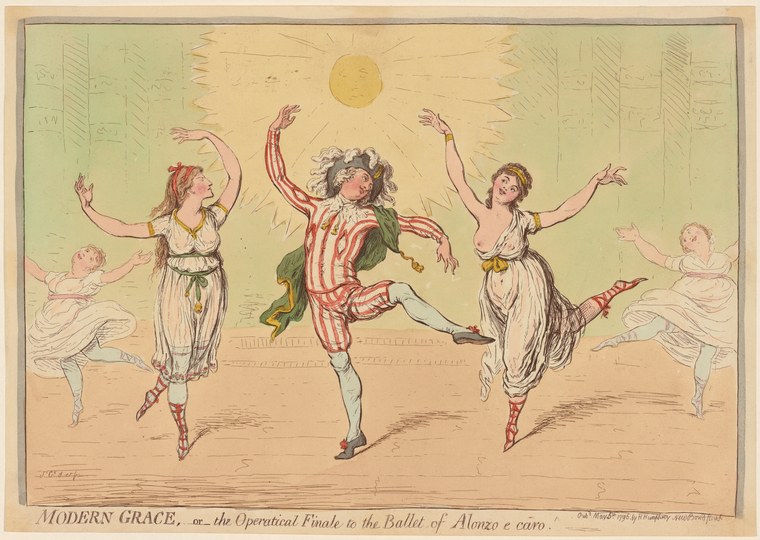
Modern grace, or The operatical finale to the ballet of Alonzo e Cora
Unknown artist
- Collection:
- Prints depicting dance
- Source:
- New York Public Library
- Rights:
- Public domain — free to use, share and adapt.
- Recorded as:
- Public Domain
This print documents both a specific work and a general shift in dance aesthetics—from courtly social dance toward theatrical ballet as a virtuosic and spectacular art form. For historians, it is evidence of what was deemed worthy of commercial reproduction and circulation; for dancers, it is a rare visual record of how bodies were trained and displayed in this era, before photography made such documentation routine.
What you are looking at
A theatrical scene of five figures dancing in a sunlit clearing or stage space. Three principal dancers occupy the center and foreground: a woman in classical drapery at left with arms raised in a graceful arc, a male dancer in a striped tunic and hose at center in a springing leap, and a woman in white drapery at right with arms extended. Two smaller figures—putti or child dancers—appear at the edges, one at far left and one at far right, both in similar poses of raised arms and lightness. The background is treated as an open sky with radiant lines around a pale sun, suggesting an idealized or pastoral setting rather than a specific locale. The entire composition is rendered in soft watercolor with fine pen detail, in the style of late 18th-century theatrical illustration. The dance vocabulary is all elevation, extension, and open poses; the bodies move outward and upward rather than in closed or grounded formation.
The dancing
All five figures are captured in the air or at the apex of a bound movement—no dancer has weight planted on the ground. The three adult principals display turned-out legs, extended arms, and the lifted carriage of trained courtly or theatrical dancers. The male figure at center springs upward with one leg extended behind and arms raised, echoing the Romantic ideal of buoyancy and weightlessness. The women flank him with mirror-image arm gestures: both have limbs lifted high and drawn back, suggesting a moment of suspension or flight. The smaller figures repeat this vocabulary at reduced scale, implying either children trained in the same method or allegorical attendants. No dancer makes contact with another; the group is organized by visual symmetry around the central male figure rather than by partnership or spatial proximity.
The dance depicted
The title and composition suggest this depicts the finale of a theatrical ballet, specifically identifying it as the operatic finale to *Alonzo e Cora*, a work now obscure but apparently recognizable to the original audience. The dance style—elevated, turned-out, with open arm positions and a emphasis on weightlessness—aligns with late 18th-century theatrical dance, which evolved from the aristocratic courtly tradition toward a more virtuosic stage idiom. The inclusion of multiple dancers and the celebratory, symmetrical composition indicate this is a corps finale rather than a duet or solo. The vocabulary suggests either a Romantic-era ballet or a balletic interlude within an operatic work, a common theatrical form in the period. Without access to the original production record, the specific choreography cannot be recovered, but the artist has clearly understood the aesthetic values of the moment: elevation over weight, openness over closure, and the illusion of flight.
How it was made
This is a colored engraving or etching, likely hand-colored, executed with fine pen line and watercolor wash. The technique allowed precise delineation of the dancers' bodies and costumes while the soft coloring created atmosphere and depth. The delicate handling suggests this was a high-end theatrical print, circulated among theatergoers, critics, or collectors of dance imagery. Such prints were commercial products—reproducible, affordable, and portable—and their wide distribution meant they shaped how a broad audience understood and remembered theatrical spectacle. The condition and style indicate this was a significant work in the print market of the period.
About this work
This is a colored engraving illustrating the finale of an 18th-century theatrical ballet titled *Alonzo e Cora*. The print captures five dancers suspended in air, arms lifted and bodies weightless, arranged in a symmetrical composition centered on a male dancer in a striped tunic. The work exemplifies the aesthetic values of late 18th-century theatrical dance: elevation, turn-out, open spatial design, and the illusion of effortless flight. As a print, it is both a record of choreographic practice and a work of artistic propaganda—it shapes memory of the performance by freezing a single moment and encoding it in a widely circulated visual form.
The print belongs in a dance history because it shows us not just that people danced this ballet, but how they wanted it to be remembered: graceful, buoyant, formally composed, and visually harmonious. The artist has chosen a moment of maximum suspension and extension, eliminating any sign of effort or grounding. This is the aesthetic ideology of the period made visible.
How to look at it
Attend to the moment: every body is in the air, suspended at the peak of a jump or lift, with no foot on the ground. This is not accidental; the artist has chosen to freeze the maximum moment of elevation and extension. Notice the symmetry—the two women mirror each other's arm positions across the central male figure, while the smaller attendant figures repeat the same vocabulary. This formal balance is part of the work's rhetoric: it says that this dance is ordered, harmonious, and designed for the eye. The treatment of the background—the open sky and radiating sun—removes any sense of a specific place and emphasizes the theatrical or allegorical nature of the scene.
The artist
The artist is not recorded in the catalogue, but the style and technique identify this as the work of a professional theatrical printmaker, likely working in London or another major theatrical center in the late 18th or very early 19th century. Such prints were often unsigned or signed only with an engraver's mark; authorship was secondary to the commercial value of the subject. The print's quality and finish suggest the maker was skilled and the work was a significant commission, likely issued by a theater or a print publisher who specialized in theatrical imagery.
The period
This print dates to an era when theatrical dance was rapidly professionalizing and becoming a vehicle for artistic prestige rather than merely court entertainment. The late 18th century saw the rise of the ballerina as a celebrity, the codification of turnout and elevation as technical ideals, and the development of narrative ballet as a serious art form. In the visual arts, this same period saw an appetite for theatrical prints—images that brought the ephemeral spectacle of performance into the home or onto the collector's wall. The idealized, buoyant bodies in this print reflect Romantic aesthetics: the valorization of grace, weightlessness, and the transcendence of bodily limitation.
Where it lives
The work is held in the New York Public Library's collection of prints depicting dance. It is catalogued by title and medium but has not been assigned a date or artist attribution in the record.
Dance in this work
Questions about this work
What is *Alonzo e Cora*?
It appears to have been a theatrical work—opera, ballet, or musical drama—of the late 18th century. The title is not widely documented in surviving records, which suggests it may have been a minor production or one whose popularity did not endure. The print's survival indicates it had enough cultural currency to warrant commercial reproduction, but further research would be needed to establish dates, creators, or performance history.
Why are all the dancers in the air?
Elevation was a core value of theatrical dance training by this period. By capturing the dancers at the apex of their jumps, the artist emphasizes both the technical skill of the performers and the aesthetic ideal of the moment: weightlessness, grace, and transcendence. This is a rhetorical choice; the artist could have shown the dancers on the ground, but chose not to.
Are those children dancing with the adults?
The smaller figures at the sides could be child dancers, which was common in theatrical productions of the period, or they could be putti—allegorical cherubs or cupids added for mythological resonance. The style of representation—a lighter pen line and smaller scale—leaves this ambiguous, but either interpretation was normal in theatrical ballet of the era.
What technique are they using?
The turned-out legs, lifted arms, and buoyant carriage indicate training in the courtly dance tradition, likely refined through the emerging methods of theatrical ballet. The vocabulary is recognizably ancestral to modern ballet, though the specific system or school cannot be determined from the image alone.
More dance artwork





