49 works in this view — arrow keys or swipe to move between them.
Dance in Art
Marie Salle
Unknown artist
- Collection:
- Prints depicting dance
- Source:
- New York Public Library
- Rights:
- Public domain — free to use, share and adapt.
- Recorded as:
- Public Domain
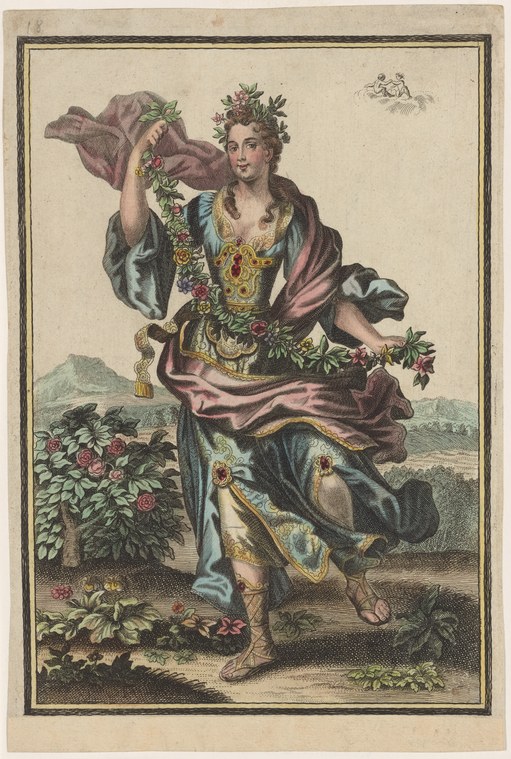
Marie Sallé was one of the most celebrated and innovative dancers of the 18th century, known for reforming ballet costume and bringing expressive, naturalistic movement to the stage. This engraving is one of the few surviving images that allows viewers to see how she was costumed, posed, and celebrated during her lifetime—a precious window into the visual culture of early theatrical ballet.
What you are looking at
A single female figure dominates the composition, posed in a graceful contrapposto stance against a landscape background with mountains and flowering plants. She wears an elaborate costume of the 18th century: a low-cut bodice in gold-embroidered white or pale silk, a voluminous skirt in soft pink with blue-grey underskirts, and a flowing pink drapery across one shoulder. Her dark hair is crowned with flowers and small ornaments. She holds aloft a billowing length of rose-colored fabric in one raised arm while her other arm gestures expressively. Flowering plants—roses and other blooms—appear both at her feet in the foreground and in a garden bed to the left. The figure's posture suggests movement: her weight appears shifted, one foot slightly advanced, as if she has paused mid-motion. The engraving is hand-colored with delicate washes of pink, green, blue, and flesh tones over the printed line. A double-lined rectangular border frames the entire composition.
The dancing
The single dancer stands in an open, presentational frame with her body angled three-quarters to the viewer. Her raised arm stretches upward and back, carrying the loose fabric in a sweeping arc; her lower arm extends forward with a gentle curve suggestive of balletic port de bras. Her stance is upright and elongated, with weight forward and legs extended in a posture that suggests the turned-out positions of formal dance training. The fabric she manipulates appears to be a prop or accessory integral to the choreography—held and moved as an extension of her body rather than incidental to the pose.
The dance depicted
This is a theatrical solo of the 18th-century stage, almost certainly a character or specialty dance rather than strict ballet. The inclusion of the floral crown and the garden setting suggest a pastoral or allegorical theme—possibly a dance representing Flora or another classical figure. The fabric manipulation is a key element: this could indicate a choreographed use of scarves, ribbons, or drapery as part of the vocabulary. The pose and costuming are consistent with the French theatrical dance of the 1730s–1760s, when such roles were performed by celebrated soloists in opera-ballets and court entertainments. The figure's name in the title likely identifies the dancer rather than the character.
How it was made
This is a hand-colored engraving, identified from the fine parallel lines (hatching and cross-hatching) that model form and shadow, and the sharp, controlled line work characteristic of the burin. The printing technique allowed multiple impressions to be hand-finished individually with watercolor, which explains the delicate tonal variations and the slight variations between surviving copies. Engravings of this type circulated widely as prints—souvenirs of celebrated dancers and roles, collected by theater-goers and sold at considerable prices. The technique's precision and the print's refined execution suggest a significant production intended for an educated audience.
About this work
This hand-colored engraving documents a celebrated 18th-century theatrical dancer in a character or specialty role, likely from a French court ballet or opera-ballet. The dancer—identified in the title as Marie Sallé—is shown in the moment of performance, posed with an elaborate prop of fabric against an allegorical garden setting. The image belongs to a genre of theatrical portraiture that recorded the spectacular costumes, poses, and movement vocabulary of famous soloists, serving as both a record of their art and a form of celebrity merchandise. The work demonstrates the conventions of depicting theatrical dance in the ancien régime: the formal, turned-out positions; the narrative costume; the integration of props into the choreographic frame. For the historian of dance, it provides rare visual evidence of how 18th-century theatrical virtuosity was presented to the public—a document both of the dancer's renown and of the visual sophistication expected of her audience.
How to look at it
Attend first to the fabric: the way it is held and positioned is central to understanding the movement. Notice that it is not decorative drapery but an active element of the choreography, held and deployed with precision. Look at the dancer's posture and weight: her body is elongated and formally positioned, but there is an asymmetry and forward momentum that suggests she is not a static statue but caught mid-phrase. Observe the carefully observed folds of the skirt and the way the body occupies the space—these details tell us something about both the artistry of the performance and the skill of the engraver in capturing it.
The artist
The engraving is not attributed in the catalogue. The style and technique are consistent with the mid-18th-century French engraving trade, where prints of celebrated theatrical performers were a significant commercial and artistic enterprise. The precision of the line work and the sophistication of the composition suggest an accomplished professional practitioner, but without a signature or documentation, the maker remains unknown. Such theatrical portraits often circulated without clear attribution, with printer-publishers more prominent in the commercial record than engravers.
The period
This engraving dates to the era of the French court ballet and the early development of ballet d'action. The 1730s–1760s saw a transition from the formal, heavily costumed court ballet toward a more dramatically engaged theatrical form. Dancers like Marie Sallé and Jean-Georges Noverre advocated for greater expressive freedom and reformed costuming that allowed the body to move more naturally. The pastoral and allegorical themes visible in this print were characteristic of the period's taste for elegant narratives drawn from classical literature and mythology. Engravings of dancers were a popular form of theatrical documentation and fan merchandise, creating a visual record of celebrated performers that survives when written descriptions of their performances do not.
Where it lives
The print is held in the New York Public Library's collection of prints depicting dance. It is one of many such engravings that document celebrated performers and theatrical moments of the 18th century, now dispersed among institutional collections.
Dance in this work
Questions about this work
Who was Marie Sallé?
Marie Sallé (1707–1756) was a French dancer and choreographer who was one of the most celebrated performers of the early 18th century. She was known for her expressive, naturalistic style and for her innovations in costume reform, particularly her decision to perform without a mask and in less restrictive clothing than was customary. She danced at the Opéra in Paris and toured across Europe, collaborating with composer George Frideric Handel in London.
What is the fabric she is holding?
The fabric appears to be a scarf, ribbon, or length of silk that was part of the choreography. In 18th-century theatrical dance, props and accessories were often integrated into the movement vocabulary. The controlled manipulation of drapery was a skilled and celebrated element of performance, allowing dancers to create flowing lines and additional visual interest.
Is this a portrait or a documentation of a specific role?
It is both. The engraving records a particular dancer in a particular theatrical role, likely identified by the elaborate costume and the allegorical setting (the flowering plants and the pastoral landscape). However, such prints also functioned as portraits—records of the dancer's appearance and celebrity—and were collected as such by theater enthusiasts.
How do we know this depicts actual movement rather than an invented pose?
We cannot be certain that any single pose was directly observed during performance. However, the specificity of the posture, the handling of the fabric, and the costume details suggest that the engraver had seen the dancer perform and was translating observed movement into a static image. The asymmetrical, forward-weighted stance and the expressive arm position are consistent with active movement rather than formal portraiture.
More dance artwork





