49 works in this view — arrow keys or swipe to move between them.
Dance in Art
Les tombeaux du Roy de l'Isle de Naxos
Unknown artist
- Collection:
- Prints depicting dance
- Source:
- New York Public Library
- Rights:
- Public domain — free to use, share and adapt.
- Recorded as:
- Public Domain
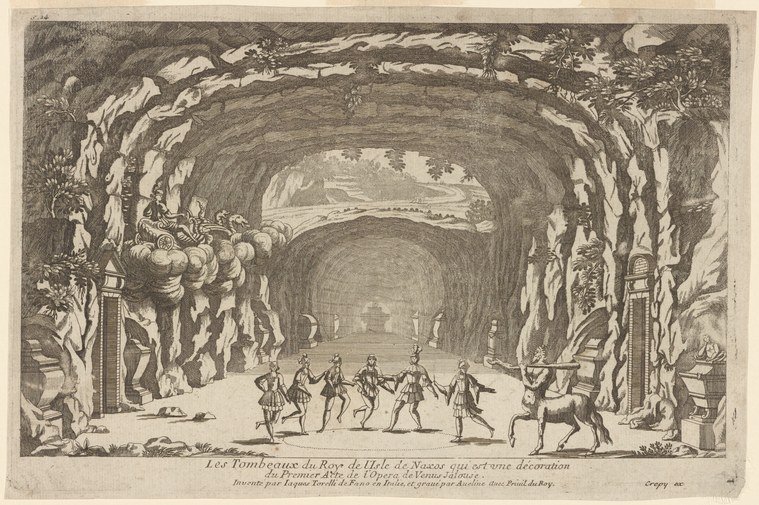
This engraving is a rare surviving visual record of an actual court ballet spectacle, capturing both the choreography and the theatrical apparatus within which it was performed. For historians of dance, it provides concrete evidence of pose, grouping, and bodily disposition in a period for which written notation is sparse and often ambiguous. It also exemplifies the intimate alliance between dance, visual art, and classical learning that defined courtly culture in the age of Louis XIV.
What you are looking at
A theatrical grotto or cavern serves as the stage for this dance scene, its cavernous depths rendered in deep cross-hatching that recedes toward a distant landscape visible through the opening. The rocky walls frame six male dancers in the foreground, arranged in a loose line across the cavern floor. They wear classical or mythological dress—short draped tunics, some with cloaks or mantles—and their bodies are caught mid-movement, legs bent in varied positions suggesting active, springing motion. The composition places them well forward of the pictorial space, the better to show their gestures and poses against the dramatic architectural setting. Light floods from the grotto's mouth, illuminating the dancers and the pale stone surfaces while the interior remains shadowed. Sculptural reliefs and carved figures decorate the walls—references, perhaps, to the classical or mythological subject matter. The engraving is finely detailed throughout, with ornament and human figures rendered with equal care.
The dancing
The six dancers occupy varied positions, none in formal partnered holds. Most stand with legs flexed or bent at the knee in attitudes of preparation or suspension—the weight distributed lightly, bodies poised as though about to leap or spring. Several raise their arms, some extended laterally, others bent; the gestures are open and declarative rather than constrained. The dancers face different directions, their arrangement suggesting a collective action rather than synchronized formation. The musculature is emphasized in the engraving, and the bare or nearly bare legs make footwork and weight placement legible, though no single choreographic system is evident. The impression is of vigorous, youthful movement in a space that permits display.
The dance depicted
The inscription at the bottom ("Les tombeaux du Roy de l'Isle de Naxos") references a plot from classical mythology—likely a theatrical work depicting the tombs or sepulchers of the King of Naxos. This appears to be a scene from a court ballet or theatrical spectacle of the seventeenth or early eighteenth century, in which classical and mythological subjects were enacted through a combination of spoken dialogue, music, and choreographed dance. The male dancers, their classical dress, the mythological setting, and the emphasis on individual virtuosity and varied poses suggest a tradition of ballet de cour or theatrical spectacle rather than social dance. The specific choreography cannot be identified from the image alone, but the style—with its emphasis on verticality, spring, and open gesture in a unified stage space—is consistent with the French ballet tradition of the Baroque period.
How it was made
This is an engraving, identifiable by its fine parallel hatching, the precision of the line work, and the tonal range achieved through variation in line density rather than color. The inscription and composition suggest it was made to document or publicize a theatrical spectacle, serving as a printed record of a performance or, more likely, as a design or announcement to circulate among potential patrons or audiences before or after the event. The technique allowed for precise rendering of both architectural detail and human anatomy, making it ideal for instructing viewers in the poses and formations of the dance. The work's circulation as a print implies an educated, courtly, or theatrical audience capable of reading classical references and appreciating the conjunction of dance, architecture, and mythology.
About this work
This is a documentary or commemorative engraving of a court theatrical spectacle centered on dance, almost certainly French and datable to the seventeenth or early eighteenth century. The work combines architectural fantasy—a cavernous grotto—with a depiction of six male dancers in classical dress executing vigorous, varied poses. It documents a moment in the history of ballet when dance was inseparable from spectacle, mythology, and courtly display, and when the male dancer was the primary focus of choreographic innovation and virtuosity. The print preserves not only the choreography of a single moment but also the aesthetic and spatial conventions within which Baroque dance was conceived and displayed.
How to look at it
Notice how the artist has frozen the dancers in a moment of propulsive energy—none are still or at rest, all are caught between positions, suggesting continuous action. Observe the varied arm positions and the turned-out legs: these are hallmarks of the balletic vocabulary being codified in this period. The careful rendering of the grotto's architecture and light establishes the theatrical context without overwhelming the dancers themselves, who remain the focus. The engraver has chosen to show the dancers from a middle distance, close enough to read their poses and gestures but far enough back to show their relation to the stage space and to one another.
The period
The late seventeenth and early eighteenth centuries saw the full development of French court ballet as a comprehensive art form uniting dance, music, scenery, and classical narrative. Under Louis XIV and his successors, the ballet de cour became a primary vehicle for courtly spectacle and the display of royal power and taste. Male dancers dominated these spectacles, performing feats of elevation and virtuosity that demanded years of training. The use of classical and mythological subjects—drawing on contemporary learned taste and on the Baroque fascination with antiquity—gave these spectacles intellectual weight alongside their visual splendor. Engravings like this one served to disseminate knowledge of such performances beyond the court itself, reaching a wider educated public and establishing conventions for how theatrical dance was to be visualized and understood.
Where it lives
Held by the New York Public Library in its collection of prints depicting dance. The work is catalogued by title alone, with no artist attribution, date, or medium recorded in the catalogue entry provided, suggesting it entered the collection as an uncatalogued or partially catalogued item.
Dance in this work
Questions about this work
What is the story behind this dance?
The inscription refers to the tombs of the King of Naxos, a classical subject. This appears to document a court ballet spectacle—a theatrical form popular in seventeenth- and eighteenth-century France that combined dance, music, poetry, and scenery to enact classical and mythological narratives. The specific work and performance cannot be identified from the print alone, but the scale, subject, and style suggest it was a significant production, possibly commissioned by or performed at court.
Were these real dancers, or is this invented?
This is almost certainly based on an actual performance or at minimum on a choreographic design prepared for performance. Court ballet spectacles were real events, documented in written accounts and occasionally in engravings like this one. The anatomical plausibility of the poses and the specificity of the theatrical setting suggest the engraver worked from direct observation or from a detailed design or description.
What style of dance is this?
This is court ballet, or ballet de cour, a theatrical form distinct from the ballet d'action that emerged later in the eighteenth century. Male dancers performed virtuosic feats of elevation and turning in classical or mythological dress, often in groups or formations. The emphasis was on refinement, elevation, and the display of technical facility within a courtly aesthetic.
How do we know this is an engraving and not some other print?
The fine parallel lines used to build tone, the precision of the line work, and the uniformity of the mark-making are all characteristic of engraving, in which an image is incised into a metal plate and ink is forced into the furrows. The technique allowed for great detail and precision, making it ideal for depicting both the dancers' poses and the architectural setting.
More dance artwork





