49 works in this view — arrow keys or swipe to move between them.
Dance in Art
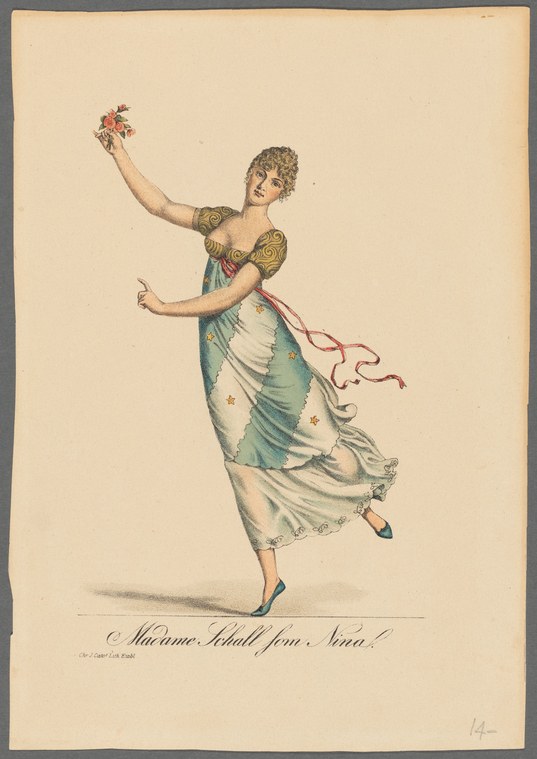
Madame Schall som Nina
Unknown artist
- Collection:
- Prints depicting dance
- Source:
- New York Public Library
- Rights:
- Public domain — free to use, share and adapt.
- Recorded as:
- Public Domain
Theatrical character-dance prints like this one are among the primary documents we have of how early 19th-century dancers moved, dressed, and were celebrated. They show us the actual stage vocabulary of the era—the carriage, the open frame, the energy—rather than relying on written description alone. The print also preserves the name and fame of a performer (Madame Schall) who would otherwise be lost to history, and it demonstrates that dance was already a commercial, celebrated art form with its own print culture and fan base.
What you are looking at
A young woman in Regency-era dress is captured mid-leap or lunge, her body energized and tilted forward in a dynamic pose of evident joy. She wears a high-waisted white muslin gown with a draped green overdress or shawl, the skirts caught mid-motion to show the movement; her arms are extended—one raised holding a small bouquet of flowers, the other flung outward for balance. Her short dark hair is dressed simply, and she wears blue slippers. The figure is set against a plain cream background with a light shadow beneath her feet to suggest the dance floor. Below the image, in script, runs the text "Madame Schall som Nina," identifying the dancer and likely the character she portrays. The print is hand-colored, with delicate watercolor washes that emphasize the translucency of the muslin and the vitality of the pose.
The dancing
The dancer stands on one foot in a pronounced arabesque-like extension or running step, her torso tilted forward with visible momentum. Her raised arm stretches toward the upper left while her other arm opens to the side, creating an open, buoyant frame. The pose suggests both balletic training and the looser, more naturalistic movement of early 19th-century theatrical dance. Her weight is clearly shifted and lifted, with the supporting leg fully extended beneath her, conveying the impression of a leap captured mid-flight rather than a static stance.
The dance depicted
This appears to be a theatrical dance print commemorating a specific performer and role: Madame Schall in the character of Nina. The style and costuming point to the romantic ballet or melodramatic pantomime of the early 19th century, a period when actresses and dancers regularly performed in such character pieces on the European stage. The exuberant, airborne quality of the pose—combined with the bouquet (a traditional prop associated with flirtation and courtship)—suggests a scene of youthful joy or romantic triumph. The Regency dress and the refined but energetic movement indicate professional theatrical training of the era.
How it was made
This is a hand-colored engraving or aquatint, a print medium that dominated theatrical ephemera and commercial portraiture in the early 1800s. The fine line work and subtle modeling are typical of professional theatrical prints, which were produced in editions for sale to the public and collectors of dance and performance imagery. The hand-coloring adds immediacy and allows the artist to capture the shimmer of muslin and the delicacy of the figure in a way line alone could not. Such prints were affordable, widely circulated, and served as souvenirs of performances and as records of celebrated dancers and their roles.
About this work
This hand-colored engraving documents a performance by Madame Schall in the character role of Nina, likely from a popular stage work of the Regency era (early 19th century). The print captures her mid-leap, arms extended, in a pose that combines balletic training with the theatrical dynamism and emotional expression that characterized melodrama and romantic ballet of the period. It is both a portrait of a celebrated performer and a record of how dance was understood, executed, and consumed in the commercial theater of its time—a moment of joy and virtuosity frozen for public appreciation and collection.
How to look at it
Note the moment the artist chose to freeze: not a static pose, but a leap or forward lunge, as if the dancer has just sprung into the air. This captures the energy and velocity of performance, not mere display. Observe how the muslin follows the body in loose folds, creating an impression of lightness and freedom—a stark contrast to the corseted, structured clothing of earlier periods. The outstretched arms and open frame are hallmarks of early 19th-century theatrical style, which prized expressiveness and emotional clarity. The bouquet in the raised hand is both a prop and a symbol, reinforcing the character's youthful joy and romantic context.
The period
In the early 19th century, theatrical dance and pantomime were wildly popular entertainments across Europe, and the Regency period (1811–1820) saw a boom in printed theatrical portraits and character studies. Dancers were celebrities, and producers sold prints of them in popular costumes to feed demand from theater-goers and collectors. This was the era before the formalization of classical ballet technique (Cecchetti, Vaganova) but after the decline of the court ballet, when theatrical innovation and commercial success were driving the art forward. The image of the young, energetic, muslin-clad dancer became an icon of the period—associated with youth, nature, sensibility, and romantic ideals.
Where it lives
The work is held in the New York Public Library's Prints depicting dance collection, a major institutional repository of theatrical and performance ephemera from the 18th through early 20th centuries. It is catalogued as a theatrical portrait print, a category that includes hundreds of similar works documenting celebrated dancers and their roles.
Dance in this work
Questions about this work
Who was Madame Schall?
The catalogue record does not provide biographical information, but the inscription identifies her as a professional dancer and actress who performed in the character role of Nina, likely on a European stage in the early 19th century. Her appearance in a professionally produced and distributed print suggests she was celebrated enough to merit such a souvenir, though archival details about her career and performances are not yet identified.
What does the bouquet signify?
In early 19th-century theater, the bouquet was a conventional prop associated with scenes of courtship, flirtation, or romantic triumph. It signals to the viewer that Nina is a character of romantic interest—likely a young woman in a moment of joy, success, or love. The raised bouquet, combined with the leap and the open, buoyant posture, emphasizes the lightness and youthful exuberance of the moment.
What is the difference between this and a ballet print?
While this print shows trained, elevated movement, it lacks the pointe work and formal costume (tutu, bodice, ribbons) that define classical ballet imagery. Instead, it depicts theatrical character dance or pantomime in street or day dress, a broader and more narrative-driven performance category. The form and energy suggest the dancer was trained in balletic technique but performing in a dramatic, emotionally expressive register rather than a purely classical one.
More dance artwork





