49 works in this view — arrow keys or swipe to move between them.
Dance in Art
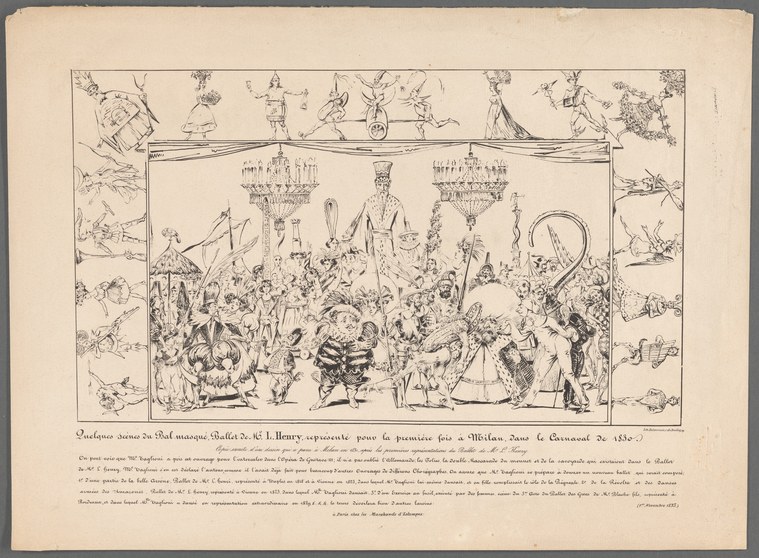
Quelques scènes du Bal masqué, ballet de Mr. L. Henry, représenté pour la première fois à Milan, dans le Carnaval de 1830
Unknown artist
- Collection:
- Prints depicting dance
- Source:
- New York Public Library
- Rights:
- Public domain — free to use, share and adapt.
- Recorded as:
- Public Domain
This image is one of very few surviving visual records of early 19th-century Italian ballet choreography and the Carnival ball traditions that influenced European Romantic ballet. It documents theatrical spectacle and design practice at a moment when dance was increasingly integrated with acrobatics, aerial display, and elaborate costume—elements that shaped the visual language of Romantic ballet. For researchers of Carnival traditions, Italian theater history, and the genealogy of Romantic ballet aesthetics, this is primary material.
What you are looking at
A densely populated masquerade ball in full theatrical chaos, rendered in the decorative manner of a printed design. The central stage shows dozens of costumed figures in various states of revelry—some dancing, some gesturing wildly, some interacting in clusters. A tall female figure in an elaborate headdress and voluminous dress dominates the center-right; she appears to be a principal character around whom the action orbits. The architectural setting suggests an interior ballroom with architectural elements visible at top and sides. Suspended above the crowd are acrobatic or aerial figures in dynamic poses, some appearing to fly or leap impossibly through the upper air, which may represent theatrical machinery or carnival fancy. The entire composition is framed by a decorative border, and the margins of the page carry ornamental vignettes showing smaller scenes of carnival activity—acrobatics, processions, theatrical tableaux—all rendered in the same line-work style. The overall effect is of a printed design documenting a spectacular staged entertainment rather than a naturalistic scene.
The dancing
The bodies throughout are rendered in exaggerated, theatrical postures—limbs extended, torsos twisted, heads thrown back. The dancers and revelers do not appear to be executing a single unified choreography but rather individual performances or free-form movement. The female figure at center stands relatively contained in her voluminous costume, while surrounding figures lean, reach, leap, and gesture in all directions. Some figures appear to be in conversation or social groupings rather than dance partnership. The aerial figures at top are depicted in impossible contortions—mid-leap, twisted, inverted—consistent with acrobatic display or the visual language of commedia dell'arte spectacle.
The dance depicted
This is a masked ball in the Carnival tradition, and the catalogue identifies it as scenes from *Le Bal Masqué*, a ballet by Mr. L. Henry first performed at Milan during Carnival 1830. The image appears to document theatrical set designs or costume designs for this production rather than a single dance moment. The masquerade ball setting, the presence of acrobats and aerial performers, and the profusion of exaggerated gesture suggest a Romantic-era theatrical ballet in the tradition of Italian carnival spectacle. The absence of a unified choreographic moment and the emphasis on costume, decoration, and individual performance suggests this documents the visual spectacle and design concept of the work rather than the actual dancing.
How it was made
This is a line engraving or etching on paper, evidenced by the fine linear hatching, the uniform line weight, and the decorative border treatment typical of 19th-century reproductive prints. The technique allowed for detailed narrative documentation and was suitable for theatrical publications and design portfolios intended for wide circulation among artists, costume makers, and the theater-going public. The ornamental border and marginal vignettes indicate this was a finished presentation piece—not a preliminary sketch but a published document intended to promote or document the spectacle.
About this work
This is a printed design document for a Romantic-era Italian masked ball ballet, *Le Bal Masqué*, choreographed by L. Henry and premiered at Milan's 1830 Carnival season. Rather than capturing a single moment of dancing, it presents the overall visual concept and theatrical spectacle of the work—a crowded, costumed, aerially active carnival scene rendered in the decorative print tradition of theater documentation. It exemplifies the early 19th-century practice of using engravings to circulate knowledge of theatrical design and costume across Europe, functioning as both artistic record and promotional document. The work sits at the intersection of dance history, theater design, and the visual culture of Carnival, preserving evidence of a now-lost choreography.
How to look at it
Attend first to the composition's deliberate chaos: there is no single focal action, but rather a field of simultaneous activities. Notice how the costume and headdress of the central female figure creates a stable visual anchor amid the swirling movement around her. Look at the margin vignettes—they show that this is not a single scene but a design concept for multiple moments and tableaux. The aerial figures at top are key: their impossible poses and suspension in air signal the use of theatrical machinery and the period's appetite for visual wonder. Finally, observe the line quality and technique: the fine, even engraving is consistent with professional theater documentation intended for publication.
The artist
The choreographer L. Henry is otherwise little documented in surviving records; this print may represent the principal surviving evidence of his work. The print itself was produced by an unnamed engraver working in the tradition of theatrical design documentation common to early 19th-century Italian and European publishing.
The period
The 1830 premiere date places this work in the early Romantic period of ballet, before the canonical Romantic ballets of the 1840s (*La Sylphide*, *Giselle*). Milan's Carnival season was a major venue for theatrical innovation, and masked balls were stock features of Carnival entertainment. The integration of acrobatics, flight effects, and spectacular costume visible here reflects the era's fascination with mechanical theater and visual excess—the aesthetic that would crystallize in later Romantic spectacle. In European printmaking, theatrical design documentation was increasingly used to publicize and preserve record of stage productions, particularly in Italy and France.
Where it lives
This print is held in the New York Public Library's collection of prints depicting dance. It is classified as a design or documentary print rather than an original artwork, and represents the category of theatrical ephemera and design documentation produced for circulation within the theatrical and artistic communities of early 19th-century Europe.
Dance in this work
Questions about this work
Is this a record of an actual dance performance?
Not a direct record of performance in the modern sense. It is a printed design document—what we would call a poster or program illustration—intended to publicize and document the theatrical concept of the ballet. It shows costumes, the setting, the types of characters and actions, and the scale of the spectacle, but not the precise choreography or movement sequence that dancers would have performed.
What is the story of this ballet?
The catalogue record provides only the title and premiere information; the narrative or plot of L. Henry's *Le Bal Masqué* is not documented in available sources. The image suggests it involved masked characters, acrobatic display, and the festive chaos of a Carnival ball, but the specific story or dramatic structure cannot be recovered from this image alone.
Why are there flying figures at the top?
In 19th-century theater, acrobats and performers suspended by cables and pulleys were a standard feature of spectacle, particularly in Carnival and festive scenes. The aerial figures represent the spectacular effects created by stage machinery—a mark of wealth and technical sophistication in theatrical production. These were likely performed by trained acrobats, not by the principal dancers.
Who was L. Henry?
Surviving records of L. Henry as a choreographer are sparse. This print may be one of the most substantial documents of his work. He was active in Italian theater during the 1820s–1830s, a period when Italian cities, particularly Milan, were major centers of dance innovation before the later dominance of French Romantic ballet.
More dance artwork





