49 works in this view — arrow keys or swipe to move between them.
Dance in Art
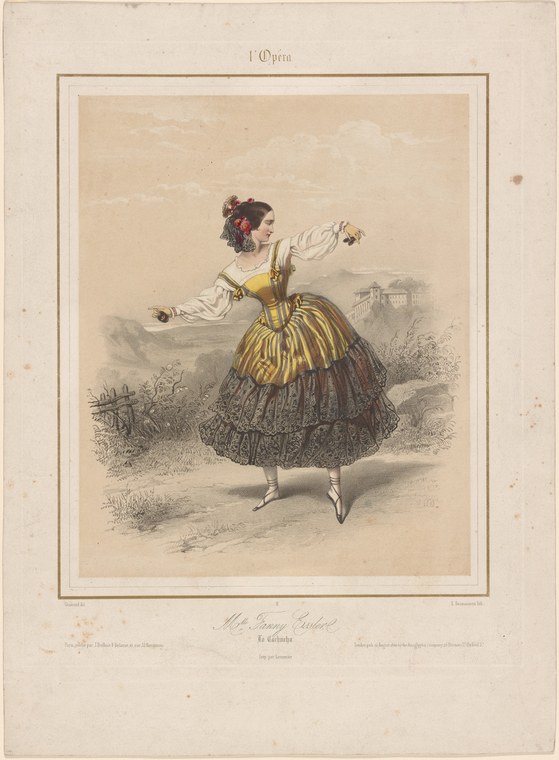
Mlle Fanny Essler [sic], La cachucha. L'opéra
Unknown artist
- Collection:
- Prints depicting dance
- Source:
- New York Public Library
- Rights:
- Public domain — free to use, share and adapt.
- Recorded as:
- Public Domain
The cachucha was one of the most discussed and imitated dances of the nineteenth century, and this print documents how a Spanish folk form was transformed into an elite theatrical spectacle. Elssler's performance of it helped establish the figure of the female solo dancer as a vehicle for both technical display and exotic fantasy—a model that would shape theatrical dance for decades.
What you are looking at
A woman in theatrical costume stands alone in a landscape, captured mid-performance gesture. She wears a yellow and brown striped skirt of considerable fullness, cinched at the waist with a white bodice or corset, and a white shawl or wrap draped asymmetrically across her shoulders and arms. Her dark hair is styled up with what appears to be a decorative comb or ornament. Her weight is shifted onto one leg in a pose of dynamic elegance; her arms are raised and extended as if mid-gesture, one hand pointed toward the distance. The background is sketchy and atmospheric—a landscape with a small building or structure visible in soft focus, rendered in grays and browns that recede behind the figure. The woman's face is shown in profile, her expression animated and engaged. The print has hand-coloring applied over what appears to be a lithographic base, giving it the characteristic warm tones and soft edges of mid-nineteenth-century popular theatrical prints.
The dancing
A single female dancer, posed in an attitude of theatrical grace. Her weight is centered on one supporting leg while the other is subtly flexed, suggesting movement or a moment of suspension. Both arms are raised and extended with apparent ease, the upper body held upright and proud. The pose demonstrates control and elegance rather than explosive energy—this is a dancer trained in balletic discipline, with the erect carriage, lifted port de bras, and pointed limbs of academic ballet tradition. The shawl draped across her body adds to the impression of fluid, continuous movement.
The dance depicted
This is almost certainly a representation of the cachucha as performed by Fanny Elssler, the Austrian dancer who was one of the most celebrated performers of the Romantic ballet era. The cachucha is a Spanish solo dance, traditionally a flamenco form, but it entered European theatrical dance in the 1830s and became a signature vehicle for Elssler—she performed it throughout her career and it was a central part of her fame. The image shows the dance as it was adapted for the concert stage: the Spanish costume is present (the striped skirt, the shawl), but the body position and carriage are those of Romantic ballet, not traditional flamenco. This represents a moment of high theatrical display rather than the rapid footwork or hip articulation of authentic Spanish dance.
How it was made
This is a hand-colored lithographic print, a standard medium for theatrical portraiture and dance documentation in the 1830s–1850s. Lithography allowed for relatively rapid production and wide circulation at modest cost, making such prints accessible to theater audiences and collectors. The artist has used the stone to capture soft modeling of the figure and atmospheric effects in the background, then applied watercolor or similar pigment by hand to add the warm tones of the costume and the delicate flesh tones. This technique—combining the precision of lithography with the immediacy of hand-coloring—was ideal for capturing the visual impression of a live performance for audiences who had seen it or aspired to see it.
About this work
This is a theatrical portrait print of a Romantic-era solo dancer in her signature role, documenting both the Spanish-inspired costume and the refined, balletic body language that made the cachucha a sensation on European stages. The image sits at the intersection of three historical currents: the international taste for Spanish exoticism that seized Europe in the 1820s–1830s; the Romantic ballet movement's fascination with folk and national dances as subjects; and the star system of European theater, which made the likenesses of celebrated dancers into desirable commodities. It is simultaneously a record of actual performance and a work of theatrical marketing, shaped by the print medium and the conventions of mid-century dance imagery.
How to look at it
Attend to the pose: this is not a moment of rapid or strenuous movement, but of posed elegance and display. The artist has chosen to show the dancer in a moment of stillness or suspension, arms raised in a gesture of greeting or flourish, which allows full visibility of the costume and the body's line. The shawl—a key prop of the Spanish costume—is rendered with particular care, as it creates dramatic visual interest and frames the figure. The soft background and the isolation of the figure on an empty stage emphasize the dancer's status as a star and the theatrical convention of the solo performance piece.
The artist
The artist is not recorded in the catalogue. The style and technique are consistent with the work of commercial theatrical print publishers operating in Paris in the 1830s–1850s. These firms—such as the Maison Turgis or the publishers who worked with lithographers like Charivari contributors—produced thousands of prints of famous dancers, often unsigned or credited only to the lithographer. Attribution would require examination of the stone signature or publication marks at the print's edge, which are not visible in this image.
The period
The 1830s saw a craze for Spanish culture across Europe, stimulated by Romantic literature (Byron, Hugo) and by the visible presence of Spanish dancers and musicians on European stages. In this context, the cachucha became a fashionable solo for ballerinas, combining the prestige of ballet technique with the appeal of national exoticism. Fanny Elssler danced it in Paris at the Opéra in the 1830s and performed it throughout her long career; it remained one of her most celebrated roles. The print belongs to the era of Romantic ballet (roughly 1830–1860), when the female dancer was increasingly positioned as the center of the spectacle, and when theatrical prints became a major form of popular entertainment and dance documentation.
Where it lives
This print comes from the New York Public Library's collection of prints depicting dance. It is a mass-produced theatrical merchandise item, one of countless similar prints distributed to audiences and collectors during the nineteenth century.
Dance in this work
Questions about this work
What is the cachucha?
The cachucha is a Spanish solo dance, traditionally a flamenco form, with rapid footwork and strong hip articulation. In the 1830s it was adapted for European theatrical stages and became a favorite solo for Romantic ballerinas. Fanny Elssler's performance of it was so celebrated that it became inseparable from her name and career.
Who was Fanny Elssler?
Fanny Elssler (1810–1884) was an Austrian dancer and one of the most famous performers of the Romantic ballet era. She was celebrated for her technical skill, her dramatic presence, and her talent for national and character dances. She toured throughout Europe and the Americas and was a rival to Marie Taglioni as the leading dancer of her time.
Why is the costume Spanish if this is ballet?
The Romantic era had a taste for exotic and national subjects, and European audiences were fascinated by Spanish culture. Theatrical dance borrowed Spanish costumes and steps to create a sense of dramatic difference and authenticity. The result is a hybrid: the body language and discipline of ballet, but with Spanish costume and some Spanish dance vocabulary.
How was this print made and distributed?
This is a hand-colored lithograph, a print technology that allowed for mass production at low cost. Publishers created thousands of such prints and sold them to theater audiences, collectors, and fans. They served as souvenirs of performances, as visual records of famous dancers, and as entertainment in their own right.
More dance artwork





