49 works in this view — arrow keys or swipe to move between them.
Dance in Art
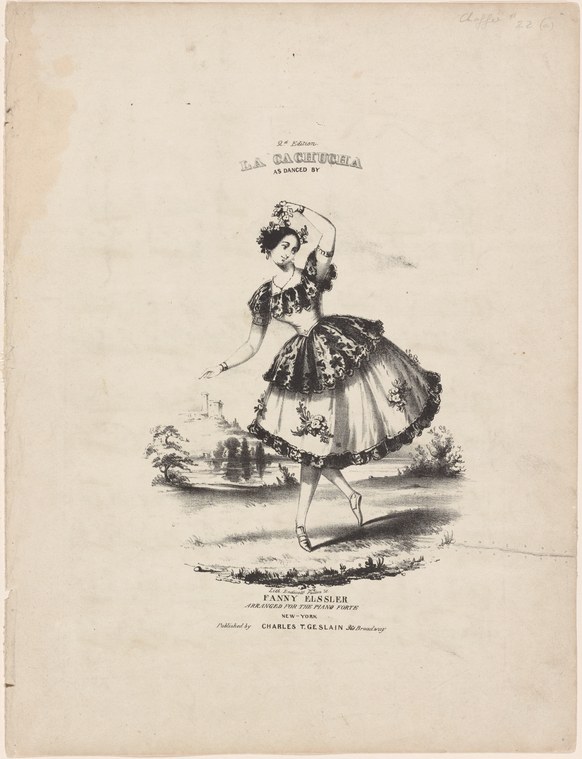
La cachucha as danced by Fanny Elssler,: arranged for the piano forte
Unknown artist
- Collection:
- Prints depicting dance
- Source:
- New York Public Library
- Rights:
- Public domain — free to use, share and adapt.
- Recorded as:
- Public Domain
Fanny Elssler was the preeminent dancer of the 1830s–40s and a figure whose virtuosity and international celebrity helped define Romantic-era ballet as a vehicle for individual female genius. *La Cachucha* was her calling card, danced hundreds of times and reproduced in prints, sheet music, and lithographs across Europe and North America; this image is evidence of that circulation and of how dance stardom was commodified and consumed. For dance historians and practitioners, it documents the physical vocabulary and theatrical presentation of a role that dominated the stage for a generation and influenced how Spanish material was understood in European high-art dance.
What you are looking at
This is a lithographed sheet-music cover for a piano arrangement of La Cachucha, depicting the Spanish dancer Fanny Elssler in the role that made her famous. She is shown in a moment of virtuosic display: standing on one leg in a lifted pose, her torso arched backward with one arm raised above her head and the other extended, her body caught in an attitude of spiraling elevation. She wears a white muslin ball gown with a fitted bodice embellished with dark floral or geometric ornament, and a voluminous skirt with a dark patterned overskirt or apron creating a striking color contrast. Her dark hair is swept up and adorned with what appears to be a jeweled comb or tiara. The background is minimally rendered—a faint landscape with a few buildings or fortifications suggests a distant theatrical vista, but the focus is entirely on the dancer's body. The composition is spare and elegant, with the figure occupying the center of the page against a cream ground.
The dancing
Elssler is captured in a sustained, turned-out position that demonstrates considerable training in the academic vocabulary of ballet. Her working leg is fully extended and lifted to hip height or higher; her supporting leg is straight and rotated outward. The upper body shows an unusual degree of extension and flexibility, with the spine arched and the head tilted back in a pose that blends classical ballet geometry with a display of physical virtuosity verging on the acrobatic. The positioning of the arms—one overhead, one extended to the side at shoulder height—follows the épaulement conventions of theatrical dance of the 1830s–40s. A single figure, entirely self-contained, requires no partnering or ensemble: the dance exists as a vehicle for the individual dancer's body.
The dance depicted
La Cachucha is a Spanish dance in triple meter with Andalusian roots, but this particular version—Elssler's famous interpretation—was a theatrical balletic adaptation, not the folk dance itself. Elssler premiered it in Paris in 1836 and it became her signature role and one of the most celebrated dances of the Romantic era. The dance was structured as a vehicle for technical display: rapid footwork (both battement and bolero-influenced castanets work), turns, and elevation. This print captures her in a moment of balletic apotheosis—an impossible-seeming suspension that the lithographic medium renders with graphic clarity. The dance was understood as belonging to the Spanish national idiom but performed entirely within the balletic and theatrical conventions of Parisian Romantic ballet.
How it was made
This is a lithograph, identifiable from the crayon-worked tonal gradations and the slight graininess characteristic of stone printing. Lithography allowed rapid, relatively affordable circulation of theatrical imagery to a middle-class audience; this was sheet music, a commodity distributed through music shops and domestic circles. The medium was perfectly suited to capturing the detailed dress and pose with tonality and atmospheric suggestion without the cost or labor of hand-coloring or engraving. The image would have been drawn directly on the lithographic stone, then printed in black ink on cream stock.
About this work
This is a promotional lithograph for a piano-vocal arrangement of *La Cachucha*, the Spanish-inflected theatrical dance that became the defining role of the Romantic-era prima ballerina Fanny Elssler. The print dates from the height of that role's fame, likely the late 1830s or 1840s, and documents not the dance itself but rather the star dancer in a moment of balletic magnificence—arched, elevated, and in the command of her body that made her revolutionary. It belongs to the category of theatrical souvenir and musical commodity: a way for audiences to possess a memory of a famous performance, to play its music at home, and to see the dancer's likeness. The work is simultaneously an artifact of music commerce, a record of an individual performer's charisma, and a document of how the Romantic ballet absorbed and theatricalized Spanish idioms.
How to look at it
Note the extreme arch of the spine and the lifted quality of the torso, which suggests Elssler's famous "ballon"—the appearance of weightlessness or suspension in the air. The artist has chosen a moment of stillness or apogee rather than a moment of rapid footwork, emphasizing the purity of line and the control of the turned-out body. The white dress with its dark patterned overskirt creates a visual accent that draws the eye downward, anchoring the figure to the ground even as the pose suggests flight. The minimal background and the isolation of the figure reflect the conventions of theatrical lithography of the period: the dancer is framed as a jewel, distinct from and elevated above the everyday world.
The artist
The artist is not recorded in the catalogue. The print is published by Charles D'Almaine of London, a music publisher of the period. The lithograph was made by a commercial theatrical print shop, likely based on a sketch or painting by a more celebrated artist—such work was typical of mid-19th-century theatrical merchandise, where the image and text were designed as a unified commodity for sale through music and print shops.
The period
This falls in the era of European Romanticism in dance and the height of the "Romantic ballet" (roughly 1830–1850), when ballet was at the center of theatrical entertainment and individual female dancers achieved unprecedented celebrity and international touring. The 1830s in particular saw an explosion of interest in Spanish, Italian, and Eastern European national dances adapted for the balletic stage—what was called the "cachucha fever" or craze for Spanish idioms in Western European theater. Lithography, perfected in the previous decades, had become the dominant medium for theatrical promotion, allowing cheap mass production of images of famous dancers in famous roles. The composition and dress are consistent with Parisian ballet aesthetics of the 1830s–40s, when the tutu was shortening, the pointe shoe was becoming standard, and the balletic arabesque and attitude were codifying the ideal female dancer's body.
Where it lives
This lithograph is part of the New York Public Library's collection of prints depicting dance. It is a music publication—a score or arrangement for home or salon performance—rather than a fine-art print, which means its original circulation was commercial and domestic.
Dance in this work
Questions about this work
Was Fanny Elssler the choreographer of La Cachucha?
No. The dance was choreographed by Jean-Baptiste Barrez and first performed in Paris in 1836. Elssler was the performer who made it famous and who danced it internationally. She was a virtuoso interpreter of roles created for her, not a choreographer in her own right.
What is the connection between this Spanish dance and ballet?
La Cachucha is a Spanish folk dance in triple meter, but Elssler's version was a thorough theatrical adaptation: it was performed in a tutu and pointe shoes, to orchestral accompaniment, in the balletic vocabulary of port de bras and épaulement. The Spanish idiom—the triple-meter rhythm, the name, the cultural identity—was preserved, but the movement vocabulary was balletic.
Was this print sold as sheet music or as a standalone image?
Both. The print is the cover of a piano arrangement, so it was distributed with the score to music publishers' customers—people who wanted to play the tune at home. But such theatrical lithographs were also collected and displayed separately, as they were among the most accessible and popular images of famous dancers.
Why does Elssler look so arched and backwards in this pose?
The artist chose to freeze a moment of maximum physical display—likely a pose held at the climax of the dance, where Elssler's famous flexibility and strength would be on exhibition. The arched spine and lifted torso are balletic attitudes showing control, training, and a body shaped by decades of dance.
More dance artwork





