49 works in this view — arrow keys or swipe to move between them.
Dance in Art
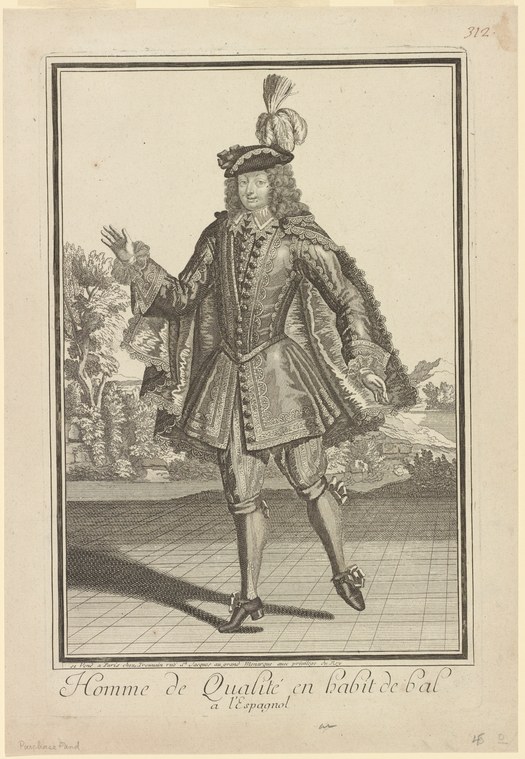
Homme de qualité en habit de bal à l'espagnol
Unknown artist
- Collection:
- Prints depicting dance
- Source:
- New York Public Library
- Rights:
- Public domain — free to use, share and adapt.
- Recorded as:
- Public Domain
This print documents the vocabulary of baroque courtly male dance as it was actually performed, in authentic costume, at a moment when such dances were a central practice of aristocratic life and education. It is one of the few visual records that captures a dancer mid-phrase rather than posed in formal dress, offering a rare glimpse of how the body moved within these elaborate clothes.
What you are looking at
A single male figure stands in a formal outdoor setting, posed in profile facing left. He wears an elaborately decorated coat with ornamental embroidery and a long, flowing cape or cloak lined with fur or textured fabric, both typical of Spanish court dress of the late seventeenth or early eighteenth century. His attire includes knee breeches, stockings, and heeled shoes. A tall feathered plume rises from his hat. The background shows a distant landscape with trees and architectural elements rendered in light lines. The figure's right arm is raised in an open gesture, while his left hangs naturally; his posture suggests a moment of presentation or choreographed movement rather than static standing. The composition is enclosed in a simple rectangular border, characteristic of period prints.
The dancing
The single male dancer is captured mid-movement, weight appears forward on the right leg with the left leg bent or extended behind. His right arm lifts outward at approximately shoulder height with an open palm, in the ornamental arm carriage typical of courtly dance; his left arm hangs loosely at his side. The pose suggests a moment within a larger sequence—neither a prepared stance nor a completed rest, but rather a suspended instant of movement. The carriage is upright and aristocratic throughout.
The dance depicted
The title identifies this as a Spanish ball costume (habit de bal à l'espagnol), and the pose and dress strongly suggest a courtly dance of the baroque period, most likely a branle, passepied, or similar court dance that featured this kind of open, presentational arm work and sustained, decorative posture. The Spanish styling in the costume—evident in the cut and ornamental density of the coat—suggests either an actual Spanish dance or a European court dance performed in Spanish fashion, which was fashionable in late-seventeenth-century France and other European courts. The figure's isolation and formal presentation suggest this is a costume study or dance figure for courtly entertainment rather than a narrative scene.
How it was made
This is an engraving, recognisable from the uniform parallel hatching used to build tone and shadow, the crisp line-work, and the characteristic plate-mark border. The technique allowed fine detail in the embroidery and costume ornament—visible in the dense patterning of the coat—while maintaining the linear clarity essential for printed distribution. The print would have circulated widely in manuscript form or as part of a larger series documenting court dances or costume practices, reaching dancers, choreographers, and courtiers beyond the initial performance.
About this work
This is a costume and dance figure study from the baroque period, documenting a male dancer in Spanish court dress during an actual moment of choreographed movement. The engraving records not just the costume but the bodily deportment required to wear it and move in it—the open arm, the forward weight, the erect carriage. It belongs to a tradition of printed dance notation and costume documentation that runs through the seventeenth and eighteenth centuries, capturing the vocabulary of court dance at a moment when dance was becoming increasingly codified and dispersed through print. The work is valuable precisely because it shows dance as embodied practice, not as static dress, and because it preserves a moment of movement that would otherwise leave no trace.
How to look at it
Attend to the moment of the movement: the figure is caught mid-phrase, with weight forward and arm open, neither starting nor finishing. The artist has chosen the instant of fullest extension and most decorative arm carriage, the moment of greatest visual impact. Notice how the costume—the heavy coat, the flowing cape, the feathered hat—frames and emphasises the movement of the arm and the direction of the body. The engraving technique preserves the texture of the embroidery and the fabric, which would have moved and caught light as the dancer moved, making the costume an active partner in the dance rather than merely worn over it.
The period
The late seventeenth and early eighteenth centuries saw an explosion of interest in documenting dance through print, driven partly by the spread of French court dance across Europe and partly by the growing fashion for Spanish and Spanish-influenced styles in French and other European courts. Baroque court dance was becoming increasingly formalised and codified during this period; prints served both as instruction and as record of prestige fashion. Spanish dress and Spanish dance held particular prestige in this era, carried partly by the long cultural influence of Spain and partly by dynastic ties between the French court and Spanish succession politics.
Where it lives
The work is held in the New York Public Library's collection of prints depicting dance, catalogued in their broader collection without additional accession or location information provided.
Dance in this work
Questions about this work
What dance is being shown?
The title identifies the costume as Spanish (habit de bal à l'espagnol), and the movement and arm carriage suggest a baroque court dance, possibly a branle, passepied, or other courtly form. The specific dance cannot be identified from the image alone, but the pose and vocabulary are consistent with dances performed in European courts of the late seventeenth century, often under French influence.
Why is only one figure shown?
This is a costume and figure study rather than a dance scene. It documents how the body moved within a specific court costume, serving as both a record of fashion and an instruction in how to carry and move in that costume. Single-figure studies like this circulated widely to inform performers and courtiers of approved styles.
How do we know the figure is actually moving?
The weight distribution, arm position, and forward inclination of the body all indicate a moment within movement rather than a standing pose. The arm is lifted and open, the body is not symmetrical, and the legs suggest motion rather than stable stance. The artist has frozen a moment of choreographed action.
What was Spanish dance fashion in this period?
Spanish dress and Spanish-influenced dances held high prestige in European courts during the late 1600s and early 1700s, partly through cultural inheritance and partly through dynastic politics. Spanish fashions were considered elegant and aristocratic, and Spanish costume elements—like the ornamental coat and cape shown here—were incorporated into court dress across Europe.
More dance artwork





