49 works in this view — arrow keys or swipe to move between them.
Dance in Art
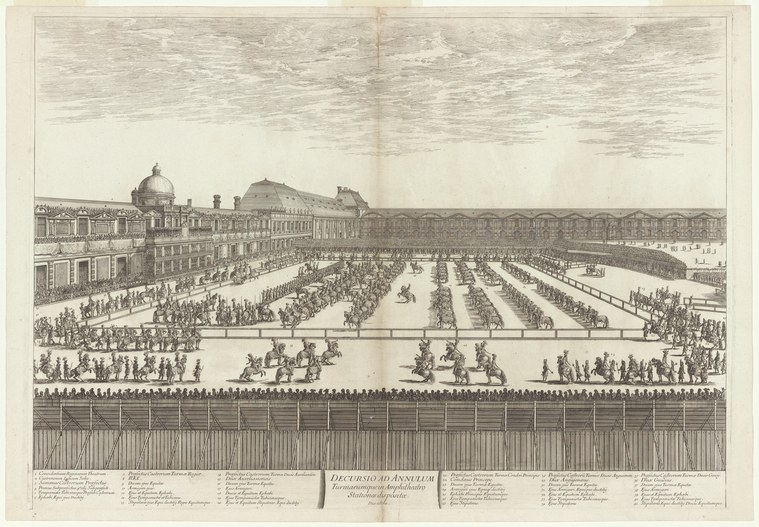
Decurso ad Annulum Turmarumque in Amphitheatro stationes dispositæ. Dies altera
Unknown artist
- Collection:
- Prints depicting dance
- Source:
- New York Public Library
- Rights:
- Public domain — free to use, share and adapt.
- Recorded as:
- Public Domain
This engraving is a rare documentary record of how Renaissance and Baroque courts choreographed large-scale public spectacles, organizing hundreds of bodies into formations that were legible from elevated viewing platforms. It shows that 'dance' in the courtly context was not limited to ballroom steps or theatrical performance, but extended to tournament, military pageantry, and formal procession—all of which were carefully arranged and rehearsed. For historians of performance and spectacle, it reveals how early modern power asserted itself through organized, visually impressive movement and geometric order.
What you are looking at
This engraved bird's-eye view depicts a formal equestrian spectacle or tournament unfolding in a vast amphitheater or palace courtyard. The composition is divided into distinct zones: in the foreground, a wooden palisade contains spectators standing shoulder-to-shoulder along the perimeter; beyond this barrier, the open arena is filled with orderly formations of mounted figures and foot soldiers arranged in geometric patterns, creating parallel lines and squares that emphasize military precision. The background features a palatial complex with domed and pitched roofs, symmetrical colonnaded buildings that frame the scene on both sides, establishing this as a court ceremony of considerable magnificence. The Latin inscription at the bottom identifies this as 'Decurso ad Annulum Turmarumque in Amphitheatro stationes dispositae. Dies altera' (the second day of ring-running and squadron formations in the amphitheater). The entire scene is rendered in the delicate parallel lines and cross-hatching characteristic of Renaissance or early Baroque engraving, creating subtle gradations of tone across the vast architectural and human landscape.
The dancing
The human figures are rendered small relative to the landscape but with enough specificity to show mounted knights in full armor, foot soldiers carrying pikes or halberds, and a few unarmored spectators. The mounted figures maintain formal alignment, arranged in columns and geometric formations rather than chaotic movement, suggesting choreographed military pageantry. The horses are depicted in profile or three-quarter view, and their positioning emphasizes order and symmetry rather than dynamic action. Individual bodies are subsumed into collective patterns; the viewer's eye is drawn to the formation itself rather than to individual performers' technique or expression.
The dance depicted
This is not a representation of dance in the theatrical or social sense, but rather a documented record of a formal court spectacle—specifically, a tournament or martial exercise (a 'decurso ad annulum,' or ring-running competition, combined with organized cavalry maneuvers). Such events were common in Renaissance and early Baroque courts and functioned as choreographed displays of military prowess, courtly virtue, and princely power. Participants included mounted nobility and their retinues. The image records the 'second day' of an event, suggesting multi-day ceremonial programming. The geometric arrangements and formal processions qualify this as a performed spectacle with strong choreographic elements, even if the physical vocabulary is equestrian and martial rather than balletic or social-dance-based.
How it was made
This is an engraving, identifiable from the uniform parallel line work, cross-hatching, and characteristic burnished whites of the medium. The technique allowed for fine architectural and spatial detail across a wide panoramic format while maintaining legibility of numerous small figures, making it ideal for documenting and circulating images of court spectacles to a literate elite audience. The precision of the linear perspective and the cartographic quality of the composition suggest this was produced as an official record or commemorative print, likely made shortly after the event or under court patronage. Such prints served documentary, celebratory, and diplomatic functions in early modern princely courts.
About this work
This engraving records a formal court spectacle—a tournament featuring ring-running (decurso ad annulum) and organized cavalry maneuvers—performed in an amphitheater or palace courtyard during the Renaissance or early Baroque period. The bird's-eye perspective and geometric arrangement of mounted figures and foot soldiers reveal the deeply choreographed nature of courtly pageantry: participants move in ranked formations and patterned blocks, not in naturalistic or spontaneous ways. Although the participants are armed soldiers rather than dancers, the event itself is a performing art, a display of masculine martial virtue and courtly order for an assembled audience. The image belongs in a gallery of dance because it documents an important class of Renaissance and Baroque performance—the court spectacle or tournament—in which movement, costume, hierarchy, and formal geometry served aesthetic and political purposes alongside any martial function.
How to look at it
Read this image as a map first and a scene second. The bird's-eye perspective reveals the choreographic logic—the geometric formations, the segregation of performers from spectators, the symmetry of the architectural frame. Note how the mounted figures in the arena are arranged in ranks and columns, not scattered or overlapping; this discipline is the point of the spectacle. Look at the scale relationship between the palatial buildings and the human figures: the architecture dwarfs the performers, emphasizing that this is a ceremonial display of court power rather than an intimate entertainment. The inscription at the bottom signals that this is an official record, not a fanciful interpretation—this is what actually happened, arranged in this measured, geometric way.
The period
Court tournaments and equestrian spectacles were major forms of elite entertainment and ritual display across Renaissance and Baroque Europe, particularly in the Holy Roman Empire and Italian courts. These events served to display martial skill, courtly virtue, dynastic power, and allegiance to the ruler. The 'ring-running' or 'tilt at the ring' (decurso ad annulum) was a specific competitive exercise in which mounted knights attempted to spear or strike a suspended ring while riding at speed—a feat requiring both horsemanship and coordination. By the 16th and 17th centuries, such tournaments were increasingly formalized and choreographed, with participants arranged in squadrons and formations, spectators seated in purpose-built amphitheaters, and the entire event orchestrated as theater. The engraving as a medium was ideally suited to circulating images of these spectacles throughout Europe, making them visible to rulers and courts who did not attend in person.
Where it lives
This engraving is held in the Prints collection of the New York Public Library. It is catalogued as depicting dance but without recorded artist, date, medium, or further documentation. The Latin inscription and the cartographic quality of the work suggest it was produced in the 16th or 17th century as a court document or commemorative print.
Dance in this work
Questions about this work
Is this a dance, or is it a tournament?
It is both. The event—a decurso ad annulum (ring-running) combined with organized cavalry maneuvers—is martial in purpose but choreographic in execution. Participants moved in rehearsed formations and geometric patterns, making it a performed spectacle. In Renaissance and Baroque courts, tournaments were indeed considered among the performing arts, staged with as much care as a ballet or masque.
Why is this print in a dance collection?
Because it documents an organized, publicly staged performance in which hundreds of bodies moved in calculated patterns under the direction of court masters. The movement vocabulary is equestrian and martial rather than balletic, but the principles—choreography, formation, spectacle, hierarchical arrangement—are those of courtly performance art. Tournaments and court spectacles are part of the history of dance as a category of organized, meaningful movement.
What is the 'second day' in the title?
Major tournaments and court spectacles often ran for multiple days, with different events, matches, or formations featured on each day. The inscription 'Dies altera' (second day) indicates this engraving records the middle or final phase of a multi-day ceremonial event. This suggests careful scripting and repetition across the event, a further indicator of choreographic intent.
Who performed in these events?
Mounted knights drawn from the nobility and their armed retinues, typically young men of high birth or courtiers seeking to display prowess and earn the favor of the ruling prince. Foot soldiers and servants may have assisted in managing the formations or acting as obstacles or targets. Participation was an honor and a demonstration of allegiance and martial virtue.
More dance artwork





