49 works in this view — arrow keys or swipe to move between them.
Dance in Art
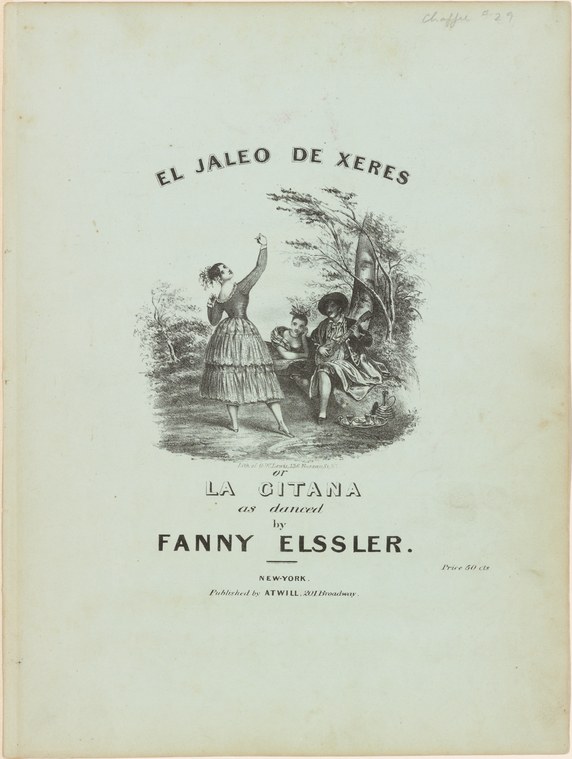
El jaleo de Xeres or La gitana, as danced by Fanny Elssler
Unknown artist
- Collection:
- Prints depicting dance
- Source:
- New York Public Library
- Rights:
- Public domain — free to use, share and adapt.
- Recorded as:
- Public Domain
Fanny Elssler was one of the most celebrated dancers of the 19th century, and her Spanish dances—particularly the *jaleo* and *cachucha*—were crucial to expanding the technical and aesthetic range of ballet beyond classical vocabulary. This print is evidence of how her performances were commodified and circulated as popular imagery, reaching audiences who could not attend live performance. It also reveals the assumptions of 19th-century theatrical exoticism: the way European dancers performed 'Spanish' or 'exotic' femininity through heightened gesture and costume, and how that performance was packaged for consumption.
What you are looking at
A theatrical scene of Spanish or Spanish-derived dance, rendered as a wood engraving or steel engraving. The composition shows three figures in a landscape setting with a windswept tree: a standing woman in the foreground with one arm raised overhead in an expressive gesture, wearing a full skirt with horizontal stripes or fluting; two seated or reclining figures to the right in darker clothing, one appearing to hold or play an instrument. The woman's raised arm and turned body suggest a moment of solo performance or display, while the other figures appear to be musicians or attendants. The setting is spare—bare ground, the tree bent by wind—giving the scene a sense of rural or outdoor theatricality. The style of the engraving, with fine cross-hatching and tonal modulation, suggests mid-19th-century printing technology and aesthetic.
The dancing
The principal figure is a soloist in a dynamic, asymmetrical stance: standing with weight apparently on one leg, the upper body twisted, one arm extended overhead in a raised arc. This posture reads as an arabesque, arch, or display position characteristic of Spanish dance performance. Her skirt is full and voluminous, cut to emphasize the leg line and allowing for display in turning movement. The two attendant figures are static and seated, not dancing, their role subsidiary to the soloist's performance. The engraver has concentrated anatomical detail on the soloist's lifted arm and tilted head, suggesting the artist understood the importance of upper-body port de bras in the dance.
The dance depicted
This is a theatrical rendering of Spanish or Spanish-derived dance, most likely *jaleo*, a lively, often improvised or semi-improvisational Spanish dance characterized by hand and arm gestures, castanets, and rhythmic footwork, traditionally performed by women. The title attributes the dance to Fanny Elssler, the Austrian-born Romantic-era ballerina famous for her 1836 *Cachucha* and her *Danse des Almées* in Paris. Elssler toured extensively and performed Spanish and exotic character dances; she was celebrated precisely for bringing technical ballet training to Spanish and Middle Eastern dance forms. The *jaleo* became one of her signature pieces. The image captures the idiom of Romantic-era theatrical Spanish dance: the isolated, spectacular arm position, the full skirt designed for visibility, the performance of passion and vitality rather than the plotless abstraction of classical ballet.
How it was made
This is a wood engraving or steel engraving, a relief printing technique that produces fine linear detail through cross-hatching and tonal variation. The technique was dominant for theatrical and literary illustration in the 1830s–1850s, allowing for high-quality mass reproduction in newspapers, periodicals, and illustrated books. The print's place of publication (New York, published by Atwell on Broadway) and price marking suggest it was a commercial theatrical print—inexpensive, widely distributed, intended for fans and theater-goers. The quality of the engraving and the composition suggest it may have been copied or adapted from a drawing or painting made during or after a performance.
About this work
This is a promotional or commemorative engraving documenting Fanny Elssler's performance of *El Jaleo de Xeres* (also titled *La Gitana*), a Spanish character dance that became one of the Austrian ballerina's signature roles in the 1830s–1840s. The print captures the idiom of Romantic-era theatrical Spanish dance: a soloist in a moment of spectacular arm gesture and emotional display, performing exoticism and vitality for a European and American audience. It records not just a dance but a cultural moment—the expansion of the ballet world to include non-classical character dances, and the circulation of images of famous dancers across the Atlantic through commercial print.
The work sits at the intersection of theatrical dance history, Romantic-era aesthetics, and the rise of theatrical celebrity culture. It belongs in a dance gallery because it documents both a specific choreographic tradition and the broader phenomenon of how 19th-century dance was remembered, promoted, and made portable through mass-produced imagery.
How to look at it
Look at the woman's raised arm and tilted head: the engraver has captured a moment of maximum extension and emotional expression, not a static pose. This is the aesthetic of Romantic ballet—the body as a conduit for feeling and spectacle, not geometric precision. Notice the full skirt with its pronounced horizontal fluting: this is not a tutu (which was still being developed in the 1830s) but a full, voluminous skirt designed to move, to catch the light, and to emphasize the dancer's leg line in high positions. The two attendant figures ground the composition and suggest the social context—this is a performance, not a dance in isolation. The sparse landscape and the gesture toward the sky give the image a sense of wildness and abandon, qualities associated with the 'Spanish' and 'exotic' dances of the Romantic era.
The artist
The engraver is not recorded in the catalogue. The print was published by Atwell of Broadway, New York, a commercial theatrical print publisher active in the 1830s–1850s. The quality of the engraving and composition suggest it may have been made after a drawing or painting, possibly by a theater artist or hack illustrator working from written description or a live performance. The style and technique are consistent with mid-19th-century American theatrical ephemera.
The period
This print dates to the height of the Romantic ballet era, when interest in non-European dance forms and character dances was reshaping the classical ballet vocabulary. The 1830s–1840s saw the rise of the 'exotic' ballet: *La Sylphide* (1832), *Giselle* (1841), and works featuring Spanish, Middle Eastern, or national character dances. Fanny Elssler's American tour (1840–1842) was a major theatrical event, and she was promoted through prints, reviews, and popular images as a vehicle for both technical virtuosity and romantic emotion. The representation of Spanish dance in this print reflects the European fascination with Iberian and Mediterranean culture during the Romantic period, a fascination also evident in literature, visual art, and music. The fact that a Viennese ballerina performing a 'Spanish' dance was celebrated in New York reveals the global circulation of Romantic theatrical culture and the rise of the international celebrity performer.
Where it lives
This is a theatrical print held by the New York Public Library as part of their collection of prints depicting dance. The publication information—Atwell, 348 Broadway, New York—places it as a commercial theatrical print, one of many such images circulated in American cities in the 1830s–1850s. The price marking (50 cts) indicates it was affordable to middle-class theater-goers.
Dance in this work
Questions about this work
Who was Fanny Elssler and why does she matter?
Fanny Elssler (1810–1884) was an Austrian ballerina and one of the most celebrated dancers of the 19th century. She was famous for her technical virtuosity and her mastery of character dances—particularly Spanish dances like the *cachucha* and *jaleo*. At a time when ballet was dominated by ethereal, plotless abstract works, Elssler brought drama, passion, and a wider range of dance vocabularies to the stage. Her 1840–1842 American tour was a major cultural event and made her an international celebrity.
What is the jaleo and how was it danced?
The *jaleo* (or *jáleo*) is a Spanish dance form characterized by hand and arm gestures, rhythmic footwork, castanets, and often improvisation. It is rooted in Andalusian folk tradition but was theatricalized and incorporated into ballet repertoire in the 19th century. In Elssler's performance, the *jaleo* would have combined the castanets and arm gestures of Spanish tradition with the turned-out positions, extensions, and upper-body port de bras of ballet technique. The result was a hybrid idiom that was neither purely Spanish folk dance nor purely ballet.
Why was Spanish dance so fashionable in the Romantic era?
Spain and Spanish culture were objects of intense romantic interest in 19th-century Europe and America, associated with passion, wildness, exoticism, and non-European 'otherness.' Romantic artists and writers were drawn to Spain for its history, its landscape, and its supposed cultural difference from northern Europe. Spanish dances fit the Romantic aesthetic perfectly: they were emotional, physically impressive, and understood as expressions of a different cultural identity. Elssler's Spanish dances were part of a broader fascination with Spain that included Goya's paintings, Byron's poetry, and Mérimée's *Carmen*.
What does this print tell us about 19th-century theatrical celebrity?
This print is evidence that by the 1830s–1840s, famous dancers had become commercial properties. Their images were reproduced and sold as affordable prints, reaching audiences who could not afford theater tickets or live performances. The print advertised Elssler's name and her signature role, creating a portable version of her fame. This is how performance became a reproducible, distributable commodity—a phenomenon we recognize today as celebrity culture but which was relatively new in the 19th century.
More dance artwork





