49 works in this view — arrow keys or swipe to move between them.
Dance in Art
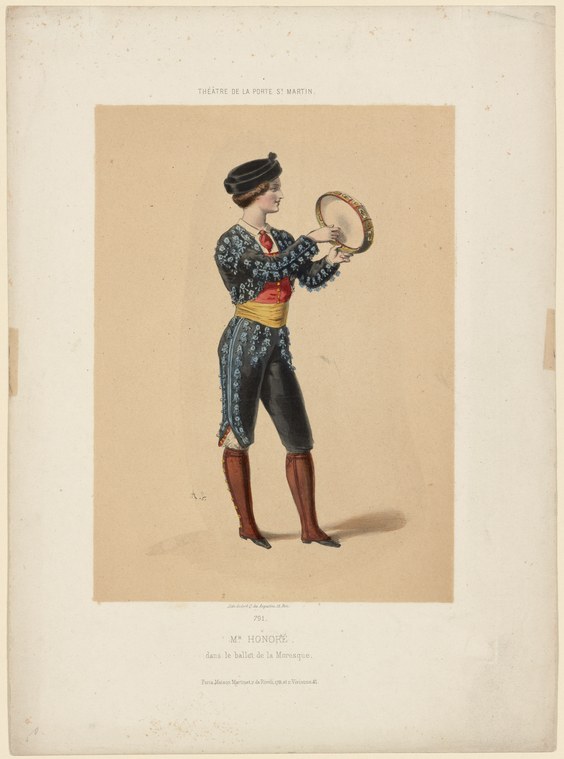
Théâtre de la Porte St. Martin. Mr. Honoré dans le ballet de la Moresque
Unknown artist
- Collection:
- Prints depicting dance
- Source:
- New York Public Library
- Rights:
- Public domain — free to use, share and adapt.
- Recorded as:
- Public Domain
This print documents the aesthetics and staging conventions of 19th-century French theatrical dance, particularly the orientalist exoticism that dominated European ballet spectacle. For dance historians, it shows how non-European imagery was appropriated, repackaged, and sold to European audiences through costume, music, and theatrical framing—a practice that shaped both the visual language of ballet and European attitudes toward non-European cultures.
What you are looking at
A single figure occupies the center of this hand-colored engraving, posed against a warm tan background. The dancer wears a richly decorated costume in jewel tones—a dark blue or teal jacket with ornate gold embroidery and red trim, worn over a red corset or belt, paired with dark blue-black breeches that extend to the knee and red boots that rise to mid-calf. A small dark cap or turban sits atop the head. The figure holds a tambourine aloft in the right hand, positioned as though about to strike or play it, while the left arm rests at the side. The pose is upright and elegant, with weight balanced evenly on both feet, the body oriented in three-quarter view facing left. The figure's expression is alert and the gaze directed outward. The overall impression is of a theatrical performer pausing in performance or standing in readiness, captured in a formal portrait mode rather than mid-movement.
The dancing
The single dancer stands in an upright, composed posture with no visible bend in the knees or weight shift—a formal presentation stance rather than an active dance position. The right arm is raised to shoulder height, hand holding the tambourine with fingers visible gripping the frame. The left arm hangs naturally at the side. The torso is straight and the head held high with an outward-gazing expression. There is no suggestion of partnering, turning, or dynamic footwork; the position reads as a formal display of costume and instrument.
The dance depicted
The title identifies this as a performer named Honoré in *Le Ballet de la Moresque* (*The Moorish Ballet*), a theatrical work staged at the Théâtre de la Porte St. Martin in Paris. The costume—jeweled jacket, red boots, turban, and especially the tambourine—are consistent with the exotic, orientalist aesthetics that dominated European theatrical dance of the 19th century. The *moresque* or "Moorish" style was a popular genre in French and European ballet, associated with spectacle, sensual movement, and non-European imagery. However, the static, portrait-like pose tells us little about the actual choreography or movement vocabulary—this is costume documentation rather than a captured moment of dance.
How it was made
This is a hand-colored engraving, identifiable by the fine parallel line work visible in the background and shadows, with watercolor or hand-applied pigment added for the costume details and skin tone. The technique of engraving allowed for sharp detail in the costume embroidery and the fine lines of the figure, while hand coloring made it reproducible with variation—a common practice for theatrical prints of the 19th century. Such prints circulated widely among theater audiences and collectors, serving both as souvenirs and as records of celebrated performers and roles. The presence of the title text below the image confirms it was a published commercial print, likely sold in Paris theater lobbies or through print shops.
About this work
This is a portrait engraving of a performer in an exotic theatrical costume, documenting a role in a Parisian ballet of the 19th century. The *Ballet de la Moresque* was part of a long European tradition of orientalist spectacle in dance, in which performers in invented "Eastern" or "Moorish" costumes enacted fantasies of adventure, sensuality, and cultural otherness. The print itself—a hand-colored engraving—was a standard medium for circulating images of celebrated dancers and roles, making it both a record of what audiences saw on stage and a commodity for popular consumption. The figure's formal, static pose reflects the conventions of actor and dancer portraiture, designed to display the costume and the performer's bearing rather than to capture movement.
How to look at it
Look at the costume first: the engraver has rendered the embroidered jacket and the contrast of fabrics with considerable care, conveying the richness and spectacle of the stage costume. The static pose and formal framing—the figure centered and frontal—reflect theater portraiture conventions; this is not a moment of action but a formal presentation of the performer and role. Notice the tambourine held aloft in the right hand, which signals both the percussive music associated with orientalist dance and the performer's readiness or invitation to the viewer. The upright posture, alert expression, and direct gaze address the viewer as an audience, reinforcing that this is a theatrical commodity made for public circulation.
The artist
The artist's name is not recorded in the catalogue. The print bears the credit "Théâtre de la Porte St. Martin," the Paris theater where the ballet was staged, and the technique and hand-coloring suggest a commercial theater print workshop of the mid-to-late 19th century, likely produced by one of several Parisian engraving and publishing houses that specialized in theatrical documentation.
The period
The 19th century saw the rise of exotic, orientalist subject matter in European ballet, fed by colonial expansion, travel narratives, and Romantic-era fascination with "otherness." The Théâtre de la Porte St. Martin was a major venue for spectacular ballet and pantomime in Paris during the second half of the 19th century. Printed portraits of dancers in costume were mass-produced commodities, similar to today's theater lobby photographs, and were collected by fans and theater-goers. The style of the costume—the jeweled jacket, the turban, the tambourine—reflects the visual language of European orientalism, which bore little relation to actual Moorish or North African dress but was designed for theatrical impact and exotic appeal.
Where it lives
This print is held in the Prints collection of the New York Public Library, which documents theatrical and performance imagery from the 19th century onward. It is a commercial, published engraving, one of numerous such prints documenting performers and roles at Parisian theaters during this period.
Dance in this work
Questions about this work
What is a 'Moorish ballet' and why were these popular in 19th-century Europe?
Orientalist ballets drew on European fascination with North Africa, the Middle East, and Asia, fueled by colonial expansion and Romantic-era taste for exotic settings and sensuality. They were a form of spectacle—expensive to produce, visually striking, and appealing to audiences hungry for travel and adventure. The actual choreography, music, and costumes bore little relation to Moorish culture; they were European inventions designed for theatrical effect. By the mid-19th century, such roles were staples of the ballet repertory in Paris, London, and across Europe.
Why does the dancer look so still and posed?
This is a costume portrait, not an action shot. Theater prints of this era were designed to display the performer's bearing and the costume in full view, so a frontal, upright stance was standard. The pose tells us about the conventions of theater portraiture and the importance of visual spectacle in 19th-century ballet, but it tells us little about what the actual choreography looked like in performance.
How were prints like this made and sold?
The image was engraved on a metal plate (a labor-intensive process), then printed in quantities. Each print was then hand-colored by assistants using watercolor, making each copy slightly different. These were sold as souvenirs in theater lobbies, through print shops, and to collectors—much like theater photographs today. They were affordable enough for fans to buy but fine enough in quality to keep as keepsakes.
More dance artwork





