49 works in this view — arrow keys or swipe to move between them.
Dance in Art
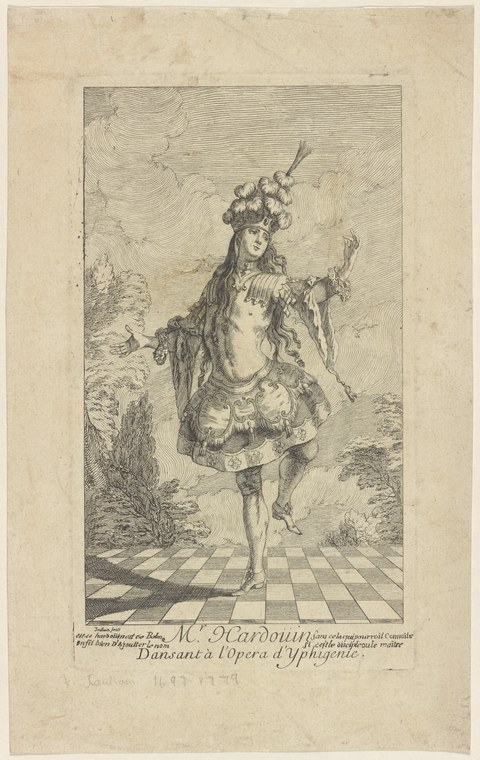
Mr. Hardouin dansant à l'Opéra d'Yphigenie
Unknown artist
- Collection:
- Prints depicting dance
- Source:
- New York Public Library
- Rights:
- Public domain — free to use, share and adapt.
- Recorded as:
- Public Domain
This engraving is a documented record of a named performer executing the physical vocabulary of French Baroque theatrical dance at a specific moment in Paris opera history. It preserves costume and bodily form that would otherwise be invisible to us—the exact silhouette, the geometry of the pose, the decorated surface of a dancer's theatrical garment. For historians reconstructing how Baroque dance actually looked in performance, images of named dancers in known roles are rare and precious.
What you are looking at
A single figure stands alone on a checkered floor within a rectangular frame, positioned slightly off-center against a background of loose, atmospheric hatching. The dancer wears an elaborate costume of the late 17th or early 18th century: a short ornamental jacket or tunic heavily decorated with embroidery or jewels, with a bare or lightly draped chest, paired with fitted breeches or tights. A elaborate headdress crowns the figure—a tall, feathered or plumed construction suggesting theatrical grandeur. The dancer's posture is animated and open, with one leg extended in a gesture suggesting movement or balance, and the arms held in an expressive, gestural frame. The floor beneath is rendered with careful perspective lines creating geometric recession. Foliage or natural elements sketch the edges of the stage space, framing this as a theatrical scene rather than an outdoor setting.
The dancing
A single male dancer in a frontal, three-quarter stance, weight appearing to rest on one leg with the other extended or raised in a buoyant attitude. The torso is held upright and open to the viewer; the arms are raised and spread in a broad, welcoming gesture typical of formal court or theatrical dance vocabulary. The posture suggests a moment of display or salutation rather than a transitional movement—a pose held for effect rather than captured mid-motion. The figure occupies the full height of the frame, emphasizing the costume and the stance as the primary visual content.
The dance depicted
This is almost certainly a depiction of an opera or theatrical dance of the period labeled as French Baroque or early 18th-century theatrical dance, performed at an opera house (the inscription mentions 'l'Opéra d'Yphigenie'—Iphigénie, likely referring to Quinault and Lully's 1674 tragédie-lyrique or a later reworking). The figure is identified as 'Mr. Hardouin,' a professional dancer known from the early 18th-century Parisian stage. The costume and pose conform to conventions of the heroic or aristocratic male dancer role in opera-ballet or tragédie-lyrique of the period, where dancing was integrated into dramatic narrative. The extended leg, open arms, and frontal presentation echo the formal vocabulary of the minuet and court dance, adapted for theatrical spectacle.
How it was made
This is an engraving or etching on paper, rendered in fine parallel lines (hatching and cross-hatching) to create tone and volume. The technique is characteristic of 17th- and early 18th-century French print culture, designed for reproduction and distribution. The clarity of line and the contained rectangular frame suggest a formal, published print, possibly from a collection documenting dancers or operatic performers. Engravings of this kind were affordable and circulated among educated audiences with interest in theater, dance, and the Paris opera; they functioned as both souvenirs of performances and records of celebrated performers and roles.
About this work
This is a formal portrait-engraving of a professional dancer in theatrical costume, recorded in action at a moment of display or salutation on the opera stage. It documents a specific dancer (Hardouin) in a specific context (the opera production of Iphigénie), capturing both the costume and the physical vocabulary of early 18th-century French theatrical dance. The work belongs to a tradition of dancer portraiture and operatic ephemera that provides rare visual evidence of how the body moved and was dressed in the tragédie-lyrique, the most prestigious theatrical form of the period. For dance historians, it offers concrete detail: the height of the headdress, the cut and decoration of the costume, the posture and arm carriage expected of a male dancer in an elite context.
How to look at it
Attend to the deliberate frontality and stillness of the pose—this is not a snapshot of motion but a formal presentation, likely capturing the moment after an action (a turn, a jump, a gesture) where the dancer holds a readable shape for the audience. The extended leg and open arms are designed to fill space and read from a distance; the posture conveys ease and aristocratic grace, not strain. The checkered floor and careful perspective ground the figure in stage space and invite the viewer to imagine the theater and the moment of performance.
The period
This engraving dates to the era of the tragédie-lyrique, the dominant form of French theatrical spectacle in the late 17th and early 18th centuries. Dancing was a structural component of these works, executed by professional dancers and integrated into the dramatic and musical narrative. The figure of the noble, male dancer in heroic or romantic roles—a peer of the sung protagonist—was a defining visual element of the form. The print's formal, portrait-like treatment of a male dancer reflects his status as a celebrated professional performer, a public figure whose appearance and virtuosity were worthy of documentation and circulation.
Where it lives
This work is part of the New York Public Library's collection of prints depicting dance, held as part of its broader prints and photographs collection. It survives as a sheet engraving, likely bound or preserved as part of a collection or album of theatrical or dance imagery.
Dance in this work
Questions about this work
Who was Mr. Hardouin?
Hardouin was a professional dancer performing in Paris, likely in the late 17th or early 18th century. Beyond his appearance in this engraving and the opera Iphigénie, detailed biographical information does not survive. Professional dancers of the period left few written records; what we know of them comes largely from printed documents like playbills, librettos, and dancer portraits such as this one.
What opera is this from?
The inscription refers to 'l'Opéra d'Yphigenie'—an opera on the theme of Iphigénia. The most famous version is Quinault and Lully's *Iphigénie en Aulide* (1674), though the theme was revisited by other composers. Without a date on the print, it is difficult to establish which version Hardouin danced in, but the costume style suggests the late 17th or early 18th century.
What is Hardouin doing in this pose?
The pose is a formal presentation stance common in court and theatrical dance of the period: upright, open to the audience, with one leg extended and the arms held in a graceful, expressive frame. It is not mid-movement but a legible, held position—the kind of pose a dancer might strike at the climax of an entrance or after executing a notable step. It conveys confidence and aristocratic ease.
Why is the costume so elaborate?
Theatrical dance at the Paris opera was an elite spectacle, closely tied to court culture and royal patronage. Dancers in heroic or romantic roles wore richly decorated costumes that signaled nobility, heroism, and magnificence. The headdress, the jeweled or embroidered tunic, and the fitted breeches all mark this as a high-status character and reflect the investment in visual grandeur that defined the tragédie-lyrique.
More dance artwork





