49 works in this view — arrow keys or swipe to move between them.
Dance in Art
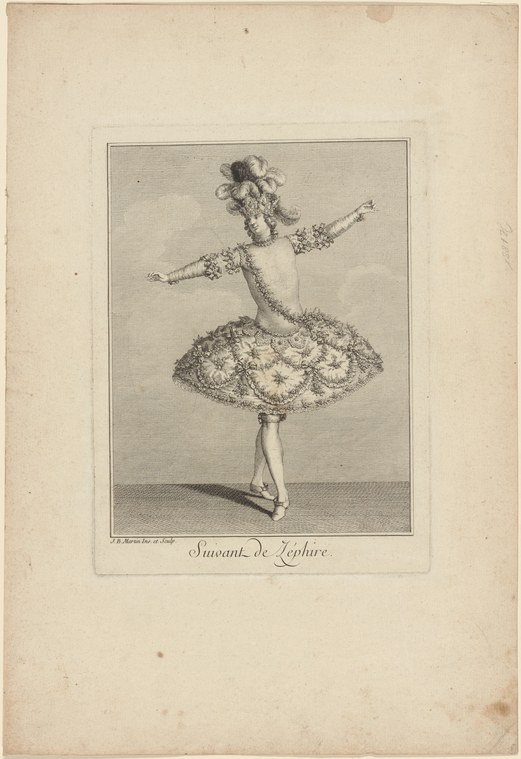
Suivant de Zéphire
Unknown artist
- Collection:
- Prints depicting dance
- Source:
- New York Public Library
- Rights:
- Public domain — free to use, share and adapt.
- Recorded as:
- Public Domain
This image is one of the few surviving visual records of baroque court dance and costume, showing how mythological and allegorical narratives were staged through elaborate dress and stylised movement. For dance historians, it offers concrete evidence of the integration of costume design, scenic fantasy, and bodily presence in a tradition where dance was inseparable from music, poetry, and visual spectacle. The work testifies to a period when dance was primarily a courtly art form understood through its narrative and decorative contexts rather than as abstract movement.
What you are looking at
A single female dancer is shown in a three-quarter pose against a neutral background, captured in a moment of suspended, theatrical movement. She wears an elaborate costume consisting of a heavily ornamented skirt composed of what appears to be layered, puffed fabric arranged in a dome or balloon shape, decorated with floral or foliate patterns. Her upper body is draped in fitted fabric, and her hair is styled up and decorated. Her arms are extended outward and upward in an expansive, expressive gesture, with her body angled slightly forward in a posture suggesting ethereal lightness or flight. She stands on one leg, the other leg extended or raised, creating a sense of buoyant movement. The engraving is rendered in fine lines with careful attention to the volumetric fabric and the dancer's elongated, graceful proportions.
The dancing
A single female dancer poses on what appears to be tiptoe or in an elevated position, creating vertical extension. Her arms frame her body in an open, welcoming attitude, extended at roughly shoulder height and slightly back. The pose conveys weightlessness and spiritual elevation rather than technical ballet vocabulary. Her costuming—the voluminous, structured skirt and fitted bodice—suggests she is meant to appear otherworldly or allegorical rather than as a creature of the earth. The overall frame is one of buoyancy and lyrical expression.
The dance depicted
The title 'Suivant de Zéphire' (Following [or in the train of] Zephyr, the West Wind in classical mythology) indicates this is an allegorical figure from the baroque or rococo theatrical tradition. The image most likely depicts a figure from a court ballet or theatrical divertissement of the 17th or early 18th century, where mythological and allegorical characters were common. The weightless, ascending pose and the ornate costume with its exaggerated skirt volume are consistent with the aerial, otherworldly characters that populated baroque court spectacles. The dance itself appears to be a stylised, presentational form rather than a social dance—theatrical in intent and mythological in subject.
How it was made
This is a finely executed engraving, rendered in line work with subtle cross-hatching to model form and create tonal depth. The technique allows precise delineation of the costume's elaborate detail—the patterning of the skirt, the ribbons and decorations, the texture of the fabric—as well as the dancer's refined proportions. Engravings of this type were typically made for circulation among the educated elite and served as a record of court spectacles or as designs for costumes and scenarios. The print's small size and portable format suggest it was intended as a collector's item or a reference document for designers and performers.
About this work
This engraving depicts an allegorical figure—Zephyr or a character in the train of the West Wind—from the baroque theatrical tradition, likely a court ballet or similar spectacle from the 17th or 18th century. The dancer embodies the weightless, ethereal qualities of air and mythology through her elevated pose, expansive gesture, and impossibly voluminous costume. The work is a document of theatrical dance as understood in the baroque period: a fusion of classical allegory, costume design, and stylised movement intended for aristocratic audiences. It belongs in a gallery of dance art as a record of how dance was conceived, costumed, and choreographed in the age of Louis XIV and his successors—not as technical virtuosity but as embodied spectacle and narrative.
How to look at it
Observe the deliberate artificiality of the pose: this is not a moment captured from a social dance but a carefully composed, almost sculptural presentation of a mythological idea. The artist has frozen the dancer at the moment of weightless ascent, with the skirt arranged to suggest flight or suspension in air. The engraving technique allows the viewer to read every detail of the costume—the patterning, the structure, the decorative elements—which were as much a part of the choreographic spectacle as the body itself. The work asks you to understand dance as a fusion of design, theatricality, and movement, rather than as pure physical virtuosity.
The artist
The engraver's identity is not recorded, but the style and subject matter are consistent with the tradition of dance and theatre documentation in 17th- and 18th-century France. Such prints were often commissioned to commemorate court spectacles or to serve as designs for future productions. The artist demonstrates technical skill in the rendering of fabric, proportion, and the suggestion of movement within the constraints of static line work.
The period
This work belongs to the age of Louis XIV and the baroque court, when dance was one of the primary arts of courtly display. Ballet at this period was a spectacle involving elaborate scenery, music, poetry, and costuming, with narrative drawn from classical mythology and allegory. Dance was performed by courtiers and professional dancers as part of larger theatrical productions. The engraving format was central to the circulation of designs, descriptions, and images of these spectacles among the European elite. By the 18th century, such documents became valued as records of a fading courtly tradition, even as theatrical dance evolved toward the romantic ballet of the 19th century.
Where it lives
This engraving is held in the New York Public Library's collection of prints depicting dance. Such prints were typically created in series and distributed among courts and collectors, serving as both documents and designs for future performances.
Dance in this work
Questions about this work
Who was Zephyr and why would a dancer embody this figure?
Zephyr is the West Wind in Greco-Roman mythology, associated with gentleness, movement, and the arrival of spring. In baroque court spectacles, classical deities and allegorical figures were common subjects, allowing dancers and designers to create otherworldly characters. The costume and pose here deliberately suggest weightlessness and ethereal presence to evoke the wind itself embodied as a dancer.
What is the large, dome-shaped skirt, and how did dancers move in it?
This is a pannered or hoop skirt, typical of baroque and rococo court dress. The structure was achieved through frameworks of bone or wood sewn into the fabric. Dancers in such costumes could not move with the legwork and elevation that became common in later ballet; instead, movement was primarily from the waist up, creating the illusion of floating or gliding. The skirt's volume made it a visual spectacle in itself.
Is this ballet?
This predates classical ballet as we know it. It is baroque court dance or theatrical spectacle—a form where narrative, music, poetry, and visual design were integrated with movement. Ballet as a codified technique with a vocabulary of steps and positions was just beginning to emerge in this period. What matters here is the theatrical and allegorical character of the dance, not technical vocabulary.
More dance artwork





