49 works in this view — arrow keys or swipe to move between them.
Dance in Art
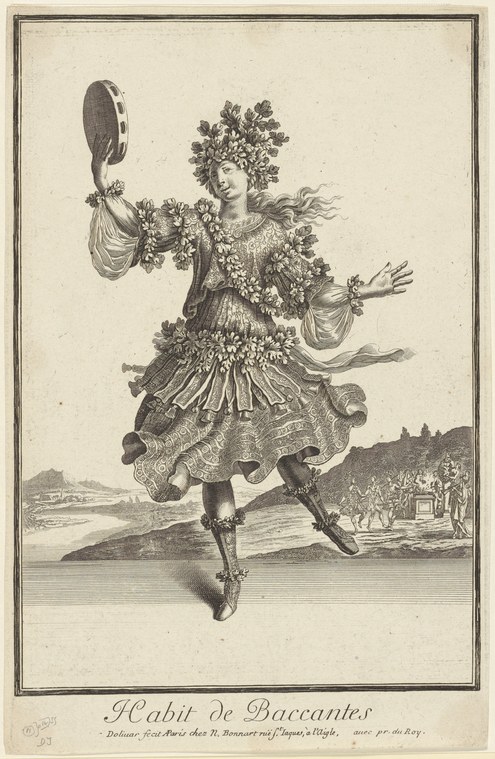
Habit de baccantes: Dolivar fecit.
Unknown artist
- Collection:
- Prints depicting dance
- Source:
- New York Public Library
- Rights:
- Public domain — free to use, share and adapt.
- Recorded as:
- Public Domain
Bacchanal imagery is central to how early modern Europe imagined dance itself—as ecstatic, transgressive, and fundamentally different from the orderly social dances of the ballroom. This print gives us a concrete record of how a theatrical bacchant was actually dressed and posed, offering rare evidence of the movement quality and visual spectacle of court and stage dance. The engraving also shows the influence of classical sources (Roman maenads, Dionysian mystery cults) on how Europeans choreographed and visualized dance.
What you are looking at
A single female figure dominates the composition, posed in a dynamic leap or bound across a shallow river landscape. She wears an elaborate costume of classical inspiration: a fitted bodice densely embroidered or patterned, a voluminous skirt with deep pleats and scalloped hem in motion, and draped sleeves. Her headdress is a crown of vine leaves or ivy. She holds a tambourine aloft in her right hand, and her left arm extends outward for balance. The pose is one of weightless suspension—her feet barely touch the ground, and her body arches with kinetic energy. In the middle distance, on the far bank, a small procession or gathering of figures can be seen, suggesting a ritual or celebratory context. The engraving employs fine hatching and cross-hatching to model form and create atmospheric depth; the figure stands out against a lighter sky and landscape rendered in delicate parallel lines.
The dancing
The dancer's body is twisted in mid-leap, with the torso lifted and the hips thrust forward in a posture of exultation. Both legs appear to be off the ground, with the body weight distributed through the momentum of the jump rather than supported by contact. The right arm is raised high, the wrist bent to display the tambourine; the left arm is extended horizontally. The head turns slightly upward, face in profile, chin lifted. The overall frame is one of abandon and ecstatic movement—the costume and headdress amplify the sense of ritual or theatrical display rather than social partner dancing.
The dance depicted
This is almost certainly a *bacchanal*—a riotous, ecstatic dance associated with Dionysus and the maenads or bacchants of classical mythology. The inscription confirms this: *Habit de Baccantes* names the figure as a bacchant (female follower of Dionysus). The tambourine, the ivy crown, the wild leap, and the river setting are all standard attributes of Bacchic imagery in European art. Bacchanals were performed in the theatre and in court masques from the Renaissance onward, and this print likely depicts a theatrical or courtly interpretation of classical Bacchic revels. The pose captures the moment of ecstatic trance or frenzied joy that bacchants were imagined to embody.
How it was made
This is an engraving (the inscription attributes it to 'Dolivar fecit'—Dolivar made this). The fine, controlled hatching and the precision of the line work are characteristic of the engraver's burin rather than an etcher's needle. Engravings of this type, showing costume designs or theatrical figures in isolation against minimal landscape, were common in the 17th and 18th centuries; they circulated as prints for collectors, theatre practitioners, and the educated public. The technique allowed for sharp detail and fine tonal gradation, making the costume ornament and the movement of the fabric legible at a distance.
About this work
This is an engraved *costume print* depicting a bacchant—a figure from classical mythology and from theatrical tradition. The bacchant was a stock character in court ballets, opera, and masque performances across Europe, particularly in France and Italy from the 1600s onward. The print shows the idealized costume and the characteristic movement vocabulary of the role: ecstatic, unbound, possessed by divine fury. The figure leaps across a river in a pose of joyful abandon, her body twisted and weightless, her face tilted toward the sky. Such prints served as records of court spectacle, as designs for costume makers, and as visual models for dancers learning the part. The work belongs to a larger tradition of engraved costume documentation that stretches from the Renaissance through the 18th century.
How to look at it
Attend to the moment the engraver chose to fix: not a moment of stability or rest, but the apex of a leap, when the dancer's weight is entirely suspended and the costume floats around the body. The artist has exaggerated the dynamism of the pose—the twist of the torso, the reach of the arms, the lift of the face—to convey ecstatic movement rather than naturalistic human anatomy. The tambourine, held high and visible, is both an attribute of the bacchant and a device for catching light and drawing the eye upward. The landscape recedes almost to nothing; the figure and the costume are the subject.
The artist
The engraver is identified only as 'Dolivar' in the inscription. Without further research, nothing more can be said with confidence. Costume prints of this type were often produced by minor or anonymous printmakers working for theatre companies, court establishments, or print publishers. The name may be a signature or a workshop attribution.
The period
The style of the engraving—the fineness of the line work, the format of the inscription, the costume vocabulary—suggests a date in the 17th or early 18th century. This was the golden age of court ballet in France and Italy, when allegorical and mythological dances were central to aristocratic culture. The bacchant was a popular character type in these spectacles, embodying themes of divine possession, sensuality, and the wild forces of nature. At the same time, engravings and etchings of theatrical costume were beginning to circulate as a distinct category of print, documenting and disseminating knowledge of dance and performance.
Where it lives
The work is part of the NYPL's collection of prints depicting dance. The print appears to be an original engraving or an early impression, though without handling it is difficult to be certain. Such prints were commonly bound into collections or albums during the 18th and 19th centuries.
Dance in this work
Questions about this work
What is a bacchant and why does she leap like that?
A bacchant (or maenad) was a female follower of Dionysus in Greek and Roman mythology, imagined to be possessed by divine madness or ecstatic frenzy. In theatrical and courtly dance, the bacchant was a character type used to depict wild, transgressive, or divinely inspired movement—the opposite of the controlled, geometric dances of the ballroom. The leap captures that state of ecstatic possession: the body is weightless, the movement is violent and unrestrained, and the dancer is imagined to be not in control of herself but seized by the god.
Is this a real dance or just a mythological fantasy?
Both. Bacchanals were performed as theatre and as court dances, with choreography, music, and costumes designed to evoke (and often to exaggerate) the classical image. Dancers trained in these roles and learned specific movement vocabularies. However, the actual movement was constrained by the costumes, the music, and the conventions of courtly decorum—the print shows an idealized or heightened version of what the dance actually looked like. The image is a fantasy of classical antiquity, but it documents a real theatrical practice.
Who would have seen this print?
Costume prints like this circulated among theatre practitioners, dancers, costume makers, and educated collectors. They might have been sold individually or bound into albums. A dancer learning the role of a bacchant could use the print as a reference for costume and pose. A theatre patron or aristocrat could collect it as a record of a court spectacle they had seen or heard about. Prints also served as a form of publicity or documentation for the institutions that commissioned them.
More dance artwork





