49 works in this view — arrow keys or swipe to move between them.
Dance in Art
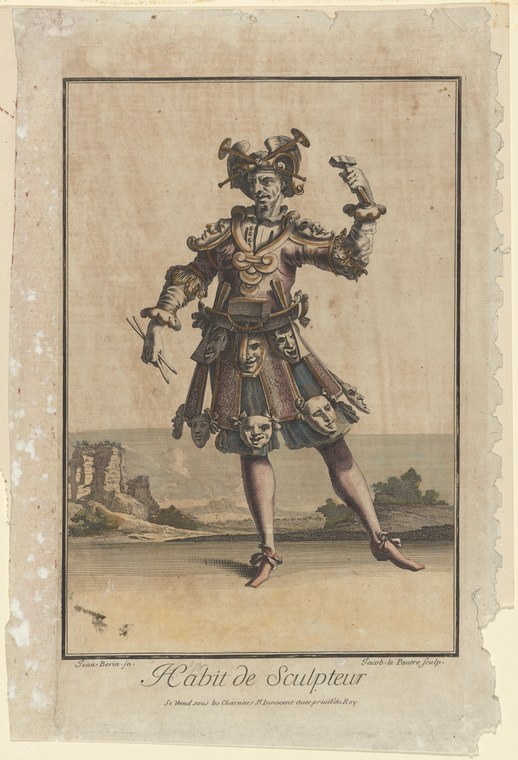
Habit de sculpteur
Unknown artist
- Collection:
- Prints depicting dance
- Source:
- New York Public Library
- Rights:
- Public domain — free to use, share and adapt.
- Recorded as:
- Public Domain
This print preserves a visual record of how a specific theatrical role—the Sculptor—was embodied in costume and pose, showing what court audiences saw and what performers wore. It demonstrates that baroque theatrical spectacle fused dance with elaborate costume design, heraldic presentation, and allegorical character, and that these moments were considered significant enough to engrave and distribute as prints.
What you are looking at
A single figure dominates this engraving, standing in contrapposto against a distant landscape with classical ruins and water. The dancer wears an elaborate costume: a decorative armor-like breastplate adorned with faces and ornamental details, a short pleated skirt, and what appears to be winged or feathered shoulder pieces. The figure's head is crowned with an elaborate headdress featuring multiple projecting elements—horns or plumes. In the raised right hand is a sculptural tool or mallet; the left arm is extended outward. The figure's pose is theatrical and exaggerated, with weight shifted onto one leg in a pronounced contrapposto stance. The engraving is finely executed with careful hatching to model form and suggest the texture of fabric and metal. The title *Habit de Sculpteur* (Sculptor's Costume) and a caption below identify this as a costume design, likely for a theatrical character or ballet.
The dancing
A single standing figure in a strongly asymmetrical pose: weight on the back leg, chest rotated, arms at dramatically different heights and angles. The right arm raises a tool or implement; the left extends outward at shoulder height. The head is tilted upward and back, gazing toward the raised hand. The posture suggests neither balletic alignment nor narrative naturalism, but rather a heraldic or emblematic presentation—the body angled to display the elaborate costume from multiple aspects simultaneously. This is a figure composed for visual spectacle rather than movement.
The dance depicted
The inscription identifies this as a costume—a *habit*—and the figure depicted appears to be a character or dancer costumed as a sculptor, or possibly an allegorical personification of Sculpture itself. The theatrical pose and elaborate dress suggest this is a design for a court ballet or similar theatrical spectacle, likely from the 17th or early 18th century when such costume prints circulated as records of celebrated performers and roles. The exaggerated contrapposto and the heraldic presentation of the figure indicate a courtly, formalized mode of movement rather than naturalistic dance, consistent with the conventions of ballet de cour.
How it was made
This is a finely executed engraving, likely created from a drawing or painting and printed on laid paper. The technique allows precise rendering of the costume's complex details—the armor, the feathered headdress, the tool—and demonstrates the sculptor's careful attention to both form and ornament. Engravings of this type were produced and circulated as prints, making them accessible to artists, designers, and patrons beyond the court. They served as records of celebrated costumes and roles, and as reference material for designers and performers.
About this work
This engraving documents a character costume from court theatrical practice, most likely from the baroque period. The figure presents an allegorical or character role—a dancer-performer costumed as a sculptor—in the mannered, heraldic style typical of 17th-century court spectacle. The inscription and the precision of the engraving suggest this was a documented role, preserved as a print for circulation among artists and patrons. The image belongs in a gallery of dance art because it records how dance was costumed, performed, and conceptualized in a courtly context where elaborate costume design was inseparable from choreography and character.
How to look at it
Attend to the deliberately composed, heraldic quality of the pose: the figure is not captured mid-movement but presented frontally and symmetrically (despite the contrapposto), arranged to display the costume from a viewing distance. The raised arm with the tool and the tilted head are theatrical gestures designed to catch light and emphasize the character's identity. The distant landscape setting grounds the figure in a courtly space. The precision of the engraving—the fine hatching, the careful rendering of costume details—indicates that this is a document made to circulate and to be studied, not a spontaneous record of performance.
The artist
The engraving is attributed to artists identified by signatures at bottom left ("Chauveau fecit" is likely) and bottom right ("Berain le Brunne fecit"), suggesting this may be based on a design by Jean Bérain (1637–1711), the celebrated French designer of court spectacles and ballets for Louis XIV, or a member of his workshop. If so, this would be a record of costume from the highest level of court theatrical production. The signatures and print format indicate professional printmakers and designers working within the established market for such documentation.
The period
This print likely dates to the late 17th or early 18th century, the era of the most elaborate and documented court ballets in France. During this period, the ballet de cour was a central form of courtly spectacle, incorporating dance, music, elaborate costume, and allegorical narrative. Costume prints like this one were a recognized genre, circulated among patrons, artists, and performers as records of celebrated roles and as inspiration for future designs. The allegorical subject—a dancer costumed as Sculpture, one of the liberal arts—reflects the intellectual and emblematic framework of court spectacle, where dancers embodied abstract virtues and artistic disciplines.
Where it lives
This print is held in the New York Public Library's collection of prints depicting dance. It is an example of the seventeenth-century print trade in theatrical and costume documentation, likely produced in France and distributed among patrons and practitioners of court spectacle.
Dance in this work
Questions about this work
What does 'Habit de Sculpteur' mean, and what was this costume for?
Habit means "costume" or "dress." This appears to be a design for a character role—a dancer costumed as the allegorical figure of Sculpture—likely created for a court ballet or court spectacle. Such characters representing arts, sciences, and virtues were common subjects in baroque theatrical entertainment. The costume itself—with armor, tools, and an elaborate headdress—visually embodies the concept of Sculpture through ornament and symbolic objects.
Who made this print and when?
The signatures at the bottom suggest attribution to Jean Bérain or a workshop member, and to Chauveau as engraver, but the exact dating and attribution cannot be confirmed from the image alone. Based on the style and costume, it likely dates to the late 17th or early 18th century, the era of the most celebrated and best-documented French court ballets. The print would have been made after an original design, engraved for circulation.
How did dancers move in these costumes?
The costume is heavy and ornate—designed for spectacle rather than technical virtuosity. The pose shown here is a static, heraldic presentation rather than a movement captured mid-action. Dancers in such costumes would have moved with controlled, formal dignity, emphasizing grands ports de bras and turning presentations of the body to display the costume and headdress, as was typical of court ballet and court dance.
Why was this costume print preserved and circulated?
Such prints documented celebrated roles, celebrated performers, and the costume designs of master designers like Bérain. They circulated among patrons, future performers, and artists as records of what had been created and as inspiration for future productions. They were part of the professional and artistic infrastructure of court spectacle, much as production photographs are today.
More dance artwork





