49 works in this view — arrow keys or swipe to move between them.
Dance in Art
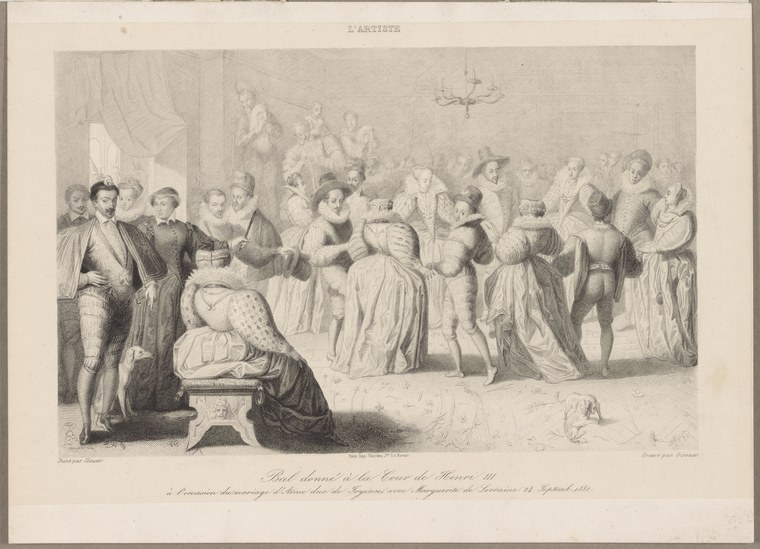
Bal donné à la cour de Henri III à l'occasion du mariage d'Anne duc de Joyeuse avec Marguerite de Lorraine, 24 Septemb. 1581
Unknown artist
- Collection:
- Prints depicting dance
- Source:
- New York Public Library
- Rights:
- Public domain — free to use, share and adapt.
- Recorded as:
- Public Domain
Court balls were the primary context for dancing among the European nobility in the Renaissance, yet few images capture the full scale and social organization of such occasions. This engraving documents not just the dances themselves but the ceremony, the hierarchy, and the participation of both sexes in formal movement within the palatial court setting—essential evidence for understanding how dance functioned as political and social display.
What you are looking at
A grand court ball in progress, with figures arranged across a high, columned interior space lit by a suspended chandelier. At center, couples and groups engage in formal dance and courtly interaction; in the foreground left, a figure in masculine courtly dress (short breeches, puffed sleeves) stands prominently. Women wear the voluminous skirts and fitted bodices of late 16th-century court fashion, many with the broad skirts that characterize the period. To the left, a seated female figure in dark drapery bends forward observing the scene. The crowd fills the space in a loose, processional arrangement rather than a tight formation, with figures standing, conversing, and moving in various attitudes of formal sociability. The composition emphasizes the hierarchical grandeur of the occasion: the high ceiling, the orderly (if animated) crowd, and the measured spacing of the figures all suggest a ceremonial moment of state.
The dancing
The bodies are upright and formal throughout, maintaining the erect carriage required by court fashion and etiquette. Arms are held at moderate distances from the body, and the stance is frontal or three-quarter; no figures are deeply bent or in extreme extension. The nearest couples show minimal physical contact—hands may touch but the overall frame is open and restrained, consistent with court dance of the period. Most figures are standing or in slow walking motion rather than in dynamic steps. The weight appears centered and controlled, with no indication of the balletic leg extension or lift that would emerge a century later.
The dance depicted
This depicts a formal court ball of the late Renaissance, most likely a ballo—the Italian court dance that dominated noble gatherings in the 16th century. The title specifies this as a wedding feast ball (1581), the most prestigious occasion for such ceremony. The ballo is characterized by processional and geometric group formations, stately pavane-like opening sequences, and organized couple dances performed in turn before the assembled court. The image captures not a single choreographed moment but the general activity of the ball: the circulation of dancers, the watching, the formal greeting, the measured movement through space. The restrained posture and open formations confirm the social and courtly nature of the dance rather than any athletic or theatrical display.
How it was made
This is an engraving, identifiable by the parallel line hatching used to create tone and shadow, the fine incised line quality, and the monochrome appearance characteristic of 16th- and 17th-century print reproduction. As an engraving, it was produced from a plate and could be printed multiple times, making it accessible to a wider educated audience than a painting—ideal for circulating images of court spectacle to nobles and courtiers across Europe. The technique required precise draftsmanship and the ability to suggest three-dimensional space and rich fabrics through line alone. The inscription in French below the image suggests this was made for a French-reading elite audience, likely issued as a broadsheet or included in a printed account of the wedding celebration.
About this work
This is a documentary engraving of a royal court ball held in 1581 to celebrate the wedding of the Duke of Joyeuse and Marguerite of Lorraine. It records the formal dances, dress, and ceremonial order of one of the most elaborate court spectacles of the Renaissance. The image serves as both a visual record of how court dancing was organized and a prestige document, intended to circulate images of royal magnificence among the nobility and educated classes. For the history of social and court dance, it provides rare evidence of the actual arrangement, scale, and mixed-gender participation in Renaissance ball culture.
How to look at it
Attend to the physical restraint: there is no bending of the knees, no lifting, no extension of the limbs that would later characterize theatrical dance. The bodies move with deliberate formality, and the space between dancers is significant—proximity was regulated by rank and gender. Notice too the dominance of the voluminous skirts, which governed the range of movement women could perform and made the ball as much a display of luxury fabric as of bodily skill. The engraver has chosen to show the moment not at its visual climax but in the sustained, processional activity of the ball itself—the circulation, the conversation, the measured rhythm of high ceremony.
The artist
The artist is not recorded in the catalogue. The work is attributed only to the engraver's hand visible in the technique and style. The composition and subject matter suggest it was made by a court artist or a specialized printmaker working from a court drawing or description, possibly in the immediate aftermath of the 1581 celebration, as such commemorative prints were typically issued to mark major state occasions.
The period
The 1580s were the height of the Renaissance court spectacle in France, particularly under the influence of Catherine de' Medici, who imported Italian court dance practice and elaborate ball choreography. This was the era of the ballo and the emerging ballet de cour, in which dance was becoming formalized, documented, and bound to court ideology. The wedding of 1581 was itself a famous event, one of the most lavishly celebrated of the century, and multiple accounts and images were commissioned to commemorate it. Court dancing at this time was strictly hierarchical, morally codified, and inseparable from fashion, music, and the display of noble virtue.
Where it lives
The work is held in the New York Public Library's collection of prints depicting dance. It was likely issued as a broadsheet or included in a printed account of the 1581 wedding celebration, making it a public commemorative document rather than a unique work.
Dance in this work
Questions about this work
What was a ballo?
The ballo was the dominant form of aristocratic couple dance in Renaissance Italy and France, characterized by a combination of walking steps, geometric formations, and stylized gestures performed to instrumental music. It was formal, hierarchical, and served primarily as a display of grace, breeding, and obedience to social order. Ballos were the main event at court balls and were often danced in a sequence, with different couples or groups taking turns.
Why would anyone commission an engraving of a ball?
Court balls were not merely social events but state ceremonies that displayed the power, wealth, and cultural refinement of the ruler. Commissioning an engraving to circulate images of the event extended that prestige beyond those who attended, allowing nobles and distant courts to witness and honor the occasion. Such prints were gifts, diplomatic statements, and records of magnificence.
How is this different from later court dancing?
The restrained posture, minimal contact between dancers, and emphasis on processional geometry here contrast sharply with the more athletic and theatrical ballet de cour that emerged in the early 17th century. By the 1600s, court dance incorporated higher legs, more visible technique, and narrative elements. This 1581 image shows an earlier, more austere model of courtly movement.
More dance artwork





