49 works in this view — arrow keys or swipe to move between them.
Dance in Art
A lively idea
Unknown artist
- Collection:
- Prints depicting dance
- Source:
- New York Public Library
- Rights:
- Public domain — free to use, share and adapt.
- Recorded as:
- Public Domain
This print documents a pivotal moment in the history of social dance—the rise of close partnering and the waltz—and shows how the public understood dancing as a site of transgression and desire. For historians of dance and gender, it is evidence of how intimate movement was celebrated, anxiously debated, and ultimately normalized in early 19th-century society.
What you are looking at
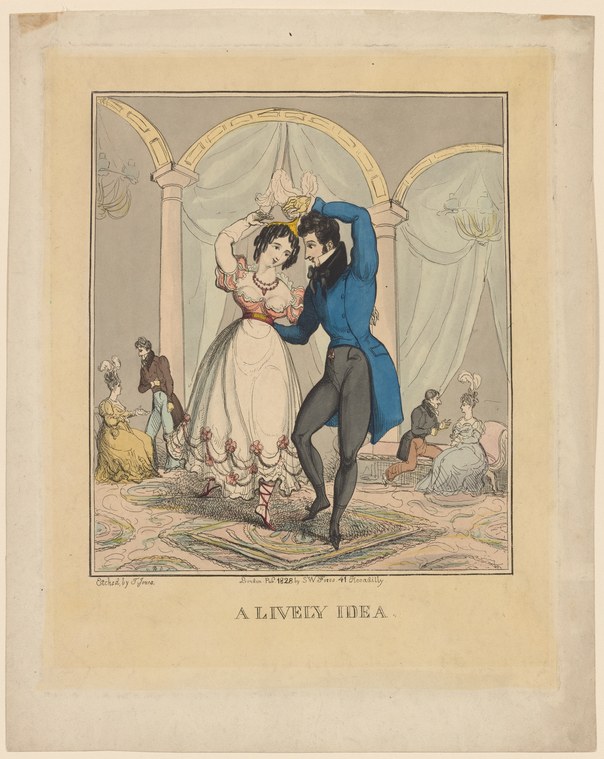
A young couple dominates the center of an elegant interior, caught mid-dance in an intimate moment. The man, dressed in a blue coat and dark breeches, leans toward the woman in a white muslin gown with a deep pink fichu around her shoulders; he appears to kiss or nuzzle her neck while she tilts her head back with an expression of delighted surrender. The setting is a neoclassical room with tall fluted columns supporting graceful arches draped in pale fabric, their folds precisely rendered. To either side, other figures—some seated, some standing in conversation—populate the background in softer focus, suggesting a ball or assembly. The floor is scattered with flowers. The hand-colored engraving employs warm tones: the flesh of the dancers glows against the cooler grays and whites of the architecture, while the woman's pink shawl and the man's blue coat are the only bright accent colors. The lighting is even and decorative rather than naturalistic, typical of the period's satirical or anecdotal prints.
The dancing
The couple are upright and mobile rather than in a closed ballroom hold; the man's posture is bent slightly forward from the hips, his right arm raised around the woman's shoulder, his left hand at her waist. The woman stands with her weight supported, her left arm extended, her right elbow bent, her face turned away from the viewer. Their bodies are in contact but the frame is open and informal—this is a stolen moment rather than a structured dance position. The fluidity of their movement and the absence of rigid partnering suggests social dancing of the late 18th century rather than a formal cotillion or minuet.
The dance depicted
This appears to be a work depicting social courtship dancing of the Regency or late Georgian era, likely a waltz or a country dance in its most flirtatious moment. The title 'A Lively Idea' suggests a print intended to capture the spirit and impropriety (by the standards of the time) of intimate dancing rather than to document a specific dance type. The image emphasizes the sensuality of close contact and the woman's apparent pleasure, making this as much a comment on romantic manners and gender relations as a record of choreography. The absence of musicians or visible musical instruments suggests the focus is on the emotional rather than the technical or social aspects of the dance.
How it was made
This is a hand-colored engraving, identifiable by the fine parallel lines used to model form and shadow, the precision of the architectural detail, and the quality of the impressions. The coloring is applied by hand in watercolor or similar medium over the printed line work. The technique allowed for rapid production and wide circulation of topical prints, particularly satirical or sentimental scenes aimed at the middle-class and upper-class market. The presence of a text plate (visible but not fully legible in this image) indicates this was a commercial print, likely published as a standalone sheet or in a series, and the hand-coloring suggests it was purchased by someone with means.
About this work
This hand-colored engraving captures a moment of courtship dancing in the late 18th or early 19th century, when close partnering and physical intimacy in social dance were becoming fashionable and controversial. The print emphasizes the emotional and romantic dimensions of dance rather than its technical or social structure, using the neoclassical interior setting to frame an intimate moment. The work belongs to a large body of satirical and sentimental prints that commented on manners, fashion, and gender relations of the Regency era, and it shows how dance was understood as a primary vehicle for flirtation and social display.
How to look at it
Attend to the man's forward lean and the tilt of the woman's head: the artist has chosen not the moment of active turning or stepping, but the moment of proximity and affection, suggesting a pause or a sway rather than a step. The architectural frame—the columns, arches, and drapes—creates a stage-like enclosure for the couple, isolating them from the background figures and emphasizing the intensity of their interaction. The title 'A Lively Idea' may be ironic: the 'idea' of liveliness is conveyed not through vigorous movement but through the energy and intimacy of the pose.
The period
The print dates to the Regency era or the decades immediately before or after, when the waltz and other continental dances were beginning to displace the formal English country dance and cotillion in fashionable society. The waltz's close hold and rapid turning motion shocked conservative observers and delighted younger dancers. Contemporary texts—novels, conduct books, satirical prints—repeatedly comment on the impropriety and excitement of dancing so near a partner, and caricaturists often exaggerated the physical contact for comic or moral effect. The neoclassical architectural setting reflects the taste of the period, as does the high-waisted muslin gown worn by the woman, a silhouette associated with the 1790s–1810s.
Where it lives
The work is held in the New York Public Library's Prints collection, catalogued under 'Prints depicting dance.' It is a commercial hand-colored engraving of the type widely distributed in Britain and Europe during the Regency period, serving both as a satirical commentary on fashion and as a souvenir or gift.
Dance in this work
Questions about this work
Is this the waltz?
Almost certainly a representation of the waltz or a similar close-contact dance of the late 18th or early 19th century. The closeness of the partners, the man's arm around the woman's shoulder, and the informal setting all suggest the waltz rather than the formal country dances that dominated earlier in the century. The print does not show active turning or footwork, so the specific choreography cannot be determined.
Why are they kissing?
The man appears to be nuzzling or kissing the woman's neck, which was a daring and controversial aspect of close-contact dancing in the period. This exaggeration was typical of satirical prints, which often amplified the physical closeness and intimacy of fashionable dances to comment on changing manners and morality.
Who made this print?
The artist is not recorded in the catalogue. The print was a commercial product, likely published in London or another British center of print production. Many such prints were issued anonymously or under a publisher's name rather than an artist's signature.
What does 'A Lively Idea' mean?
The title is likely ironic or witty: it refers to the notion or concept of liveliness—the spirit and vitality of youth and courtship—rather than to vigorous choreography. The 'idea' is captured in the emotional and physical closeness of the couple rather than in the mechanics of the dance.
More dance artwork





