49 works in this view — arrow keys or swipe to move between them.
Dance in Art
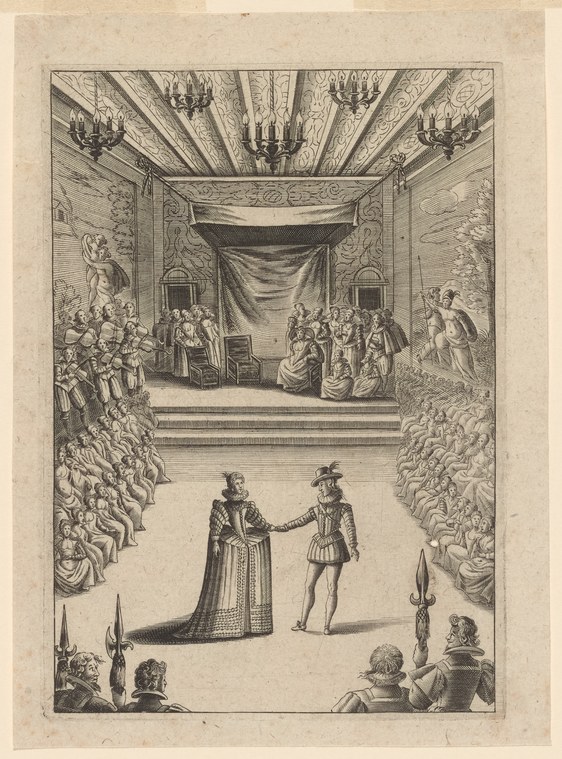
Louis XIII dansant au Louvre avec Anne d'Autriche
Unknown artist
- Collection:
- Prints depicting dance
- Source:
- New York Public Library
- Rights:
- Public domain — free to use, share and adapt.
- Recorded as:
- Public Domain
Court ballet was inseparable from royal ceremony and politics in 17th-century France; this image shows the architectural and social setting in which that dance occurred, and the formal protocol that structured it. For historians of dance, costume, and court culture, the engraving is valuable not for showing choreography—it does not—but for documenting the scale, the costumes, the audience arrangement, and the relationship between dance and ritual in the ancien régime.
What you are looking at
A grand interior hall, viewed in perspective from a high vantage point, shows an assembly of courtiers arranged in two dense groups flanking the sides of the space. The ceiling features ornate coffered decoration with hanging candelabra. At the far end, a raised stage or dais holds a small group of figures beneath a draped canopy. In the foreground, two figures dominate the composition: a woman in an elaborate gown with a long train, her garment heavily patterned and richly detailed, stands with a man in fitted doublet and hose who gestures toward her in address or invitation. A polearm and what appears to be a military standard are visible in the immediate foreground, suggesting court ceremony. The engraving's linear perspective and dense cross-hatching create a sense of ceremonial formality and controlled space.
The dancing
Two central figures occupy the foreground in what appears to be a formal introduction or opening gesture rather than an active dance. The woman's posture is upright and frontal, her train extended behind her; the man stands at a slight angle, one arm raised in a gesture of address or presentation. Neither figure shows the bent knees, lifted carriage, or dynamic weight shift characteristic of active dance movement. Their separation and formal positioning suggest either the beginning of a dance, a ceremonial greeting preceding it, or a representational moment chosen for heraldic rather than kinetic interest.
The dance depicted
The title identifies this as Louis XIII dancing at the Louvre with Anne d'Autriche, placing it within the court ballet tradition of early 17th-century France. However, the image itself does not show active dance: the foreground figures are stationary, posed in formal greeting. The dense crowd of courtiers in the background—some standing, some possibly seated—suggests the assembly of an aristocratic entertainment rather than a moment of vigorous movement. If this represents a dance at all, it captures either the formal procession or opening ceremony before the dance proper began, a moment when courtiers were arranged and introduced before the actual choreography commenced.
How it was made
This is an engraving, established from the image by its characteristic parallel hatching lines, black line on white ground, and the fine linear detail throughout. The technique allows precise rendering of costume, architectural setting, and the arrangement of many figures in deep space—ideal for documenting court ceremony. The print format and careful composition suggest this was a commemorative work, likely produced after the event for distribution among courtiers or for the royal archive, a common practice for documenting significant court entertainments in the 17th century.
About this work
This engraving depicts a moment of formal ceremony at the court of Louis XIII, identified in the title as a dance or ballet at the Louvre. The composition captures not the dance itself but the processional or ceremonial arrangement that preceded it—a scene of royal presentation in which the king and queen (or a queen or noblewoman) are formally introduced to an assembled court. The work is a documentary image of courtly ritual, using the conventions of linear perspective and dense figuration to emphasize the grandeur and formality of the occasion. It belongs in a dance history collection as evidence of how court ballet was framed within broader ceremonial life, and as a record of the setting and social context in which early French court dance took place.
How to look at it
Attend to the composition: the foreground figures are posed for presentation, not caught mid-movement. Note how the artist uses perspective to emphasize the scale of the hall and the number of assembled courtiers—the point is ceremony and hierarchy, not choreography. The detailed costume and the formal gesture are the focus; the actual dance, if it occurs, is not the subject of this image. The engraving's purpose is to document the event as a monument to court splendor, not to analyze or celebrate the dance technique.
The artist
The artist is not recorded. The work appears to be an anonymous commemorative engraving of the type produced for major court events. The careful architectural rendering, perspective construction, and attention to heraldic detail suggest a professional print workshop, likely active in Paris in the early-to-mid 17th century.
The period
This engraving dates to an era when court ballet in France was at its height of political and artistic significance. Under Louis XIII and Cardinal Richelieu, ballet de cour served as spectacle, political theater, and a tool of royal authority. These events were frequently documented in prints, which circulated among the nobility and served as records of courtly magnificence. The careful staging and architectural grandeur visible here reflect the importance of such entertainments to the projection of royal power and the maintenance of court hierarchy.
Where it lives
The work is held in the New York Public Library's collection of prints depicting dance. The catalogue record provides no date, artist attribution, or technical details beyond the title and collection designation.
Dance in this work
Questions about this work
Is this engraving showing an actual dance?
Not the choreography itself. The foreground figures are in a formal pose of introduction or address, not executing dance steps. The image likely captures the moment before or after the dance proper, or the ceremonial opening of the event. For court ballet, such processional and formal moments were part of the entertainment and had symbolic importance.
Who danced in court ballet like this?
The king and nobility, including queens and ladies of the court. Louis XIII was an accomplished dancer and participated in ballet de cour throughout his reign. These were not performances by professional dancers but participatory events in which courtiers' rank and grace were on display. The audience and performers were often the same people.
What style of dance was court ballet?
Court ballet combined elements of Renaissance dance (stately, linear, symmetrical) with increasingly complex geometry and theatrical spectacle. It was performed in indoor halls, in rich costume, and often to live music. By the mid-17th century, it was evolving toward the codified technique that would become ballet proper, though it remained rooted in courtly manners and aristocratic decorum.
Why is this at the Louvre?
The Louvre was a primary royal residence and the site of significant court ceremonies and entertainments, particularly during the reigns of Louis XIII and Louis XIV. Court ballets were frequently staged in its great halls; this engraving commemorates one such event.
More dance artwork





