49 works in this view — arrow keys or swipe to move between them.
Dance in Art
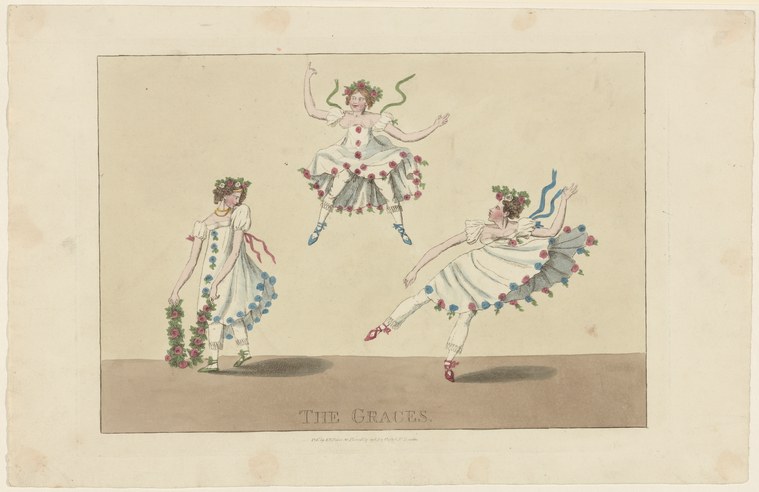
The Graces
Unknown artist
- Collection:
- Prints depicting dance
- Source:
- New York Public Library
- Rights:
- Public domain — free to use, share and adapt.
- Recorded as:
- Public Domain
This image is a rare documentary record of how neoclassical allegory was performed through the dancing body in the late 18th century—a period when ballet was becoming a primary medium for visual storytelling. It shows that the Graces were not merely painted subjects but active dance roles, with specific gestures and poses that viewers were expected to read as expressions of abstract virtue. For historians of dance, it reveals the vocabulary of pose and elevation that choreographers and dancers employed when asked to embody classical figures.
What you are looking at
Three female figures in classicizing dress perform against a neutral ground in what appears to be a theatrical or allegorical setting. The center figure floats or leaps airborne, arms raised in exultation, crowned with a wreath and adorned with dangling ornaments that catch light. To the left stands a more modest figure in a long diaphanous gown, looking downward in a pose of restraint or melancholy; to the right, a third figure extends one leg in an arabesque-like line, her body tilted, her drapery swirling. All three wear simple white or cream-colored costumes decorated with blue and purple accents, and all are crowned with floral wreaths. The composition balances movement and repose—the jumping figure at the center creates vertical energy while the flanking figures provide grounded counterweight. This is clearly an allegorical representation of the Three Graces, the classical deities of charm, beauty, and elegance, rendered as dancers.
The dancing
The three figures occupy different registers of movement and verticality. The central dancer achieves lift through what appears to be a jump or elevation, with arms spread wide in an open, celebratory position. The left figure adopts a standing pose with inward-facing arms and downward gaze, suggesting contemplation or reserve. The right figure extends her leg in an open line—neither fully arabesque nor tendu—while her torso leans away, creating dynamic diagonal tension. All three maintain classical turnout and an upright carriage. The spacing and pose relationships suggest a corps or ensemble piece in which each dancer articulates a distinct emotional or allegorical character.
The dance depicted
This image illustrates the Three Graces as conceived within the theatrical and balletic tradition of the late 18th or early 19th century. The Graces were a recurring motif in both academic art and court ballet, where they appeared as allegorical figures embodying abstract virtues. The costumes—classicizing drapery with floral crowns—and the posed, somewhat frozen quality of the movement suggest either a tableau vivant (living picture) or a moment from a pantomime ballet designed for theatrical effect rather than rapid action. The image does not depict a specific named dance style, but rather a neoclassical allegorical performance in which the bodies of dancers serve the purposes of visual narrative and moral instruction.
How it was made
This is a hand-colored engraving or etching, recognizable by its linear precision, the use of cross-hatching for shadow and form, and the delicate application of watercolor or gouache for tone and detail. The technique allowed for wide circulation of images of theatrical performances to audiences who might never see them performed, and the hand-coloring made each print individually varied. The blue and pink hues were likely applied after printing. The clear outlines and shallow spatial setting are characteristic of late 18th-century theatrical imagery, where the focus is on the silhouette and pose of the figures rather than illusionistic depth.
About this work
This hand-colored engraving depicts the Three Graces as a theatrical dance piece, likely dating to the late 18th century. The three female figures in classical drapery perform an allegorical dance, their poses and costumes invoking the neoclassical idiom that dominated European theatrical design of the period. The work belongs to a tradition of printed theatrical imagery that documented and disseminated performances to the broader public, particularly women's ballet and pantomime roles. The Graces was a perennial subject in both visual art and dance, offering choreographers and artists an opportunity to explore beauty, virtue, and movement through the language of classical mythology.
How to look at it
Notice how the artist has arranged the three figures not in a unified dance formation but as three distinct poses that together communicate a narrative of beauty and virtue. The central leaping figure draws the eye upward and conveys energy and exultation; her elevation and open arms suggest a moment of climax or apotheosis. The left figure's downward gaze and closed posture introduce a note of humility or introspection, while the right figure's extended leg and diagonal lean create dynamic visual interest without departing from classical restraint. These are not naturalistic dancers mid-movement but carefully composed poses that viewers were meant to read as expressions of allegorical meaning—a convention of theatrical design from the period.
The period
The late 18th century saw a revolution in ballet and theatrical design toward neoclassicism, driven by the influence of antiquarian scholarship and Enlightenment aesthetics. Marie-Anne de Cupis de Camargo and Marie Taglioni were among the famous dancers of earlier and later phases of this era who performed roles as classical deities and allegorical figures. The Graces in particular appeared regularly in divertissements (short dance interludes) and as subjects of engravings and paintings that circulated widely among the literate and theatregoing classes. This image belongs to a large body of late 18th-century theatrical ephemera that documented women's roles in ballet and pantomime, recording costumes, poses, and allegorical meanings for readers who might never attend a performance.
Where it lives
The work is held in the New York Public Library's collection of prints depicting dance. It is a hand-colored engraving or etching, a form of theatrical documentation that was produced in large numbers and intended for sale to the general public, particularly to audiences interested in the latest fashions and theatrical performances.
Dance in this work
Questions about this work
Who were the Three Graces and why did they appear in dance?
In classical mythology, the Three Graces (Aglaia, Euphrosyne, and Thalia) were goddesses who embodied beauty, charm, and elegance. They were popular allegorical subjects in Renaissance and neoclassical art. In 18th-century theatre and ballet, they appeared as recurring roles because they offered choreographers a way to celebrate feminine beauty and abstract virtue through the dancing body. Their poses and groupings carried symbolic meaning: grace, modesty, joy, and refinement.
What does this print tell us about women's dance in the 18th century?
This image shows that women dancers were the primary performers in ballet and theatrical dance of this period, and that their roles were often allegorical or mythological rather than narrative. The costumes—classical drapery with minimal ornamentation—reflect an aesthetic ideal of elevated, dignified beauty. The poses suggest that 18th-century dance training emphasized turnout, upright carriage, and controlled, legible gesture. The careful hand-coloring and wide distribution of such prints indicates that theatrical dance was a significant popular entertainment and that women's roles were of considerable interest to the public.
Is this a record of an actual performance?
Almost certainly. Theatrical prints of this type were regularly made from sketches of actual performers in actual roles. However, the image is a stylized representation: the artist has idealized the poses, the lighting, and the proportions of the figures to convey allegory and classical taste rather than to document movement exactly as it appeared on stage. It is a theatrical document, but one filtered through artistic convention.
What is the difference between this and a painting?
This is an engraving or etching—a printed image made by carving or etching lines into a metal plate, then inking and pressing the plate onto paper. Because it is printed, it could be made in multiple copies and distributed widely and affordably, which made it an ideal format for theatrical publicity and popular entertainment. Paintings were expensive and rare; prints like this one reached a much larger audience.
More dance artwork





