49 works in this view — arrow keys or swipe to move between them.
Dance in Art
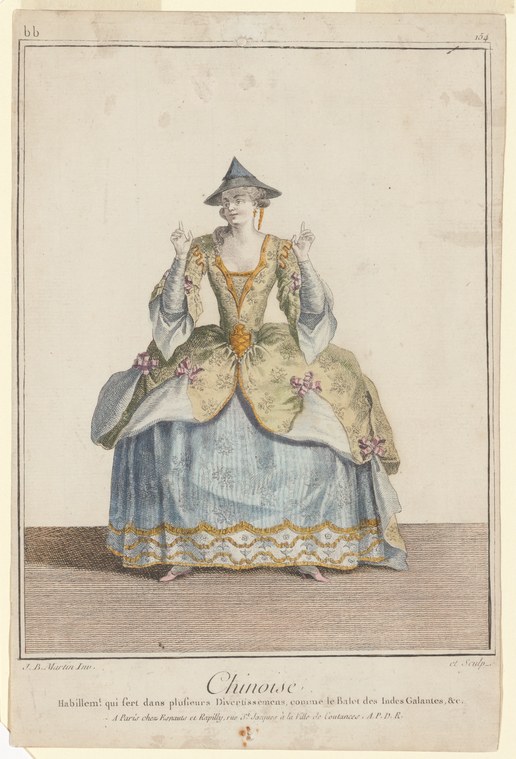
Chinoise, habillem't qui sert dans plusieurs divertissemens, comme le balet des Indes Galantes, &c
Unknown artist
- Collection:
- Prints depicting dance
- Source:
- New York Public Library
- Rights:
- Public domain — free to use, share and adapt.
- Recorded as:
- Public Domain
This single image encapsulates the world of early 18th-century court ballet: the spectacle, the exoticism, the formal presentation, the blending of dance with costume and character. For historians, it documents the 'Ballet des Indes Galantes' and the taste for chinoiserie that drove European entertainment; for dancers, it shows the static, presentational stance of Baroque theatrical performance—the pose of display rather than the acrobatic or rapidly mobile bodies of later dance forms.
What you are looking at
A single female figure stands centered against a plain background in an elegant three-quarter pose. She wears an elaborate costume consisting of a fitted golden-yellow brocade bodice with deep V-neckline, decorated with floral embroidery in purples and golds, over a full skirt in pale blue with a decorative border of golden-brown lace trim at the hem. Her arms are raised to shoulder height with elbows slightly bent, hands gesturing outward in a welcoming or presenting motion. Over her shoulders and arms drapes a voluminous grey fur-trimmed cape or overdress, creating a sense of movement and volume. She wears a distinctive tall conical hat in dark fabric, possibly meant to suggest Asian or exotic styling. Her posture is upright and dignified, with weight evenly distributed, suggesting the formal stance of a court dancer or performer. The colored engraving shows fine line work and hand-applied watercolor, with particular attention to the textures of fabric and fur.
The dancing
The single dancer stands in an open, frontal pose with arms raised symmetrically to frame the body. The gesture is expansive rather than contained—elbows bent at roughly 90 degrees, hands open and relaxed, palms not fully facing forward but angled slightly outward. The stance is upright with no visible weight shift or lunge; the figure appears stationary rather than captured mid-movement. This is the pose of presentation or display rather than active dance phrase, consistent with court or theatrical costume demonstration rather than a moment of kinetic action.
The dance depicted
This is a costume design or character sketch from the early 18th century French theatrical tradition, specifically labeled as a 'Chinoise' or Chinese-style costume used in divertissements and court spectacles such as the 'Ballet des Indes Galantes.' The inscription indicates this was a costume 'used in several divertissements.' The figure demonstrates the Baroque court tradition of exotic costuming—a fantasy version of Asian dress created for European aristocratic entertainment. This is not documentation of an actual Chinese dance form, but rather the European theatrical adaptation and exoticization of Asian aesthetics, characteristic of the period's taste for chinoiserie. The raised-arm gesture and static pose are typical of how early 18th-century dancers presented themselves in character roles within mixed entertainment spectacles.
How it was made
This is a hand-colored engraving or etching, executed with fine line work in black ink and finished with watercolor in yellows, blues, greys, and purples. The technique allowed for wide circulation as a print, and the addition of hand-coloring made each impression individually finished. Such costume prints were part of the documentation and promotion of court spectacles and theatrical productions—they served as records of what was performed and as visual publicity for the entertainment. The quality and care of the execution suggests this was a professional production meant for an educated audience familiar with court ballet and its conventions.
About this work
This is a French Baroque court ballet costume design from the early 18th century, specifically a 'Chinoise' character used in the divertissements that accompanied French court spectacles, including the famous 'Ballet des Indes Galantes.' The image documents the European taste for exotic, non-European costume as entertainment—a fashionable fantasy rather than ethnographic accuracy. It belongs in a dance archive because it shows us what Baroque courtiers watched and how the period visualized other cultures through the lens of aristocratic performance. The costume print is a primary source for understanding the movement, aesthetics, and social function of court ballet in its mature phase.
How to look at it
Note the careful attention to the costume's structure and fabric: the print documents not just the character but the precise construction of the garment—seams, trim, the way the fur drapes. The pose is formal and still, designed to show the costume fully rather than suggest active movement. The raised arms and open gestures are theatrical rather than kinetic—this is the moment of presentation or address to an audience, typical of how characters in court ballet introduced themselves or appeared before the court. The exotic hat and the blend of European tailoring with fantasy Asian elements show how thoroughly Baroque courts reinterpreted foreign cultures through their own aesthetic.
The period
The 'Ballet des Indes Galantes' was a major court entertainment of the early 18th century, part of the broader Baroque fascination with distant lands and cultures filtered through European artistic convention. This era saw the height of the French court ballet tradition under the influence of the Académie Royale de Danse, which had codified dance technique and vocabulary. Exotic characters and costumes were standard elements of court spectacle—they allowed performers to step outside court protocol while maintaining the formality and grandeur of the performance. The print medium itself reflects the circulation of courtly entertainment: such engravings documented and publicized the spectacles for those who attended and for distant courts eager to know what was performed elsewhere.
Where it lives
This print is held in the New York Public Library's collection of prints depicting dance. It is part of the documentary record of European court spectacle, likely produced in Paris and circulated among the aristocratic and courtly audiences who attended such entertainments.
Dance in this work
Questions about this work
Was this a real Chinese dance?
No. This is a European fantasy interpretation of Asian costume created for aristocratic entertainment. The 'Chinoise' character was a standard exotic role in French court ballet, designed to delight audiences with imagined foreignness rather than to represent actual Chinese dance or dress. The costume blends European tailoring and Baroque aesthetic principles with decorative elements meant to suggest the exotic East.
What is the 'Ballet des Indes Galantes'?
This was a major French court spectacle that combined dance, music, and theatrical design. The 'Indes Galantes' featured a series of divertissements (entertainment scenes) set in various exotic locations, with characters in costume performing formal court dances. It was a showcase for the virtuosity and spectacle that court ballet could achieve.
How was this image used?
As a hand-colored print, this served multiple purposes: it documented what had been performed, it advertised the spectacle to those who attended or heard of it, and it circulated the fashionable visual language of court entertainment to distant courts and collectors. Such prints were treasured objects in aristocratic collections.
What does the pose tell us about Baroque dance?
The formal, frontal stance and the static, presentational quality reflect the Baroque aesthetic: dance as a display of elegance and nobility, not as continuous movement. The raised arms and open gesture are characteristic of how characters presented themselves in court ballet—moments of display punctuated by the actual dance phrases, which would have followed.
More dance artwork





