49 works in this view — arrow keys or swipe to move between them.
Dance in Art
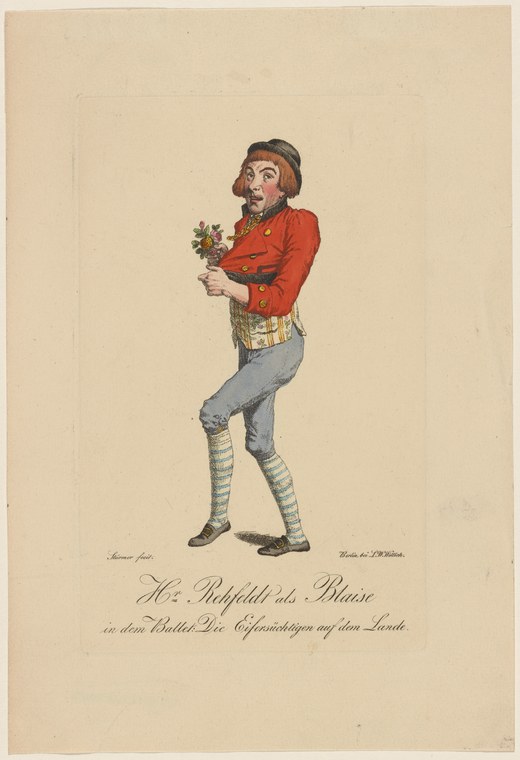
Hr. Rehfeldt als Blaise in dem Ballet Die Eifersüchtigen auf dem Lande
Unknown artist
- Collection:
- Prints depicting dance
- Source:
- New York Public Library
- Rights:
- Public domain — free to use, share and adapt.
- Recorded as:
- Public Domain
This print records a specific performer and role from the professional theater world of the German-speaking lands in the late 1700s, a period and region less well documented in dance history than Paris or London. It shows that comic, character-driven ballet existed alongside the more celebrated grand pantomime and noble ballet—an important corrective to narratives that emphasize only the most prestigious forms. The specificity of the inscription (naming both dancer and ballet) makes it a rare document of how particular roles were embodied and celebrated.
What you are looking at
A single male dancer stands in a dynamic, energetic pose against a plain cream background. He wears a striking red jacket or coat with buttons, a gold-trimmed belt or sash, and gray breeches with striped stockings—costume elements suggesting either military dress or theatrical formality of the late 18th or early 19th century. His posture is animated and playful: weight shifted onto one leg, the other bent, shoulders turned, and his face animated with an expression of surprise or exhilaration. He holds a small posy of flowers in one hand near his chest. The figure occupies the center of the composition, posed as if caught mid-movement, with no scenery or other figures to contextualize the moment—the focus is entirely on the performer and his costume.
The dancing
A single male dancer in a lively, asymmetrical stance: one leg appears to carry his weight while the other is flexed and lifted, creating a sense of springiness or momentary suspension. His torso is turned, shoulders angled, and his upper body expresses energy and gaiety. The arm holding the flowers is extended at mid-height; the other arm is positioned to balance the pose. His head is tilted slightly back, his expression animated. The overall frame suggests a moment of exuberance rather than formal technical precision—the body language reads as comic or lighthearted rather than noble or tragic.
The dance depicted
This is almost certainly a character from a late 18th-century theatrical ballet or pantomime, most likely a comic or peasant role. The title identifies the performer as 'Hr. Rehfeldt als Blaise,' indicating this is a portrayal of a named character (Blaise) by a specific dancer, Herr Rehfeldt. The inscription references a ballet called 'Die Eifersüchtigen auf dem Lande' (The Jealous Ones in the Country), a rural or pastoral setting, typical of light comedic ballet of the period. Blaise was a stock character in 18th-century theater—a simple, good-natured peasant or valet. The costume, pose, and flower suggest romantic comedy and flirtation rather than grand ballet technique. The image documents a specific performer in a specific role, likely for circulation among theaters or patrons.
How it was made
This is a hand-colored engraving or etching, as evidenced by the fine line work, the cream paper, and the subtle color applied with pigment—a common format for theater portraiture in the late 18th century. Such prints were produced and sold to audiences to commemorate celebrated performers and famous roles, circulating knowledge of particular actors and their distinctive interpretations. The inscription at the bottom, in German, indicates this was made for a German-speaking theater world, likely Vienna, Berlin, or another major German city. The technique allowed for reproducibility and widespread distribution, making the performer and role publicly visible and memorable.
About this work
This hand-colored engraving documents a celebrated performer, Herr Rehfeldt, in the character of Blaise from a late 18th-century pastoral ballet-pantomime, 'Die Eifersüchtigen auf dem Lande.' The work is a theater portrait in the tradition of actor prints that circulated widely to preserve and publicize famous roles and celebrated interpretations. The image captures not virtuosity or classical technique but theatrical character and personality—the playful, flirtatious energy of a comic peasant role, conveyed through costume, posture, and expression. It serves as both a record of a specific historical performance and a document of the lighter, vernacular side of late 18th-century theater dance.
How to look at it
Notice the arrested moment the artist chose: not a formal pose but a caught instant of energy and personality, as if Blaise has turned to acknowledge the audience with a mixture of innocence and flirtation. The exaggerated expression and asymmetrical posture emphasize character and comedy over technical display—this is a portrait of an actor in a role, not a demonstration of balletic skill. The flowers, though small, are carefully rendered and are the key prop of the moment, suggesting a romantic encounter is underway. The striped stockings and bright red jacket are costume markers that would have been instantly recognizable to the audience of the time.
The artist
The engraver or artist is not recorded in the catalogue, though the inscription 'Künstler gez.' (drawn by the artist) appears at the lower left. The hand-coloring was likely applied by workshop assistants after the print was struck. The print was produced in the commercial theater print market of the German-speaking world, where such portraits were standard products, made for actors to sell to fans and theaters to distribute to patrons. Such prints were often unsigned or bore only the publisher's mark.
The period
This work dates from the late 18th century, when ballet was undergoing significant change: the Baroque court ballet tradition was fading, narrative pantomime-ballet was flourishing, and a new emphasis on expressive character and realism was emerging alongside continued classical technique. In the German-speaking theaters, Italian and French styles mingled with local traditions. Theater portraiture in print form was at its height during this period—a major form of public entertainment documentation and star-making. Herr Rehfeldt's prominence in this print suggests he was a celebrated performer in his time, and the care with which his costume and expression are rendered reflects his status.
Where it lives
This print is held in the NYPL's Prints collection documenting dance and performers. It is catalogued as a work depicting dance but retains minimal identifying information—the artist, engraver, publisher, and precise date are not recorded. The German inscription provides the only internal evidence of date, place, and context.
Dance in this work
Questions about this work
Who was Blaise and why is this character important?
Blaise was a stock peasant or valet character in 18th-century theater, descended from commedia dell'arte traditions. The character was a vehicle for comedy, physical humor, and sympathy with lower-class life. In this ballet, Blaise's role in a rural jealousy plot allowed for lighthearted romance and buffoonery—a contrast to the tragic or noble heroes of grand ballet. The character gave performers like Rehfeldt a chance to shine through wit and expressiveness rather than pure technique.
What does the title 'Die Eifersüchtigen auf dem Lande' tell us?
The title translates as 'The Jealous Ones in the Country,' indicating a pastoral comic ballet set in a rural setting, probably a village or farmyard. Such settings allowed for broad humor, peasant dances, and romantic complications—a tradition inherited from commedia and popular theater. The plot likely involves mistaken identities, flirtations, and comic misunderstandings among country characters, with Blaise as the good-natured fool caught in the middle.
Why would a dancer's portrait be printed and sold?
Theater portraits in print were a major form of entertainment publicity and souvenir in the 18th century. Actors of note would commission or authorize prints of themselves in celebrated roles, which would be sold in theaters, at printing shops, and by the performers themselves to admirers. These served as advertisements for the performer, records of a specific celebrated interpretation, and collectible souvenirs for theatergoers—much as playbills and photographs do today. Such prints circulated knowledge of stars across cities and countries.
What does Rehfeldt's costume tell us about the dance tradition?
The military-influenced jacket, breeches, and stockings suggest a hybrid costume: part theatrical formality, part character realism. By the late 18th century, theatrical costumes were becoming less purely decorative and more tied to character identity and social rank. Blaise's outfit marks him as a commoner or servant, not a noble, and the bright colors and neat trim suggest a festive, theatrical world rather than realistic peasant wear. This reflects a period of transition in how theater represented social class and character.
More dance artwork





