25 works in this view — arrow keys or swipe to move between them.
Dance in Art · 2019
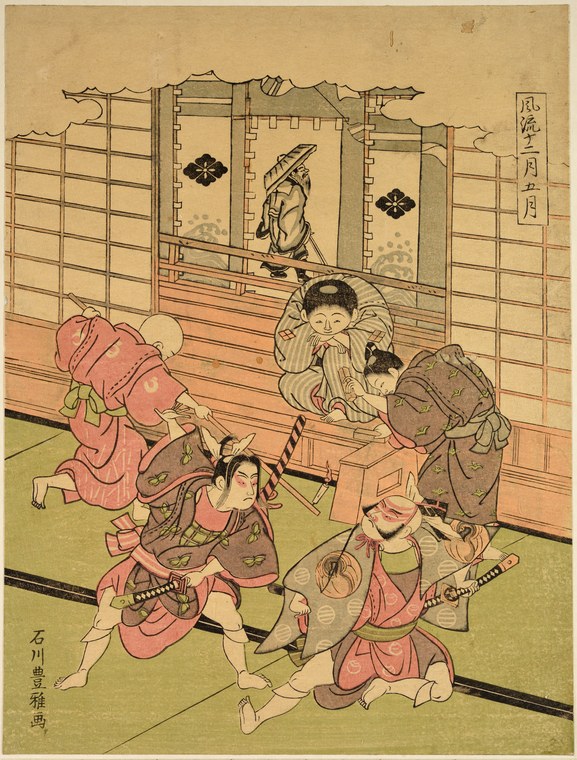
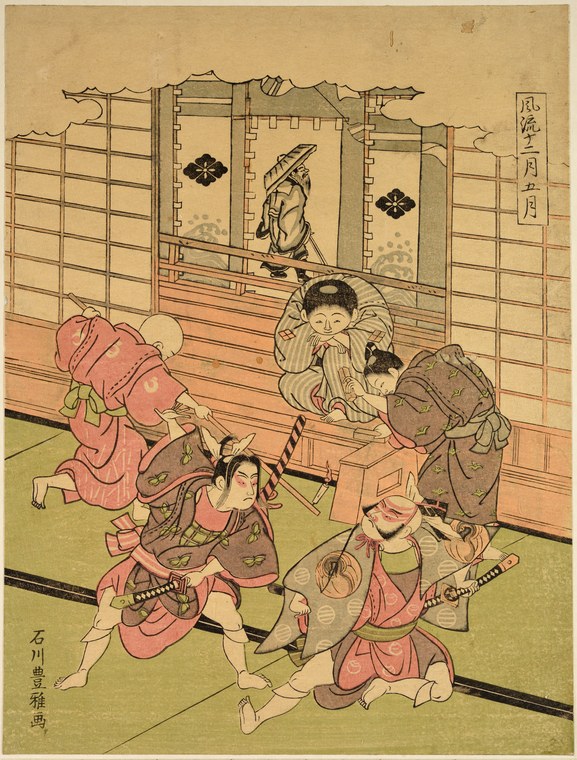
Four boys taking part in an amateur theatrical performance and a fifth seated in the veranda lookin
Unknown artist
- Dance:
- Tango
- Source:
- New York Public Library
- Rights:
- Public domain — free to use, share and adapt.
- Recorded as:
- public_domain
This print documents vernacular theatrical practice in Japan at a scale and register almost invisible in formal art history. It shows that rigorous, disciplined physical training in comic performance was taught to young amateurs and valued enough to be circulated in print, revealing a democratic side of Japanese theater often overshadowed by accounts of professional kabuki.
What you are looking at
Five young performers are shown in what appears to be an amateur theatrical production set within a traditional Japanese interior. Four boys in the foreground crouch and gesture animatedly in pink and rust-colored robes, their bodies compressed into exaggerated postures suggestive of comedic or acrobatic performance. A fifth figure sits calmly on the veranda in the background, visible through the wooden lattice framework of the building. The setting is rendered with careful attention to architectural detail—horizontal wooden planks form the floor and wall structure, while geometric patterns of the sliding screens create a stage-like frame. The color palette is restrained: soft yellows, pinks, browns, and blacks dominate. The composition emphasizes the theatrical space itself as much as the performers within it.
The dancing
The four foreground figures display extreme physical contractions and asymmetrical postures characteristic of Japanese comedic or acrobatic theater. Bodies are bent, twisted, and compressed; arms reach at odd angles; heads tilt and turn. There is no ballroom hold or classical frame—instead, the bodies occupy chaotic, individual spaces. The seated figure on the veranda maintains an upright, composed posture that contrasts sharply with the kinetic intensity of the crouching performers. Weight appears to be distributed unevenly; some figures seem to perch or spring from the ground rather than stand with stability.
The dance depicted
This appears to document amateur kabuki or similar traditional Japanese theatrical performance rather than formalized dance in the Western sense. The extreme bodily contortions, the comedic register suggested by the cramped poses, and the architectural framing all point to comic theatrical performance or kyōgen—the classical Japanese comedic theater that frequently employs exaggerated physical comedy and acrobatic movement. The catalogue's attribution to 'Tango' is almost certainly erroneous; there is nothing in the image to support Argentine or ballroom tango. The performance occurs in what appears to be a domestic or rehearsal space rather than a professional theater.
How it was made
This is a hand-colored woodblock print—a Japanese ukiyo-e work, identifiable from the bold linear composition, the characteristic palette, the woodblock technique's crisp outlines, and the printed text cartouche in the upper right corner. The medium was cheap to produce and widely circulated, meaning this documented performance would have reached a popular audience. The flattened perspective and attention to interior architecture are typical of Japanese print conventions of the Edo or early Meiji period. Hand coloring in pigments (pink, yellow, green, brown) was applied after printing.
About this work
This is a Japanese woodblock print documenting an amateur theatrical performance, most likely kyōgen or domestic kabuki practice rather than formal dance. The image captures a moment of exaggerated physical comedy within a meticulously rendered traditional interior, freezing the performers in postures of comedic contortion. It belongs in a gallery of dance-in-art because it documents how bodies moved in Japanese theatrical training and performance outside the elite classical tradition, and because it shows the intimate scale at which such performance occurred—in domestic spaces and among young practitioners, not on professional stages.
How to look at it
Attend to the moment chosen: not a climactic narrative moment, but a suspended instant of physical strain and comedic contortion. The artist has frozen the performers mid-effort, bodies compressed and twisted, rather than showing them upright and composed. Notice how the architectural frame—the geometric patterns of the wooden veranda, the latticed screens—acts as a stage-within-the-image, containing and displaying the bodies. The contrast between the frantic foreground figures and the calm, seated figure in the background suggests a narrative pause or rehearsal break. The extreme flattening and compartmentalization of space is characteristically Japanese and very different from European perspective conventions of the same period.
The artist
The artist is not recorded in the catalogue, but the style and coloring technique are consistent with late Edo or early Meiji ukiyo-e practice. The cartouche in the upper right indicates a published print, likely from a series or collection of theatrical scenes. The artist's anonymity is typical of popular woodblock production, where multiple hands—carver, printer, colorist—contributed to the final object without individual attribution.
The period
In the period when this print was likely made (probable late 18th or 19th century, based on style), both amateur kabuki and kyōgen performance were widespread in Japan. Young men and boys studied theatrical movement as part of cultural education. The print was produced during a period of intense codification of Japanese classical arts, yet it documents the casual, domestic side of that training rather than the rarified professional stage. In Europe during the same era, prints documenting amateur performance and popular theater were similarly valued as records of lived culture.
Where it lives
The work is held in the New York Public Library collection and was catalogued through their digital collections interface. It is a hand-colored woodblock print, a format designed for mass circulation. The catalogue title is incomplete and misleading; the full scene shows five figures, and the dramatic action involves the four foreground performers rather than the background observation.
Dance in this work
Questions about this work
Is this really a tango?
No. The catalogue label 'Tango' appears to be an error. Nothing in the image—not the costume, setting, body positions, or cultural context—relates to Argentine or ballroom tango. This is a Japanese theatrical print documenting amateur kabuki or kyōgen performance.
What is the performance tradition being shown?
Most likely kyōgen, the classical Japanese comedic theatrical form that emphasizes physical humor and exaggerated gesture, or amateur kabuki practice. The extreme bodily contrortions and comedic register are characteristic of kyōgen. Amateur performance of these forms was common among educated young men and was documented in prints.
Why are the bodies twisted like that?
The contorted poses are characteristic of Japanese comedic theater, where exaggerated, often grotesque physical positions were used for comic effect. The artist has captured the performers mid-effort, bodies compressed and strained, which is part of the visual comedy and the documented performance technique.
What is a ukiyo-e print?
Ukiyo-e means 'pictures of the floating world.' These are woodblock prints mass-produced in Japan, typically hand-colored, and designed for popular circulation. They documented everyday life, theater, landscapes, and celebrity. This print belongs to that tradition and would have been affordable and widely distributed.
More Tango artwork
![[Les noces de trottoir, par les compagnies Tango Sumo et Vendaval. Chalon dans la rue. 2007 / photographies de Joël Verhoustraeten] by Verhoustraeten, Joël (1954-2019). Photographe](https://gallica.bnf.fr/iiif/ark:/12148/bc6p058zgkc/f1/full/800,/0/native.jpg)