49 works in this view — arrow keys or swipe to move between them.
Dance in Art
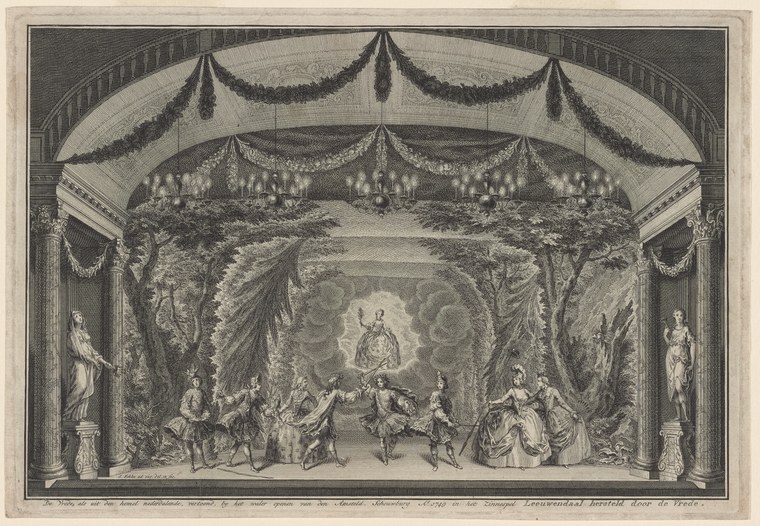
De Vrede, als uit den hemel nederdalende, vertoond by het weder openen van dan Amsteld. Schouwburg
Unknown artist
- Collection:
- Prints depicting dance
- Source:
- New York Public Library
- Rights:
- Public domain — free to use, share and adapt.
- Recorded as:
- Public Domain
This is documentation of an actual historical performance event—the reopening of an important Dutch theater—captured by a professional printmaker. It shows how Baroque theatrical dance was embedded in architecture, spectacle, and allegory, not isolated as a ballroom social form. For dance researchers, it provides rare visual evidence of stage spectacle in the Dutch Golden Age and the way professional performers and amateurs were deployed in civic celebration.
What you are looking at
This is a theatrical proscenium stage seen in cross-section, rendered in a detailed engraving. The stage is framed by a classical arch with fluted columns on either side and a coffered vault above. The proscenium opening is draped with heavy swags of fabric in the Baroque style, topped by an ornamental cornice. The stage proper recedes in deep perspective and is set with painted scenery showing a garden or parkland with tall trees and architectural elements in the background. A figure or light source glows in the distant center of the stage. In the foreground, a group of dancers or performers—perhaps eight to twelve figures—occupies the stage floor in various poses of motion and repose. Some stand, some appear to gesture dramatically, and several seem to recline or sit. The figures are dressed in what appears to be Baroque theatrical costume, with the women in flowing dresses and the men in breeches and formal wear. The entire composition demonstrates the deep receding stage and the relationship between performers and the elaborate architectural framing typical of court or civic theater spectacle.
The dancing
The dancers are scattered across the stage in asymmetrical groupings rather than formal lines, suggesting a narrative scene rather than a courtly procession. Several figures stand with raised arms in attitudes of celebration or address; others lean or incline the torso. The poses suggest pageantry and spectacle rather than ballroom precision. No tight partnered holds are visible; instead, the grouping conveys social interaction, gesture, and theatrical declamation. The varying heights and body angles suggest that figures are positioned at different depths in the receding stage space, enhancing the perspective effect.
The dance depicted
The title—*De Vrede, als uit den hemel nederdalende* (Peace descending from heaven)—indicates this is an allegorical theatrical spectacle, most likely a court ballet or civic festival performance celebrating a peace treaty. The theatrical setting and elaborate costume strongly suggest this is Dutch Baroque court entertainment from the seventeenth century, possibly marking the reopening of the Amsterdam Schouwburg (playhouse). The loose, gestural poses and the emphasis on declamation and spectacle over ballroom technique suggest this is not a social dance but a staged allegorical performance—a ballet de cour or theatrical pageant in which professional or noble performers enacted narrative and symbolic action.
How it was made
This is an engraving on paper, likely made as a print for circulation. The technique allows for sharp linear detail, making it ideal for architectural precision and the theatrical machinery and framing devices. The cross-sectional view—showing both the architecture of the theater and the stage action within it—is characteristic of early modern theatrical documentation, meant to preserve a record of an ephemeral event. The engraving would have been distributed as a keepsake or advertisement, making it evidence of how spectacle was packaged and promoted.
About this work
This engraving documents a Baroque theatrical spectacle performed in Amsterdam, recorded as a permanent image through the printmaker's art. It shows not merely the performers in action but the entire machinery of theater—the proscenium, the drapery, the painted scenery, and the perspective techniques that made the spectacle legible to an audience. The work sits at the intersection of dance history and architectural history, revealing how bodies and architecture combined to create meaning in early modern court and civic performance. For historians of dance, it offers crucial evidence about the spatial and scenic context in which Baroque dance was presented, and about the allegorical and pageant forms that existed alongside social dancing.
How to look at it
The viewer should attend first to the architecture: the framing of the stage within the proscenium arch, and the way the painted scenery recedes into the distance. Then focus on the human figures and their distribution across the stage floor—not forming rigid patterns but scattered as if engaged in a narrative moment. Notice how the printmaker has used perspective and the framing columns to guide the eye into the depth of the stage. The work is a cross-section showing both the building and what happens within it, so look at how the performer's bodies relate to the architectural surround.
The artist
The artist is not recorded in the catalogue. The engraving style and Dutch inscriptions suggest a Dutch printmaker working in the mid-to-late seventeenth century, producing documentary or commemorative prints of civic events. The quality and detail of the work indicate professional skill in both theatrical perspective and engraving technique.
The period
This work belongs to the era of the Baroque court ballet and civic spectacle, when dance was conceived not as an autonomous art but as part of a multimedia theatrical totality involving music, architecture, decor, and allegory. In the Dutch Golden Age (particularly after the 1648 Treaty of Westphalia ending the Eighty Years' War), peace celebrations often took the form of elaborate public performances. The reopening of a major Amsterdam theater was a significant civic and cultural event, worthy of being captured and circulated as a print. At this period, theatrical performance was still largely a court and civic affair rather than a commercial public spectacle.
Where it lives
The work is held in the Prints collection of the New York Public Library, catalogued as depicting dance. It is a historical print, likely made in the Netherlands in the seventeenth century as a commemorative or documentary record.
Dance in this work
Questions about this work
What is the title in English?
The title translates as *Peace, as descending from heaven, shown at the reopening of the Amstel Schouwburg* (or similar). The inscription indicates this records the reopening of a major Amsterdam theater with an allegorical performance celebrating peace.
Is this a ballet or a social dance?
This is theatrical spectacle—a staged allegorical pageant or court ballet designed for an audience. It is not a social dance, and the loose gestural poses reflect the demands of theatrical narrative and spectacle rather than ballroom technique.
How do we know this depicts an actual event?
The title names a specific place (the Amstel Schouwburg in Amsterdam) and an occasion (reopening/peace celebration). The work was made as a commemorative print—a form of documentation similar to a program or a photograph today.
Why are the figures not in ballroom poses?
Because they are not social dancers. They are theatrical performers enacting an allegorical narrative about peace descending from heaven. The poses are gestural and theatrical rather than technical.
More dance artwork





