49 works in this view — arrow keys or swipe to move between them.
Dance in Art
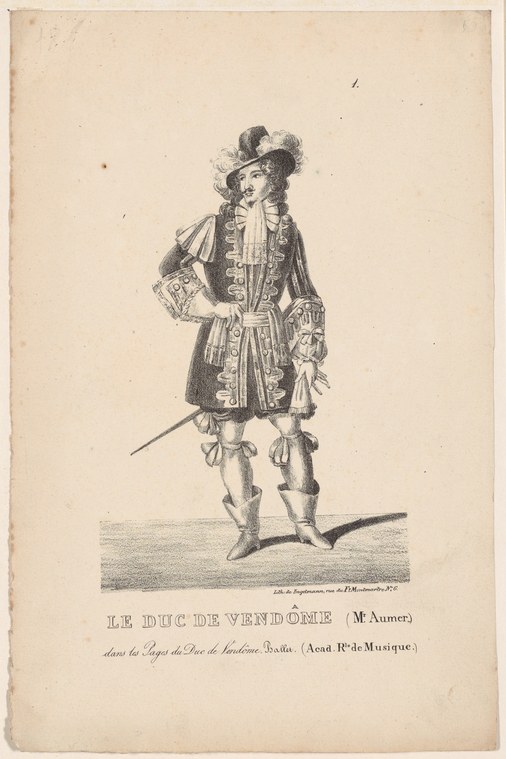
Le duc de Vendôme (Mr Aumer) dans Les pages du duc de Vendôme, ballet pantomime en 1 acte (Académie Rle. de musique)
Unknown artist
- Collection:
- Prints depicting dance
- Source:
- New York Public Library
- Rights:
- Public domain — free to use, share and adapt.
- Recorded as:
- Public Domain
This image is evidence of how early 18th-century French court dance was understood and marketed: as an aristocratic art form centered on elegant costume, refined posture, and the display of rank rather than virtuosity or athletic movement. The identification of the dancer by name suggests that individual performers were becoming recognized artists in their own right, a shift that shaped the development of ballet as a professional practice.
What you are looking at
A single male figure stands in three-quarter view against a plain background, dressed in ornate early 18th-century court costume. He wears a long embroidered coat with decorative braiding and a full skirt reaching below the knee, over tight breeches that end at the calf. His stockinged legs are long and slender, and he wears heeled shoes. A elaborate plumed hat crowns his head, and he holds a small object—possibly a handkerchief or fan—in one gloved hand. His other arm extends naturally at his side. The figure is drawn with fine hatching and line work, rendered in a classical engraving style on aged paper. A narrow ground line anchors the figure to the picture plane. The costume and bearing suggest a character from a French court ballet or pantomime, presented as a standing pose that displays the splendor of dress and the refined posture expected of an aristocratic dancer.
The dancing
The single figure demonstrates the upright, elegant carriage of early 18th-century noble dance: shoulders back, chest open, weight distributed evenly on both feet with a slight forward tilt. The extended arm and holding of a small object (handkerchief or fan) suggest a moment of courtly address or greeting rather than active movement. The long, slender proportions of the legs and the prominence of the heeled shoe indicate a body trained in turnout and the raised, weightless aesthetic of court dance. The pose is static and presentational rather than kinetic.
The dance depicted
This is a costume figure for a dancer performing in a French court ballet or pantomime entertainment, specifically identified in the inscription as appearing in *Les pages du duc de Vendôme* (The Pages of the Duke of Vendôme), with the dancer named as Mr Aumer. The work represents a type of theatrical spectacle common at the Académie Royale de Musique (Paris Opera) in the early 18th century, blending dance, pantomime, and elaborate costume. The static pose and emphasis on costume detail suggest this is a record of a theatrical character type rather than a captured movement—typical of how dancers and their roles were documented in this period.
How it was made
This is a hand-colored engraving, executed in fine lines with cross-hatching for shadow and tone. The technique allowed for precise rendering of elaborate textile detail—the embroidery, braiding, and plume—and wide distribution as a printed sheet. The use of engraving signals a work of some cultural importance and cost, circulated among the literate classes and those interested in theater, fashion, and court life. The worn surface of the paper and sepia tone suggest significant age, consistent with early 18th-century production.
About this work
This is a engraved costume plate documenting a male dancer—Mr Aumer—in character for a French theatrical production at the Académie Royale de Musique. It belongs to a tradition of theatrical prints that recorded both the dance spectacles and the magnificent dress that defined court entertainment in the early 18th century. Such engravings served multiple purposes: they circulated information about new productions, preserved a record of celebrated dancers and their roles, and satisfied public appetite for images of aristocratic fashion and theatrical glamour. The work demonstrates how dance in this period was documented as much through the display of costume and noble bearing as through the capture of movement itself.
How to look at it
Attend to the costume detail: the engraver has lavished attention on the embroidered coat, the plume, the stockings, and the heeled shoe—these elements collectively define the character and his rank within the dramatic fiction. Notice the posture: the upright carriage, the turned-out legs, and the graceful arm position are all signs of dance training and aristocratic refinement. The static pose captures not a moment of action but a moment of presentation—the dancer as an object of visual admiration, which was the primary purpose of early court ballet. The inscription at the base links the image to a specific theatrical event and performer, transforming it from a generic costume study into a historical document.
The artist
The artist is not recorded. The print bears a printer's mark (likely at the base of the composition) suggesting it was produced by a commercial engraving shop in Paris, the center of theatrical print production in the early 18th century. Such shops employed skilled engravers to document theatrical productions and circulate images to a paying public interested in fashion, theater, and court life.
The period
This print dates to the early 18th century, a period when French court ballet was transitioning from the pure dance spectacle of Louis XIV's reign toward more narrative and pantomimic forms. The Académie Royale de Musique (Paris Opera) was the center of theatrical dance in France, and its productions—whether operas, ballets, or pantomime-ballets—were major social and cultural events. The elaborate costume and courtly bearing reflect the aristocratic values that still dominated theatrical aesthetics, even as professional dancers were beginning to establish themselves as distinct from amateur court participants. Engravings like this served as both souvenirs and publicity for new productions.
Where it lives
This engraving is held in the New York Public Library's collection of prints depicting dance. It is a single-sheet theatrical print, the kind that was sold commercially in the 18th century to theater-goers and collectors of fashion and theatrical imagery.
Dance in this work
Questions about this work
Who was Mr Aumer?
The inscription identifies him as a performer in *Les pages du duc de Vendôme*, but little else is known from the print itself. The name suggests a professional dancer associated with the Académie Royale de Musique in Paris during the early 18th century. Individual dancers were becoming recognized figures in their own right during this period, making them subjects of printed documentation and public interest.
What is a ballet pantomime?
A ballet pantomime was a theatrical form that combined dance, spoken or sung dialogue, pantomimic gesture, and elaborate scenery and costume to tell a narrative story. It occupied a middle ground between pure dance spectacle and dramatic theater, and was a popular form at the Paris Opera in the early 18th century.
Why is the figure shown standing still rather than dancing?
This is a costume or character plate, designed to record and display the elaborate dress and aristocratic bearing of the role rather than to capture movement. It functioned as both a theatrical document and a fashion plate, satisfying the public's interest in the visual splendor of court spectacle.
What does the small object in his hand represent?
It is likely a handkerchief or fan, both essential props in courtly gesture and early theatrical dance. Such objects were used to convey emotion, courtesy, and social status, and their use was highly codified in court dance practice.
More dance artwork





