49 works in this view — arrow keys or swipe to move between them.
Dance in Art
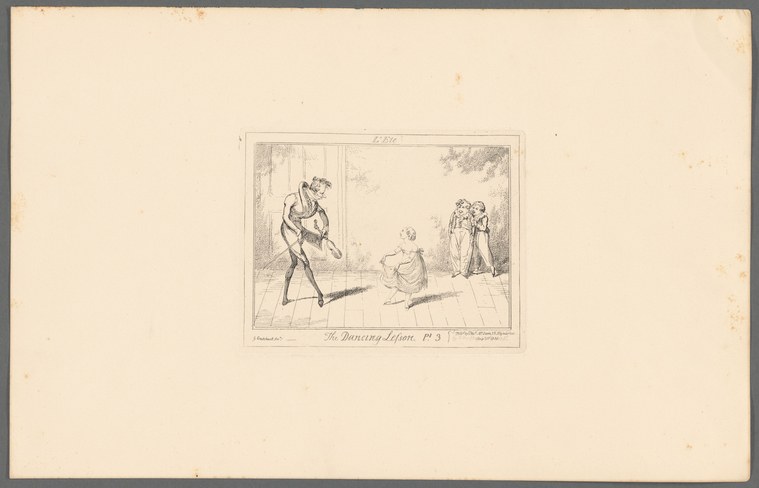
The dancing lesson, pt. 3. L'ete
Unknown artist
- Collection:
- Prints depicting dance
- Source:
- New York Public Library
- Rights:
- Public domain — free to use, share and adapt.
- Recorded as:
- Public Domain
For dance historians, this print provides insight into how Regency-era English society viewed dance instruction and classical technique—with bemusement and skepticism. The visual satire tells us what the period considered proper deportment and extension, what was teachable, and what failures were laughable. For art historians and social historians, it documents the role of the dancing master in Regency genteel life and the anxieties around class, performance, and physical education that surrounded it.
What you are looking at
A dancing master instructs a pupil in an interior space marked by wooden floorboards. The master, dressed in early 19th-century coat and breeches, stands in an exaggerated posture with one leg extended sharply backward and arms raised—a caricatured demonstration of dance deportment. The pupil, a portly figure in similar period dress, stands at the center of the floor in an awkward, knock-kneed stance, apparently struggling to imitate the position. Two additional figures observe from the right: a woman in a high-waisted Regency gown and a man in a coat, presumably waiting for instruction or evaluating the lesson. The print is lightly stippled and cross-hatched, with clear linear perspective receding into the shadowed background where architectural elements suggest a dance studio or ballroom. The title inscribed below reads 'The Dancing Lesson, Pt. 3. L'ete' [Summer], marking this as part of a series.
The dancing
The master demonstrates an exaggerated arabesque or développé, with the supporting leg nearly straight and the working leg extended high and back, the torso leaning forward dramatically. His arms are raised in a theatrical frame, elbows bent and hands positioned above shoulder height. The pupil's posture is deliberately comic: his legs are splayed inward (knock-kneed), his weight appears centered and unstable, and his arms hang at his sides or are barely raised. This physical contrast—competent extension versus clumsy rigidity—is the visual joke. The two observers stand in relaxed poses of spectatorship, the woman in profile, the man facing slightly toward the action.
The dance depicted
This is a satirical print about dance instruction, likely referencing early 19th-century ballroom or theatrical dance pedagogy. The exaggerated postures and the comedy of the pupil's failure to execute a proper ballet position (the extended leg and raised frame suggest classical or Romantic-era technique) suggest this is not documentary but social satire—mocking either incompetent pupils or overly precious dance masters. The series title 'The Dancing Lesson' with seasonal parts ('L'ete' / Summer) suggests a broader satirical cycle. The dress and setting are consistent with English Regency-period dance culture (c. 1810–1820), when dancing masters were a fixture of genteel education and a subject of humorous commentary in prints.
How it was made
This is an engraving or etching, possibly hand-colored or printed on tinted paper. The fine cross-hatching and stipple used to model form, combined with clear linear perspective lines in the floor, are characteristic of early 19th-century satirical prints. The technique allows for sharp delineation of gesture and costume detail, which is essential to the print's satirical effect—the exaggeration of the master's posture and the pupil's incompetence must read instantly and clearly. The inscription and artist's mark (partially visible lower left) indicate this was a published work, likely part of a commercial series.
About this work
This is a Regency-era satirical print depicting a dancing lesson. It belongs to the long tradition of prints mocking dancing masters and their pupils—a staple of English graphic satire from the 18th and 19th centuries. The print is part of a series called 'The Dancing Lesson,' with this plate representing 'L'ete' (Summer). Rather than document actual dance practice, it uses extreme caricature of body position and social type to comment on pretension, incompetence, and the absurdities of genteel performance culture. The work sits at the intersection of dance history, social satire, and printmaking practice.
How to look at it
Attend to the contrast between the two bodies: the master's extended, lifted, theatrical frame versus the pupil's earthbound, collapsed posture. The artist has frozen the moment of demonstration and failure, making the joke spatial and physical rather than narrative. Notice the precision of the costume detail—the cut of the master's coat, the Regency waistline on the waiting woman—which grounds the satire in a specific moment and milieu. The perspective of the floor reinforces the studio setting and allows the viewer to judge the quality of the positions as if standing on the same boards.
The artist
The artist is not recorded in the catalogue. The style and subject matter are consistent with the output of London satirical print workshops of the 1810s–1820s, a period when prints on dance, courtship, and social instruction were popular commercial products. The series structure and the inscription suggest this was part of a marketed set, possibly produced by or for a major publisher such as Rudolph Ackermann or a competing house.
The period
The early 19th century saw a boom in satirical prints in England, particularly on subjects of social education and genteel aspiration. Dance was a key component of Regency polite society: young people of the middle and upper classes took lessons in ballroom dances (quadrilles, cotillions, country dances, and increasingly Romantic ballet positions). The dancing master was a stock figure in satirical literature and prints—simultaneously essential to genteel accomplishment and ridiculous in his pretension and affectation. The Romantic period's elevation of ballet technique and the female body also created new material for satire around the gap between aspiration and reality, between elegant form and awkward bodies.
Where it lives
The work is held in the Prints collection of the New York Public Library, catalogued as part of a series on dance subjects. The inscription and publishing format indicate it was a commercial print, likely issued individually and as part of a portfolio or bound set.
Dance in this work
Questions about this work
Is this a real dancing lesson or a joke?
This is satirical social commentary, not a straightforward depiction of instruction. The exaggerated postures—the master's impossibly high extension, the pupil's knock-kneed collapse—are caricatured for comic effect. The print mocks pretentious dancing masters and inept pupils, using physical comedy to comment on Regency anxieties about genteel education and performance.
What dance is being taught?
The extended leg and raised arms suggest a position from classical ballet or the Romantic ballet technique that was becoming fashionable in English society during the 1810s–1820s. However, the print is not interested in documenting technique accurately; rather, it uses recognizably theatrical postures to amplify the humor of the pupil's failure to execute them.
Why is this part of a series called 'The Dancing Lesson'?
The series appears to follow the seasons ('L'ete' = Summer), suggesting the dancing master and pupil return in different seasonal guises or scenarios. This was a common format for satirical print series, allowing publishers to release related compositions over time and market them as sets.
What does this tell us about Regency dance culture?
The print reveals that dance instruction was a common and valued part of genteel education, but also that it was ripe for ridicule—suggesting some skepticism about its necessity or effectiveness. The clothing and setting show that dancing masters worked indoors in purpose-built or adapted spaces, and that their clients included aspiring members of the respectable middle class, not just the aristocracy.
More dance artwork





