49 works in this view — arrow keys or swipe to move between them.
Dance in Art
Homme en habit despée
Unknown artist
- Collection:
- Prints depicting dance
- Source:
- New York Public Library
- Rights:
- Public domain — free to use, share and adapt.
- Recorded as:
- Public Domain
For dancers and historians, this is direct visual evidence of how the aristocratic body was trained, valued, and understood at the moment when ballet was establishing itself as a distinct discipline. The figure encodes the turned-out stance, the lifted carriage, the controlled arm, and the emotional restraint that would become the foundation of classical ballet technique—seen here not as technical exercise but as the idealized form of masculine nobility itself.
What you are looking at
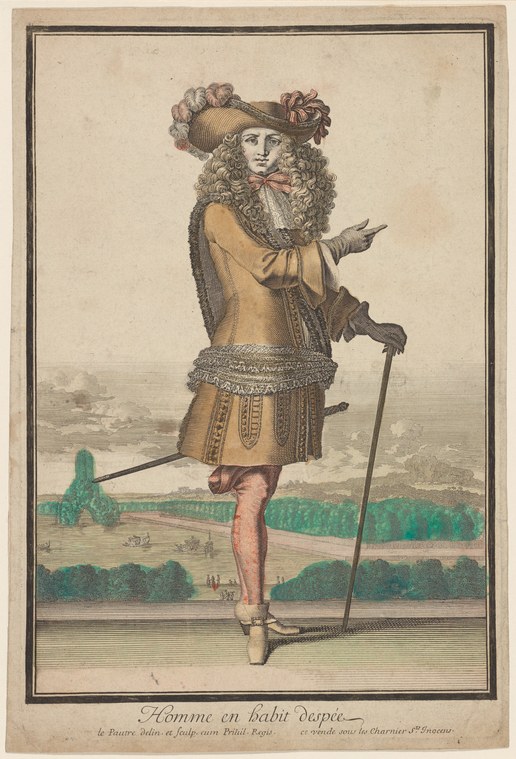
A single male figure stands in contrapposto against a distant landscape of water, green vegetation, and pale sky. He wears the rich dress of a French courtier or nobleman from the late 17th or early 18th century: a long coat of golden-tan fabric with elaborate embroidered trim at the hem, a short decorated skirt or justaucorps, silk stockings, and heeled shoes. His torso is bare beneath an open coat, displaying an ornamental belt. A large curled periwig frames his face, and he wears a pink or mauve ribbon bow at his neck. His left arm extends outward in a graceful gesture, index finger pointing; his right hand rests on a cane or walking stick held diagonally. His weight rests on his left leg while the right knee bends slightly, creating an elegant, balletic line. The figure is rendered in hand-colored engraving with fine hatching and delicate tinting. The title inscribed below reads "Homme en habit d'épée" (Man in Sword Coat), with a credit line to the Banier collection and the Brissart & Simoneau publishing house.
The dancing
A single male figure in profile-frontal view demonstrates the disciplined, upright carriage of aristocratic dance of the period. His weight is distributed with the left leg straight and supporting, the right knee relaxed and bent—a characteristic ballet and courtly dance position. His left arm extends in an open, expressive gesture with fingers articulated and extended, while his right maintains contact with a cane, allowing for balanced movement. The body shows the turned-out alignment and elongated line sought in baroque courtly movement, with the head held proudly and the gaze directed outward.
The dance depicted
This is a figure study of courtly deportment and noble movement from the French baroque court tradition, likely from the late 17th century. The image captures not a dynamic dance moment but a static demonstration of aristocratic posture and the fundamental positions and arm placements that governed baroque court dance and the emerging ballet technique. The printed French text and publication credits identify this as a teaching or reference image distributed through the Parisian print market—material that dancers and dancing masters would have consulted. The cane, the formal dress, and the controlled, geometric arm gesture are hallmarks of the *danse noble* or noble style that dominated court entertainment. Whether meant to illustrate a specific dance figure or to establish the standard of correct carriage for a gentleman, the image serves as a somatic manual for the aristocratic body in motion.
How it was made
This is a hand-colored engraving, a reproductive print technique common in France from the mid-17th through the 18th century. The fine parallel lines of the engraved background and the carefully controlled cross-hatching in the shadows show the labor-intensive process of hand-incising a metal plate. The delicate tinting—pale flesh tones, gold and tan fabrics, green landscape—was applied by hand after printing, making each impression slightly individual. The technique was expensive and suggests an educated, urban audience: wealthy collectors, aristocrats, and the emerging professional and merchant classes with access to print shops. This type of figure study in French print form had wide circulation as both art and practical pedagogical material.
About this work
This hand-colored engraving presents a solitary nobleman in the formal dress and carefully composed stance of French aristocratic society at the turn of the 18th century. The figure demonstrates not a moment of performance but a state of refined repose, the body aligned according to the principles of noble movement and early ballet technique. Published by Brissart & Simoneau of Paris and drawn from the Banier collection, it belongs to a extensive tradition of French courtly figure prints—images that served simultaneously as aspirational art, teaching aids for dancing masters, and records of fashion and deportment. The image enshrines the language of the body that ballet would inherit and systematize.
How to look at it
Attend to the precise alignment of the body: the straightness of the supporting leg, the gentle bend of the free leg, the turned-out hip. Notice the placement of the arm—extended but not rigid, with articulated fingers that suggest both grace and control. Observe how the cane, held at an angle, becomes part of the compositional balance rather than a prop; it assists the figure's elegance. The face is calm, almost expressionless, the gaze elevated: emotional restraint is as much a part of the performance as any movement. This is the vocabulary of baroque courtly deportment rendered as a still image—what a dancer of that era would have worked to embody.
The period
In the late 17th and early 18th centuries, French court culture and the emerging ballet tradition were inseparable. Louis XIV's establishment of the Académie Royale de Danse in 1661 marked the moment when aristocratic dancing became codified as a teachable discipline. French prints of courtly figures were in high demand both domestically and across Europe, circulating knowledge of French taste, fashion, and movement. Simultaneously, the professional ballet was beginning to separate from courtly amateur performance, though the aesthetic of noble bearing remained paramount. This image sits at that threshold: it presents aristocratic movement not as dance performance but as the bodily manifestation of rank and refinement—the standard against which both amateur courtiers and professional dancers would be judged.
Where it lives
The work belongs to the collection of dance-related prints held by the New York Public Library. It is identified as part of the Banier collection and credits the Parisian print publishers Brissart & Simoneau, indicating it was produced and distributed as a commercial print in the Parisian market.
Dance in this work
Questions about this work
Is this a ballet dancer or just a fashionable gentleman?
The distinction is historically unclear. In the late 17th century, the vocabulary of ballet and the movement of aristocratic gentlemen were one and the same. This figure embodies both: the dress is court dress, but the stance, alignment, and arm position are those of trained noble movement as taught in dancing schools. The image likely served both as fashion documentation and as a teaching reference.
What is the dress code visible here?
This is an *habit d'épée*—a "sword coat"—the formal dress of a French nobleman or courtier. It consists of an open, knee-length coat with ornate trim, a short decorated skirt beneath, a silk waistcoat or justaucorps, stockings, heeled shoes, and accessories including a periwig, ribbon, and cane. This was the standard formal wear for a gentleman of rank.
What historical period does this represent?
Based on the style of dress, periwig, and the publication credits to Brissart & Simoneau, this is most likely from the late 17th or very early 18th century, when French court culture and the codified ballet tradition were at their height.
Why is the figure holding a cane?
The cane was an essential accessory of aristocratic male dress and deportment. In dance and courtly movement, it served both practical and aesthetic purposes: it helped with balance, created an additional line in the composition, and demonstrated the wearer's ability to move with grace and control even while encumbered by gentlemanly accoutrements.
More dance artwork





