49 works in this view — arrow keys or swipe to move between them.
Dance in Art
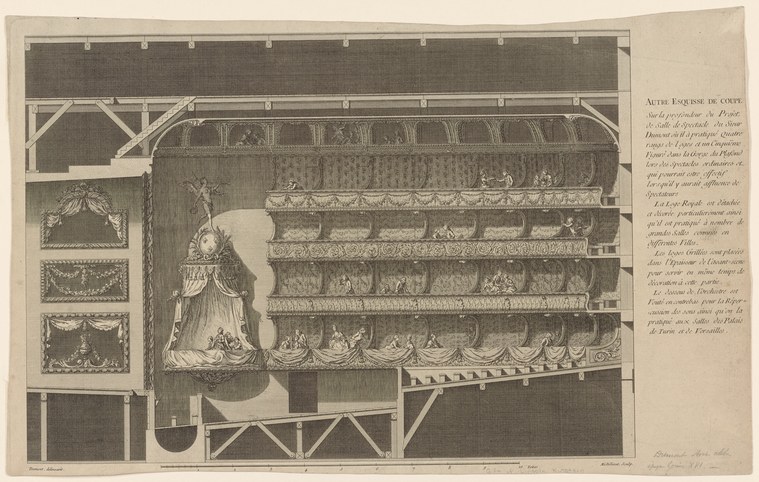
Autre esquisse de coupe
Unknown artist
- Collection:
- Prints depicting dance
- Source:
- New York Public Library
- Rights:
- Public domain — free to use, share and adapt.
- Recorded as:
- Public Domain
For dancers and historians, this is visual evidence of what theatrical dance looked like and how it was valued in its moment: a solitary, graceful body moving within a space designed to frame and glorify that movement. The drawing also documents the relationship between dance, architecture, and social hierarchy—showing us precisely where nobility and bourgeoisie sat, and how the stage was engineered to hold their gaze.
What you are looking at
This is an architectural cross-section drawing of a grand theatre interior, rendered in the neoclassical style typical of 18th-century French design. The image shows a multi-tiered auditorium with four levels of audience seating arranged in curved balconies, each tier decorated with ornamental swags and garlands. The stage occupies the right side of the composition, appearing as a deep recessed space with elaborate scenic architecture. A single female dancer in classical dress dominates the stage: she wears a long flowing gown with draped sleeves and appears captured mid-movement, bending forward from the waist in a graceful arc, her body creating an elegant curve that echoes the architectural forms surrounding her. The stage is framed by a proscenium arch and bordered by decorative panels on the left wall showing theatrical ornaments and smaller architectural details. The entire drawing is executed in fine engraved lines with careful cross-hatching to suggest depth and shadow, creating a precisely rendered technical illustration of theatrical space.
The dancing
A single female figure occupies the stage, her body extended in a forward bend that displays remarkable flexibility and control. Her posture suggests a moment of balletic grace rather than dramatic character work—the movement appears deliberate and aesthetically refined, with the upper body folding from the hips while the legs remain extended. The figure wears a classical draped costume consistent with neoclassical dance of the period. Her positioning center-stage and isolated within the vast architectural space emphasizes the solitary, virtuosic nature of the performance being depicted.
The dance depicted
This appears to depict a moment from neoclassical or romantic-era theatrical dance, likely a solo turn or variation from a ballet performed in a major European opera house. The dancer's posture—a forward bend with extended legs—suggests either a preparatory movement or a moment of ornamental grace within a larger choreographic phrase. The style is consistent with late 18th- or early 19th-century ballet as it was performed in aristocratic theatres, before the full development of pointe work technique. The isolation of the single figure against the monumental stage space suggests a moment designed for visual impact within formal theatrical dance.
How it was made
This is an engraving, identifiable by the fine parallel hatching lines used to build tone and shadow throughout the composition, and the precise black ink outlines defining all forms. The technique allows for the exact geometric rendering of architectural space while simultaneously capturing the human figure with grace and precision. This is a technical theatrical drawing—what the French called an 'esquisse de coupe' or section sketch—intended for architects, theatre directors, and patrons to understand both the spatial properties of the theatre and the visual spectacle it could frame. Engravings of this type circulated among educated elites and architectural professionals, making them documents of actual theatrical practice.
About this work
This engraving presents a cross-sectional view of an 18th-century French theatre, with a single neoclassical dancer depicted at center stage. It is simultaneously an architectural document and a record of theatrical dance practice: it tells us how the space was organized, how the audience was positioned relative to the performer, and what kind of movement was considered beautiful and worth preserving in such careful detail. The work belongs to a tradition of theatre design drawings that were as much about visualizing performance as about specifying construction. The isolation of the figure against the vast curving architecture suggests that the dancer—and the visual spectacle of the dancing body—was the focal point around which all this expensive, engineered space was organized.
How to look at it
Observe how the architect has positioned the dancer not at the front of the stage but recessed into it, creating a kind of shrine or frame-within-a-frame that directs all attention downward and inward toward the body. Notice the dancer's extreme forward bend—not a natural stance, but an achieved position that displays training and control. The curve of her back echoes the curves of the auditorium above, suggesting that the human body and the architectural space are meant to be read together as a unified aesthetic whole. The precision of the engraving technique itself—every line deliberate, nothing accidental—reinforces the idea that this is a perfected, designed moment, not a fleeting instant of life.
The period
This drawing dates to a period when the European opera house was being standardized and rationalized through architectural innovation. The neoclassical aesthetic dominated French design in the late 18th century, and theatrical dance was itself undergoing a shift away from the formality of baroque court dances toward a more 'natural' and emotionally expressive style. The emphasis on a single, extended, graceful figure is consistent with the emerging cult of the (usually female) ballet soloist, a figure who would dominate 19th-century Romantic ballet. The architectural sophistication reflects the enormous investment that aristocratic and royal patrons made in theatrical spectacle as an expression of political and aesthetic power.
Where it lives
This work is held in the New York Public Library's collection of prints depicting dance. It is catalogued as a French theatrical design drawing, a type of document that would have been created for the use of theatre directors, scenic designers, and patrons in planning or commissioning a major theatrical venue.
Dance in this work
Questions about this work
Is this actually a dance performance, or just a theatre building?
It is both: this is an architectural section drawing (a cross-section through the building), but the dancer is not incidental to the design—she is part of the visual argument the drawing is making. The theatre is designed around the spectacle of the dancing body, and the engraver included the figure to show what the space was for and how it would look in use.
What is the dancer actually doing?
She appears to be executing a forward bend or a moment of graceful inclination, a movement that displays extension and control without being a specific recognizable step. It is the kind of pose that would appear in variations or solos in neoclassical or early Romantic ballet—a moment designed to be beautiful rather than narrative or dramatic.
Why is she alone on such a vast stage?
This is a deliberate choice by the engraver to emphasize both the grandeur of the theatrical space and the importance of the individual dancer within it. By the late 18th century, the solo dancer—especially the female dancer—was becoming the primary spectacle of theatrical dance, and this drawing captures that cultural shift.
More dance artwork





