49 works in this view — arrow keys or swipe to move between them.
Dance in Art
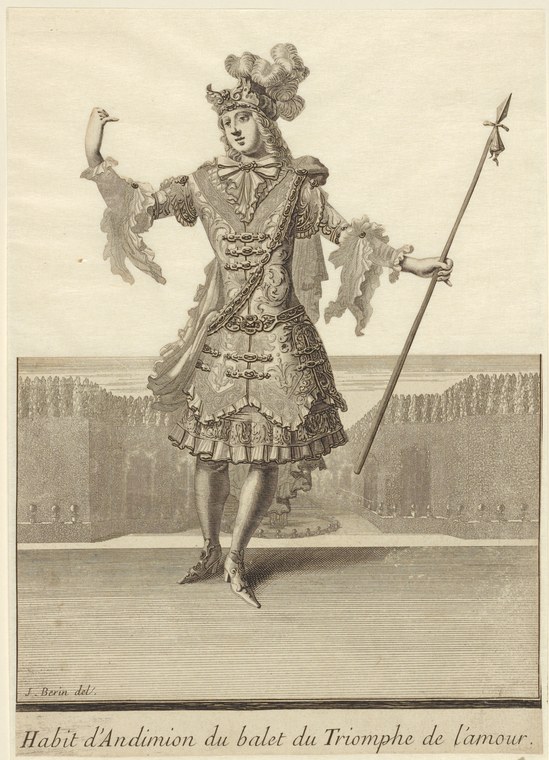
Habit d'Andimion du balet du Triomphe de l'amour
Unknown artist
- Collection:
- Prints depicting dance
- Source:
- New York Public Library
- Rights:
- Public domain — free to use, share and adapt.
- Recorded as:
- Public Domain
This engraving is a rare visual record of how court ballet performers were actually dressed and how they stood in formal presentation—crucial evidence for understanding the visual experience of 17th-century ballet, which has survived only in notation and descriptions. It also documents one of the earliest moments in ballet history, before the form moved to the professional stage, when dance was still a courtly accomplishment performed by aristocrats and royalty. The costume itself shows the theatrical elaboration of court dress that marked ballet as a special and spectacular form of courtship and political display.
What you are looking at
A single figure stands centered in a shallow stage space bounded by formal garden hedges or architecture in the background. The dancer wears an elaborate costume in the French court style: a richly decorated coat or justaucorps with ornamental trim, a knee-length skirt with layered ruffles, silk stockings, and heeled shoes. A large plumed headdress crowns the figure, and the face is painted in the manner of theatrical makeup. The dancer holds the pose of a theatrical presentation, with the left arm raised and bent, the right arm extended downward holding a tall ornamental pike or staff tipped with a pointed finial. The body is turned three-quarter to the viewer, weight balanced on the legs in a composed stance. The engraving technique creates fine linear detail throughout the costume and setting, and the horizontal line work in the background establishes atmospheric depth.
The dancing
The single figure presents a formal, frontal theatrical pose rather than a captured moment of movement. The raised arm and extended pike create an open, heraldic silhouette. The stance shows turned-out legs and a composed upper body characteristic of court dance training, with the weight evenly distributed. The figure's frame is upright and dignified, the gestures ornamental and presentational rather than dynamic. This is a costume portrait of a performer in formal theatrical attitude, not a capture of active choreography.
The dance depicted
This is a costume design document for a performer in the ballet *Le Triomphe de l'Amour* (The Triumph of Love), the foundational French court ballet. The title identifies the wearer as 'Andimion', a character role in the production. The costume and pose indicate a dramatic or heroic character rather than a lyric or shepherdess role. The pike and formal military-inflected dress suggest a warrior or noble courtier character. The image documents not the dance itself but the theatrical presentation and costume worn by a named performer, a common mode of dance documentation in the 17th century when actual movement choreography was rarely notated or recorded visually.
How it was made
This is a copper-plate engraving, identifiable by the fine parallel hatching used to create tone and shadow, the precise linear definition, and the characteristic tonal range of the medium. The artist's name appears at lower left as 'F. Bocin del.' (Bocin delineated/drew it), indicating the engraver worked from a drawn design. Engravings were expensive to produce but allowed multiple impressions to be printed and widely distributed, making them the principal medium for circulating images of court spectacles and dance costumes to a literate audience across Europe. The technique's precision and capacity for fine detail made it ideal for documenting the elaborate embroidery and trim of theatrical costume.
About this work
This engraving documents a costume worn in *Le Triomphe de l'Amour*, performed at the French court in 1681 with the participation of King Louis XIV himself. It is one of a series of costume prints that circulated to record the spectacle and grandeur of court ballet. The figure Andimion is presented in formal theatrical stance wearing the dress of a noble warrior or courtier character, complete with ornamental armor elements and a tall staff. The work belongs to the genre of court ballet documentation and serves as evidence of how dancers were costumed and how they presented themselves in formal theatrical pose.
How to look at it
Observe the precision with which the costume is rendered: every fold of the skirt, every trim and ornamental element of the coat, the structure of the headdress. This level of detail was deliberate—the print was meant to circulate the magnificence and artistry of court spectacle. Notice also the formal, still quality of the pose: this is not a caught moment of movement, but a presentation stance, the way the performer would stand to be seen and admired. The pike and raised arm create a heroic, martial silhouette typical of noble male roles in court ballet. The empty stage space and formal framing emphasize the individual performer as the center of attention, a visual convention of dance documentation from this era.
The artist
The engraver is identified as F. Bocin (or Bochin). Little is documented about this artist individually, but the work is characteristic of French court engravers of the late 17th century who specialized in the documentation of court ceremony, costume, and spectacle. Such prints were often commissioned by or distributed through the royal court to commemorate important occasions and to circulate the prestige and artistic sophistication of court life to a broader elite audience.
The period
The Triumph of Love (1681) marks a watershed moment in ballet history: it was the first ballet to include professional female dancers (as opposed to aristocratic women), and it featured the young king Louis XIV in his final appearance as a dancer. The work emerged from the tradition of court ballet as a form of aristocratic spectacle and political display that had flourished throughout the 17th century. By 1681, however, professional dance was beginning to emerge as a separate art form, and the establishment of the Académie Royale de Danse in 1661 had begun to codify and professionalize the technique. This engraving sits at that threshold: it documents a court spectacle but in a manner that emphasizes individual costume and character role, suggesting the influence of dramatic ballet and theatrical specialization.
Where it lives
The work is held in the New York Public Library's collection of prints depicting dance. It is part of a larger body of costume and spectacle prints from the French court that document the visual splendor and theatrical innovation of court ballet in the reign of Louis XIV.
Dance in this work
Questions about this work
What is 'Le Triomphe de l'Amour' and why is it important?
Le Triomphe de l'Amour (1681) is considered a landmark work in ballet history as the first ballet to feature professional female dancers, breaking the tradition of all-male court ballet. It was also one of the last ballets to feature King Louis XIV as a performer. The work marked a transition from amateur courtly spectacle toward professional theatrical dance.
Who was Andimion?
Andimion was a character role in the ballet, identified in the print's title. The costume suggests a noble warrior or courtier role rather than a pastoral or comic character. We do not know the name of the performer who danced this role, as the print documents the character rather than the individual dancer.
Why do these costume prints matter for dance history?
Before photography, costume prints were the primary visual record of how dancers were dressed and how they presented themselves on stage. They provide evidence of the visual experience of historical dance—the silhouettes, the ornament, the way the body was framed. They also show us which roles existed and how character types were differentiated through costume.
What can we learn about 17th-century ballet technique from this image?
The upright posture, turned-out legs, and open arm positions visible even in this formal pose reflect the codified technique of court ballet. The heraldic, frontal quality of the stance suggests a formal, noble bearing rather than naturalistic movement—an aesthetic very different from later ballet.
More dance artwork





