49 works in this view — arrow keys or swipe to move between them.
Dance in Art
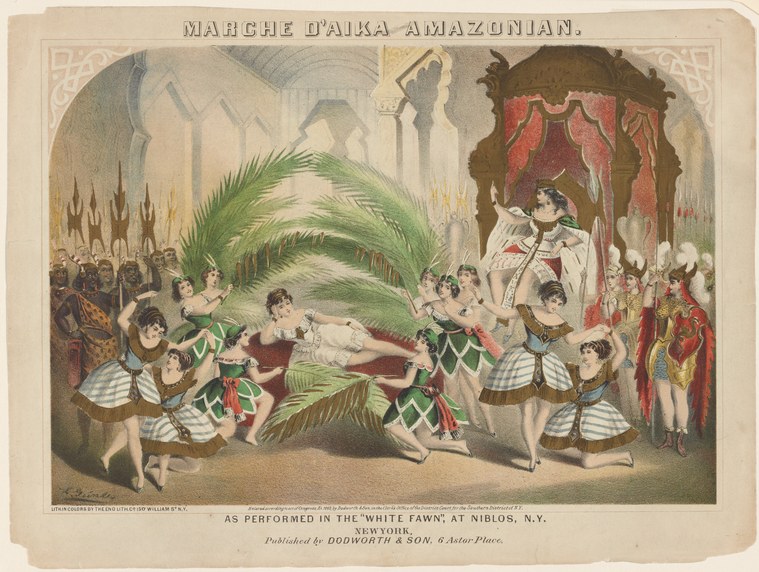
March d'Aika Amazonian, as performed in The white faun, at Niblos, N.Y
Unknown artist
- Collection:
- Prints depicting dance
- Source:
- New York Public Library
- Rights:
- Public domain — free to use, share and adapt.
- Recorded as:
- Public Domain
The work documents an otherwise undocumented performance and reveals the visual grammar of mid-nineteenth-century American theatrical ballet—how spectacle, corps work, and pantomime were staged together. It also captures the persistence of French theatrical exoticism in American venues and the circulation of European balletic practice through both performance and print.
What you are looking at
A theatrical stage scene depicts an exotic Amazonian parade or processional within an ornate interior. A large palm frond dominates the center, carried aloft by corps dancers in light, classical costume—white bodices and short skirts typical of mid-nineteenth-century ballet. In the left background, a crowd of formally dressed spectators gathers in a vaulted colonnade lit by warm overhead light. On the right, an elevated pavilion with burgundy drapery frames a regal or divine female figure in white, attended by companions and officials in rich costume. The composition pulls the viewer's eye from the naturalistic mass of spectators through the fantastical procession toward the throne-like focal point, creating a sense of ceremonial elevation and theatricality typical of Second Empire spectacle ballet.
The dancing
The central corps dancers move in loose formation around the palm, their bodies upright and arms positioned in classical ballet port de bras—some raised, some at the sides. Their weight appears light and lifted, typical of academic ballet training. Individual soloists in the foreground strike pose-like attitudes: one figure in the immediate foreground adopts a dramatic contrapposto, while another extends a leg in what appears to be a développé or similarly extended line. The figures move in a processional flow rather than in tight geometric formation, allowing the eye to read individual bodies against the exotic prop.
The dance depicted
This is a scene from a theatrical ballet, most likely from the ballet-pantomime *The White Faun*, performed at Niblo's Garden in New York in the mid-nineteenth century. The 'March d'Aika Amazonian' (or similar title, possibly transliterated from French) suggests an invented exotic geography and fantasy subject—common conceits in Romantic and Second Empire ballet. The choreography appears to be processional rather than classically structured, with emphasis on spectacle, tableau, and the integration of pantomime. The dancers' unadorned classical costume and the formal architectural setting suggest this is a balletic interpretation of exoticism rather than ethnographic dance, typical of European theatrical practice of the period.
How it was made
This is a hand-colored engraving or aquatint, identifiable by its fine linear cross-hatching for shadow and tone, the crisp edges of figures and architecture, and the quality of printed color in distinct zones. The medium allowed for mass reproduction and wide circulation in illustrated theatrical journals and souvenir prints of the period. The hand coloring—visible in the precision of the warm light on the colonnade, the deep burgundy of the pavilion curtains, and the cool flesh tones of the dancers—suggests a commercial theatrical print made for audiences or critics to take home and recall a live performance they had witnessed.
About this work
This is a theatrical dance scene from a mid-nineteenth-century spectacle ballet performed in New York, documenting a moment of invented exotic pageantry rendered in the classically trained ballet idiom of the Second Empire. The work sits at the intersection of theatrical print culture, Romantic ballet aesthetics, and the American appropriation of European operatic spectacle. It belongs in a dance gallery as evidence of how ballet companies of the era staged fantasy, used the corps de ballet as architectural mass, and marketed theatrical exoticism to paying audiences through both live performance and printed souvenir records.
How to look at it
Attend to the composition's use of the palm frond as a vertical axis organizing the corps dancers around it—this is a signature move of mid-century ballet production, using props and living bodies as sculptural elements. Notice how the formal architectural frame (the colonnade, the pavilion) gives weight and authority to the scene, elevating the dancers and their movement into a kind of ritual or coronation rather than a simple processional. The moment captured is not an instant of movement but a sustained tableau or processional pause, typical of how spectacle ballet froze moments of choreographed action for visual impact. The formal distance between the spectators and the spectacle-within-the-spectacle (the pavilion scene) suggests the theatrical convention of embedding performance within performance.
The artist
The artist is not recorded. The print was published by Dodworth & Son of Actor Place, New York—a significant theatrical print house. Dodworth & Son are known for producing hand-colored theatrical engravings and lithographs documenting performances at major New York venues including Niblo's Garden, Broadway Theatre, and the Academy of Music during the 1860s. The firm served the theater-going public and the performers themselves, making these prints both documents and souvenirs of ephemeral live events.
The period
This print dates to the period of full Romantic ballet in America, when European companies and American impresarios brought French and Italian ballets to cities like New York, and when the style and repertory of European opera-ballet began to be domesticated for American stages. The 1860s saw the rise of theatrical spectacle as a dominant aesthetic: large corps de ballet, exotic subjects, elaborate sets and machines, and the fusion of dance, pantomime, and scenic design. The work also reflects the mid-century expansion of theatrical print culture in America—souvenir lithographs and engravings were standard merchandise at theaters and in periodicals. The title's reference to 'Amazonian' geography reflects the Romantic fascination with the exotic and untamed, channeled through the disciplined formal language of classical ballet.
Where it lives
This print is held in the New York Public Library's collection of theatrical prints and dance imagery. It is a commercial theatrical print produced and distributed in New York as a souvenir or advertisement for a performance, and exists in the public record as evidence of Niblo's Garden's programming and the repertory of American theatrical ballet in the 1860s.
Dance in this work
Questions about this work
Was this performance actually in the Amazon, or is this pure fantasy?
Pure fantasy. The title 'Aika Amazonian' and the exotic framing are theatrical conceits—Romantic ballet regularly invented fantastical geographies and populated them with classical dancers in tutus. The work uses exoticism as a pretext for spectacle and corps work, not as an attempt to document actual Amazonian culture or dance.
Who danced this, and where was it performed?
The print identifies the venue as Niblo's Garden in New York and credits the performance to a ballet company, but the cast is not recorded on the print. Niblo's Garden (also called Niblo's Theatre) was a major New York venue for opera and ballet in the mid-nineteenth century. The choreography and performers are now unknown unless documented elsewhere.
What is the difference between this and a painting of a ballet scene?
This is a printed multiple, not a unique artwork. An engraving could be hand-colored and sold to dozens or hundreds of theater-goers, making it a form of mass media. This allowed the image to circulate beyond the theater itself, reaching people who had not seen the live performance and serving as advertisement or souvenir.
Why are the dancers in classical ballet costume if this is supposed to be Amazonian?
Because in nineteenth-century European and American ballet, all dancers wore classical tutus and pointe shoes regardless of subject. Classical ballet technique and costume were seen as universal and timeless, while exotic geography was conveyed through accessories, props (like the palm), setting, and pantomime. This conflation of the exotic with the classical was a signature convention of Romantic and Second Empire ballet.
More dance artwork





