49 works in this view — arrow keys or swipe to move between them.
Dance in Art
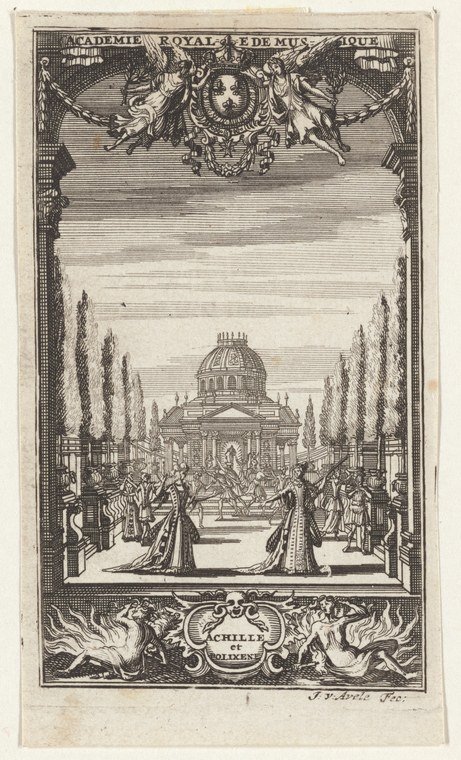
Achille et Polixene
Unknown artist
- Collection:
- Prints depicting dance
- Source:
- New York Public Library
- Rights:
- Public domain — free to use, share and adapt.
- Recorded as:
- Public Domain
Court ballets were the primary theatrical form of the French aristocracy in the 17th century, and printed images like this are among our most reliable records of how they appeared and moved. The work shows the deep integration of classical narrative, formal architecture, and trained bodily movement that defined the period's aesthetic. For historians of dance, art, and courtly culture, such prints are invaluable: they record not just what the court wanted to see, but what was worth the expense and skill of engraving to preserve.
What you are looking at
This is a formal courtly procession or ceremonial dance, seen in perspective down a long colonnade of cypress trees. In the foreground, elegantly dressed figures in late 17th-century costume move through a paved court toward a domed chapel or temple at the center distance. The figures wear elaborate long coats, breeches, and heeled shoes; the women's dresses have the characteristic high waistlines and full skirts of the period. The composition is deeply symmetrical, with the trees framing the scene and drawing the eye toward the architectural centerpiece. The scene is rendered in fine engraved lines creating a silvery, formal atmosphere. The procession moves with deliberate ceremony rather than exuberant movement—this is court dance, structured and hierarchical. The title references Achilles and Polyxena, the tragic lovers from classical mythology, suggesting this depicts a narrative moment from a court ballet or dramatic entertainment.
The dancing
The dancers move in small groups or couples, maintaining upright posture and formal spacing. Their bodies are extended but not stretched—the characteristic port de bras of baroque court dance, with arms held at the side or extended at shoulder height in controlled gestures. The figures walk rather than leap; weight appears grounded. No visible footwork detail survives the engraving technique, but the overall carriage and the formal line suggest trained court dancers executing a choreographed promenade rather than social dancing. The men and women appear to move as matched pairs, consistent with baroque court dance convention.
The dance depicted
This almost certainly depicts a scene from a court ballet or ballet de cour, a theatrical form that dominated French aristocratic entertainment in the 17th century. The classical mythological subject (Achilles and Polyxena) and the formal processional structure are typical of these elaborate productions. The setting—an idealized architectural space rather than any real theatrical stage—was standard in printed records of court ballets, which documented the dances for circulation among the nobility. The style of dress and the engraving technique date this to the late 17th century, a period when court ballet had evolved from participatory aristocratic entertainment toward more theatrical spectacle. The specific dance forms used would likely have included minuet, sarabande, or courante figures, though this engraving captures the theatrical spectacle rather than specific steps.
How it was made
This is a line engraving, rendered in the fine parallel hatching characteristic of 17th-century reproductive prints. The technique allowed intricate detail in costume and architecture while maintaining the light, airy quality appropriate to a scene of courtly ceremony. Engravings like this were the primary means of documenting and circulating knowledge of court ballets beyond those who witnessed them in person; they appeared in published relations accompanying performances or in collected volumes of dance documentation. The fine craftsmanship and formal composition indicate this was produced for a educated, aristocratic audience familiar with both classical mythology and the conventions of court spectacle.
About this work
This is a print documenting a scene from a court ballet performed in late 17th-century France, almost certainly as part of the elaborate theatrical productions that entertained the royal court. The work memorializes not a social dance but a choreographed entertainment involving classical narrative, architectural spectacle, and formally trained dancers in aristocratic dress. As a printed record of an ephemeral performance, it belongs to a critical body of documentation that is often our only evidence of how these dances looked and how court ballet integrated music, text, design, and movement. The engraving technique allowed the work to circulate in manuscript culture among those who did not witness the original performance, making it a form of cultural capital and a record of the tastes and spectacles that defined the French aristocracy.
How to look at it
Observe the deep receding perspective and the architectural frame: the artist chose to show not the dancing itself in close detail, but the spectacle as a unified whole—the dancers as elements within a designed court space. The symmetry of the composition and the processional movement emphasize order, hierarchy, and control rather than individual expression or virtuosity. Note the precision of the costume detail: these were real garments worn by identifiable nobles, and the engraver has recorded them with care, because the identity and rank of the dancer mattered as much as the dance itself. The cypress trees and chapel create a setting that is simultaneously theatrical and ceremonial, suggesting this was a performance that blurred the line between entertainment and state ritual.
The artist
The artist is not recorded in the catalogue. The engraving is characteristic of official court productions and was likely commissioned to document the performance for royal archives and circulation. The signature or mark visible at the bottom may identify the engraver, though the reproduction quality here prevents certain attribution.
The period
This work dates to the height of the court ballet tradition under Louis XIV, when elaborate multi-act performances combining dance, music, text, and spectacular stage machinery were central to courtly ceremony and royal propaganda. The form itself was in decline by the early 18th century as ballet increasingly moved out of the court and into commercial theaters, and as the role of the aristocracy as performers gave way to professional dancers. Engraved prints served as one of the few permanent records of these temporary spectacles, and collecting them became a way for the nobility to commemorate and circulate their refined taste. The classical subject matter reflects the court's identification with Greco-Roman civilization and its use of classical mythology as a vehicle for court flattery and political allegory.
Where it lives
The print comes from the New York Public Library's collection of prints depicting dance. The work is part of a significant body of documented court ballets from the 17th and early 18th centuries, most of which survive only in printed form.
Dance in this work
Questions about this work
What is a court ballet and how is it different from ballet today?
Court ballet (ballet de cour) was an entertainment form for the European aristocracy from the 16th through 17th centuries in which trained dancers—often nobles themselves—performed elaborate spectacles combining dance, music, text, and machinery. Unlike modern ballet, it was participatory, courtly rather than theatrical, and narrative was secondary to display. It eventually evolved into theatrical ballet as it moved into public theaters and professional dancers replaced aristocratic amateurs.
Why would they commission an engraving of a dance performance?
Dances were ephemeral—once performed, they existed only in memory. Printed engravings allowed the court to preserve and circulate an image of the spectacle to those who did not witness it and to future generations. They also functioned as propaganda, celebrating the taste, wealth, and power of the court. Collecting such prints became a mark of cultural refinement.
Is this scene historically accurate, or is it stylized?
Both. The engraver has recorded genuine details of costume, setting, and the formal processional structure of court ballet. However, the perspective and the idealized architectural space are artistic choices that emphasize the theatrical and ceremonial nature of the event. The image documents the spectacle as the court wanted to remember it, not necessarily as a neutral observer would have seen it.
How do we know this depicts Achilles and Polyxena?
The title is inscribed on the print itself, visible at the bottom. The classical subject was typical for court ballets, which often used mythological narratives as a framework for dance and allegory. The scene may depict a specific moment from the ballet's story, though the engraver has chosen to show the procession and spectacle rather than dramatic action.
More dance artwork





