49 works in this view — arrow keys or swipe to move between them.
Dance in Art
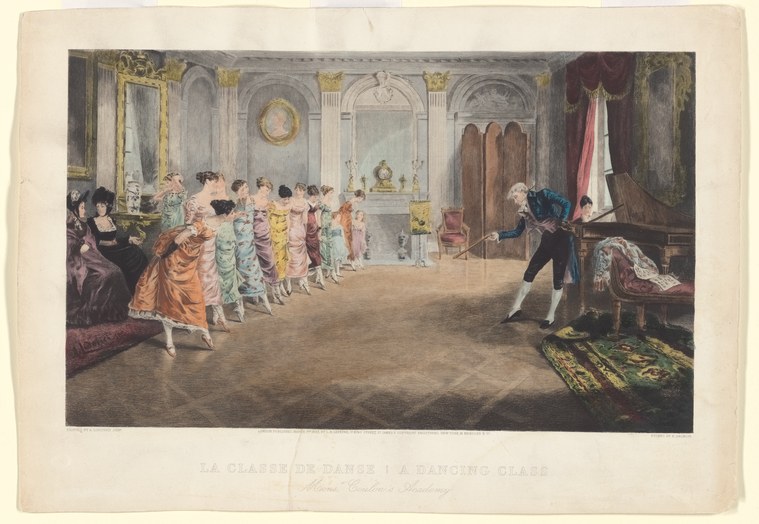
La classe de danse = A dancing class : Monsr. Coulon's Academy
Unknown artist
- Collection:
- Prints depicting dance
- Source:
- New York Public Library
- Rights:
- Public domain — free to use, share and adapt.
- Recorded as:
- Public Domain
This image is one of the few visual records of how ballet was actually taught in the early 19th century, before photography. It shows the academy as a place of social performance—the students arranged, observed, and corrected by a male authority—and reveals how closely dance instruction was tied to manners, dress, and the cultivation of genteel femininity. For historians of dance pedagogy and gender, it is a primary document.
What you are looking at
A formal dance class unfolds in an elegant neoclassical interior: a high-ceilinged room with arched niches, ornamental capitals, and classical architectural detail. A line of young female dancers in pale, high-waisted Empire-line dresses—yellows, pinks, blues, greens—stands in profile or three-quarter view along the left side of the room, each woman in a studied pose with arms positioned for instruction. At the far end of the room, a male instructor or master of ceremonies in dark coat and breeches stands with a gesture of direction or correction. The floor is bare and highly polished; the light is cool and even, characteristic of a interior lit by tall arched windows. A woman in dark clothing sits to the left—possibly a chaperone or matron—while drapery and furnishings suggest the wealth and formality of a private academy. The composition is theatrical and ordered, less a spontaneous dance than a demonstration or examination of technique.
The dancing
The young dancers are arranged in a loose processional line, each body upright and composed, with arms either raised in port de bras or held at the side in fifth position. The postures suggest a controlled, formal style: the spine is straight, the carriage elegant and restrained. The nearest figure at left shows a woman in a pale dress with arm extended, her weight settled; others behind her maintain similar formality. The instructor's gesture—arm extended toward the dancers—indicates correction or direction rather than demonstration. This is not a moment of movement but of held positions, a tableau of instruction.
The dance depicted
This is a representation of an early 19th-century ballet class or academy lesson, most likely in the French tradition, conducted in the style of the Regency or Romantic era. The title credits 'Monsr. Coulon's Academy,' which likely refers to a real historical dance master—such academies were common in Paris and London in the 1820s-1840s. The image shows formal ballet training as it was taught to young women of the gentry and nobility: the emphasis on deportment, the Empire-silhouette dresses, the orderly line, and the male instructor all point to classical ballet technique in its early modern period. The scene is one of instruction rather than performance, capturing the academy or 'classe' as a social and cultural institution as much as a training ground for dance.
How it was made
This is a hand-colored engraving or aquatint, evident from the fine linear work in the architectural detail, the precise registry of figures, and the tonal wash of color applied by hand. The technique allowed for wide circulation as prints—such scenes were popular in the 1820s-1840s as fashionable imagery for the drawing rooms of the educated classes. The use of color is restrained and decorative rather than naturalistic, enhancing the formal, theatrical quality. The medium implies an audience of collectors of social and theatrical imagery, those interested in the manners and accomplishments of polite society.
About this work
This is a print documenting the teaching of classical ballet in the early 19th century, presented as a scene of elegance and refinement. It records not the public theater but the private academy—the space where young women of means learned the techniques and social graces of ballet. The image is valuable both as evidence of pedagogical practice (the arrangement of the class, the instructor's role, the dress) and as a window into how Romantic-era ballet was perceived by its audience: as a marker of cultivation and feminine accomplishment. The attribution to 'Monsr. Coulon's Academy' anchors it to a historical institution and suggests it may be a record of a specific, named school.
How to look at it
Attend to the formal arrangement of the dancers: they are not in motion but held in positions of display, suggesting that the 'class' was also a form of social performance. Notice the instructor's gesture—this is not a ballet master demonstrating but an authority figure directing and correcting. The pale dresses and the upright carriage emphasize control and elegance over physical exertion. The architectural setting—the classical proportions, the ornament—frames dance as one element in a larger aesthetic of refinement and order. This is how the educated classes of the 1830s wanted to see dance: beautiful, controlled, and civilizing.
The artist
The artist is not recorded in the catalogue. The style and subject suggest a French or Franco-English commercial engraver of the 1820s-1840s, working in the tradition of theatrical and fashionable prints. Such images were made for the market rather than commissioned by artists; they document scenes of social and cultural interest to the educated urban public. The hand-coloring suggests a workshop practice in which a master engraver designed the plate and skilled colorists finished each print individually.
The period
In the 1820s-1840s, ballet in the English-speaking world was undergoing rapid development: the Romantic ballet was emerging, pointe work was becoming standard, and the figure of the ballerina was becoming culturally dominant. At the same time, ballet remained an accomplishment of the gentry and nobility, taught in private academies rather than democratically. The image captures this moment when ballet was fashionable but still socially exclusive—a mark of genteel education for young women. The neoclassical interior and the Empire-waist dresses place the scene in this precise period: post-Napoleonic, refined, and aligned with classical ideals of form and deportment.
Where it lives
The print is held in the NYPL's collection of prints depicting dance. It is part of a body of commercial theatrical and social imagery produced for the market in the 1820s-1840s, documenting contemporary fashions, entertainments, and manners.
Dance in this work
Questions about this work
Who was Monsr. Coulon and was this his actual academy?
Several dance masters named Coulon are recorded in early 19th-century Paris and London, but without further documentation this cannot be confirmed. The credit in the title suggests it was either a well-known academy or one sufficiently prominent to market such prints. Such images were often made to commemorate or advertise schools and teachers, suggesting Coulon was a figure of some reputation.
Why are the dancers in dresses, not ballet costumes?
These are school dresses worn during training and instruction, not stage costumes. In the early 19th century, young genteel students were taught in fashionable day dress, often Empire-waist gowns like those shown here. The purpose was to teach deportment and refinement as much as technique. Stage costumes would have been reserved for public performances.
Is this a real class or an artistic fantasy?
The specificity of the title, the documentation of the academy, and the accuracy of the architectural and sartorial detail suggest this is drawn from an actual or closely observed institution. However, the formal, theatrical arrangement suggests the image is a idealized representation meant for public consumption—showing the academy as a scene of elegance and accomplishment rather than capturing a moment of actual instruction.
More dance artwork





