49 works in this view — arrow keys or swipe to move between them.
Dance in Art
Les noces de Pelée et de Thétis
Unknown artist
- Collection:
- Prints depicting dance
- Source:
- New York Public Library
- Rights:
- Public domain — free to use, share and adapt.
- Recorded as:
- Public Domain
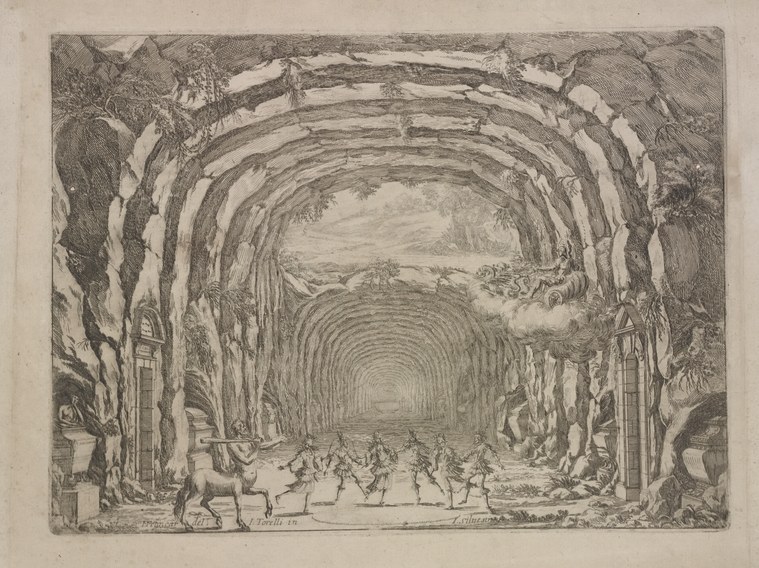
This work demonstrates how baroque theater understood dance not as a codified technique but as an expression of joy, social bonding, and mythological narrative. The architectural grandeur surrounding the dancers elevates their movement and makes clear that dance was considered worthy of the same monumental treatment as classical architecture. For historians of baroque spectacle and court ballet, this image is invaluable evidence of how movement was visualized and circulated in print.
What you are looking at
A grand architectural tunnel recedes into deep perspective, its barrel vault formed by massive rusticated stone blocks that create powerful concentric arches. The architecture is classical, monumental, and almost oppressive in scale. Within this cavernous space, a large group of figures—perhaps fifteen to twenty—are engaged in dynamic movement and dance. The figures are distributed across the floor of the tunnel, some clustered in the center, others toward the sides. They wear classical drapery and appear to be in mid-celebration: some leap, some gesture expansively, some seem locked in social embrace or mutual attention. The lighting is remarkable—it floods through the tunnel's opening at the far end, creating a bright vanishing point that throws the architectural forms into dramatic relief and silhouettes many of the dancing figures. The scene reads as joyous, frenetic, and deliberately theatrical—the kind of mythological wedding feast that would have been a natural subject for Baroque spectacle.
The dancing
The dancers are mostly upright and active, with arms raised and extended in celebratory gestures rather than in closed ballroom holds. Several figures appear to be in mid-leap or turning motion. There is no evidence of the rigid frame or paired positioning of formal baroque court dance; instead the movement reads as exuberant and informal—the kind of social celebration where individuals and small groups move with freedom. The drapery of their costumes suggests classical Greek or Roman dress. Many figures are separated from one another, indicating group celebration rather than partnered technique.
The dance depicted
This appears to depict a mythological feast or wedding celebration in the classical style—the title *Les noces de Pelée et de Thétis* (The Wedding of Peleus and Thetis) confirms this. The scene is not a formal dance in the baroque court tradition, but rather a banquet or revel with music and movement. The figures are revelers at a legendary wedding, engaged in the kind of uninhibited celebration that would have appeared in baroque spectacles and court ballets where mythological themes permitted exuberance. This is theatrical dance in the sense that it depicts dance as part of a dramatic narrative, but not as a codified ballroom or court technique.
How it was made
This is an engraving, likely 17th-century based on the style and technique. The image shows the refined linework typical of the period: parallel lines create tone and shadow, the architectural forms are rendered with precise perspective, and the human figures are defined through careful cross-hatching. Engravings of this type were produced in multiple impressions and circulated widely among educated audiences—they served both as records of court spectacles and as design inspiration. The technique demanded precision and was labor-intensive, which suggests this was a commissioned work of some importance, likely documenting or imagining a courtly or theatrical event.
About this work
This engraving depicts a mythological scene—the wedding feast of Peleus and Thetis—rendered as a baroque theatrical spectacle within a monumental classical architectural setting. The work combines rigorous perspective and architectural knowledge with the celebration of bodily movement and social revelry. It belongs to the tradition of prints that documented or imagined court ballets and theatrical events in the 17th century, where mythology provided a framework for displaying dance, music, spectacle, and the physical exuberance of celebration. The wedding of Thetis and Peleus was a standard subject in baroque theater and ballet, and this image likely reflects either an actual performance or the kind of lavish mythological scene that patrons of the arts expected to see.
How to look at it
Notice how the artist uses the tunnel's perspective to create a frame within which the dancers appear almost small—emphasizing the grandeur of the architectural setting. The vanishing point of light at the far end of the tunnel is the emotional center of the composition, drawing the eye past and through the celebrating figures. The dancers themselves are arranged to suggest motion and energy without being frozen in a single geometric pattern—this is deliberately different from the formal, line-based compositions of court dances in other prints. Look at how the drapery of the costumes suggests movement even in the engraved line, and how the varying sizes of figures convey both depth and the crowd-like nature of a feast.
The period
In the 17th century, the wedding of Peleus and Thetis was a popular subject for court ballets and grand spectacles across Europe, particularly in France and Italy. Such events combined dance, music, scenery, and narrative in elaborate productions that celebrated the power and sophistication of the court. Engravings like this one served to publicize these events and to spread their style and taste beyond the court itself. The baroque fascination with perspective, architectural grandeur, and the marriage of multiple arts forms—dance, music, architecture, poetry—finds full expression here. This was an era when dance was part of courtly education and display, not yet separated into a specialized technical discipline.
Where it lives
Held in the New York Public Library's collection of prints depicting dance. The print is part of a broader holding of dance imagery spanning multiple centuries and traditions.
Dance in this work
Questions about this work
Is this print based on an actual performance?
Possibly. Many baroque spectacles were documented in print after the event, and the wedding of Peleus and Thetis was a fashionable subject for court ballets. However, this could also be an imagined or idealized version created as an independent work of art. Without an artist signature or documented commission, we cannot say with certainty.
What is the wedding of Peleus and Thetis?
In classical mythology, Peleus (a mortal hero) married Thetis (a sea nymph). The wedding was celebrated by gods and mortals alike, and Thetis was the mother of Achilles. The abundance, exoticism, and divine participation made it an ideal subject for baroque spectacle.
How is this different from a formal court dance?
This scene shows celebration and revelry rather than the structured, geometric patterns of courtly dances like the minuet or courante. The figures are not paired in holds or arranged in formal lines, but rather scattered and active, suggesting the kind of uninhibited joy appropriate to a mythological feast.
More dance artwork





