49 works in this view — arrow keys or swipe to move between them.
Dance in Art
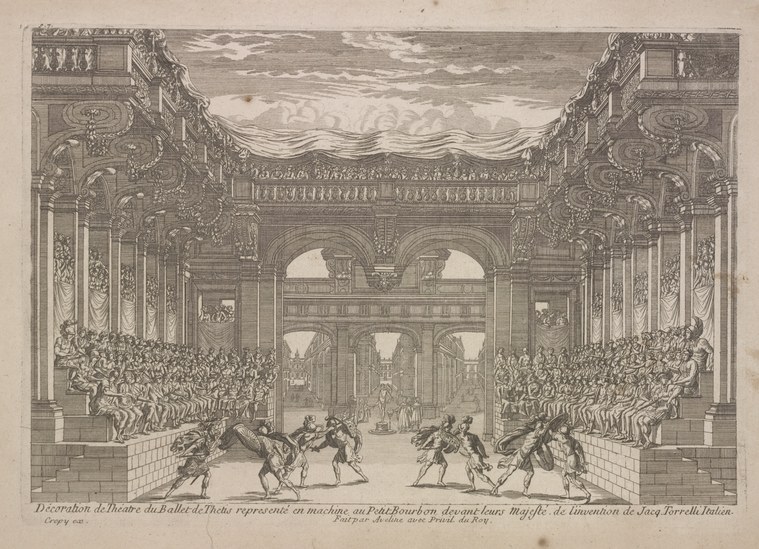
Decoration de Theatre du ballet de Thetis represente en machine au Petit Bourbon devant leurs Majesté de l'invention de Jacq. Torelli Italien
Unknown artist
- Collection:
- Prints depicting dance
- Source:
- New York Public Library
- Rights:
- Public domain — free to use, share and adapt.
- Recorded as:
- Public Domain
This is one of the earliest visual records of court ballet as a theatrical form, and it documents the decisive influence of Italian stage machinery on French dance spectacle. For historians of dance, it shows that 17th-century ballet was not a purely movement-based art but a multimedia event in which the dancer's body was framed, elevated, and defined by architectural scenery, allegorical meaning, and mechanical effect—a context wholly absent from modern ballet. For art historians, it demonstrates how printmaking served to circulate knowledge of ephemeral courtly spectacles to a wider audience.
What you are looking at
A grand theatrical interior rendered in meticulous perspective shows a machine-stage spectacle in progress. The hall is a palatial Renaissance or early Baroque space with ornate pilasters, carved capitals, and a coffered ceiling. Tiered galleries rise on both sides, packed with courtiers and attendants in dark formal dress—hundreds of figures suggest an occasion of state significance. The center stage is dominated by an architectural folly: a large classical structure with arched openings and sculptural detail, from which emerge stylized waves or water effects. In the foreground, four or five figures in Renaissance dress—appearing to be performers—enact a dramatic scene with animated gestures and postures. Their bodies are twisted and lifted in exaggerated attitudes, some appearing to struggle or reach skyward, suggesting supernatural or mythological action. The lighting is theatrical: strong contrast between the pale architectural elements and deep shadows creates drama across the crowded scene.
The dancing
The central performers display extreme, artificial postures that prioritize visual spectacle over naturalism. Their bodies are arched, twisted, and elevated with arms reaching overhead or extended dramatically. The poses suggest virtuosic, balletic movement—the figures appear to be suspended in moments of high elevation or contorted extension rather than walking or in natural stance. The grouping and spatial relationship suggests ensemble or corps work rather than paired dance; the performers are distributed across the stage floor with no evident partnering holds. Their animated attitudes are consistent with theatrical court dance of the period, where movement valued artificiality, elevation, and visual composition over fluency.
The dance depicted
This depicts a machine ballet (*ballet en machine*) of the type popular at the French court in the mid-17th century. The Petit Bourbon was the site of elaborate court spectacles, and the reference to 'l'invention de Jacq. Torelli Italien'—the engineer and stage designer Giacomo Torelli—confirms this as a machinery-driven theatrical event. Such spectacles combined dance, music, poetry, and elaborate stage technology to present mythological narratives. The exaggerated postures and aerial effects visible here reflect the integration of machine-assisted spectacle (platforms, cables, flying effects) with trained court dancers. The dancers' bodies are manipulated by the dramatic stage machinery and the visual demands of the allegorical machinery rather than by balletic form—this is proto-ballet, where the dancers are one element in a larger theatrical apparatus.
How it was made
This is an engraving, likely made from a drawn design and rendered in fine lines to capture both architectural precision and narrative action. The technique allows reproduction of fine detail—the architectural orders, the crowd of individual figures in the galleries, the expressive poses of the dancers—at a scale suitable for circulation as a printed record or souvenir of the spectacle. Such engravings served multiple purposes: they documented the event for those who attended and circulated knowledge of the spectacle to those who did not. The meticulous perspective construction and the care taken to render each element suggest this was made by a skilled printmaker, likely under the supervision of the designer or a court artist, and printed in an edition for distribution among the aristocracy.
About this work
This engraving documents a *ballet en machine*—a courtly spectacle that combined dance, machinery, music, and poetry—performed at the Petit Bourbon in Paris in the mid-17th century. The designer Giacomo Torelli, an Italian master of stage machinery, created the technical apparatus; the dancers enacted mythological or allegorical narratives within this environment of architectural fantasy and mechanical effect. The print is both a record of an ephemeral event and a demonstration of the French court's investment in spectacular visual culture. It shows dance not as an autonomous art but as one component of a larger theatrical and technical system, where the performer's body is shaped by machinery, costume, allegorical meaning, and the demands of an audience of hundreds.
The work belongs to a crucial moment in the history of dance and theatre: the transition from Renaissance spectacle to Baroque court ballet, and the influence of Italian stage design on French courtly practice. Machine ballets were costly, time-consuming events, sponsored by the crown as demonstrations of power, artistic sophistication, and technological mastery. That this moment was engraved and distributed indicates its significance both to those who made it and to the broader educated public who consumed such images.
How to look at it
Trace the perspective lines of the architecture to understand how the stage space is constructed—this illusionistic depth is essential to the machine ballet's effect. Then follow the figures in the tiered galleries and note their uniformity and density: they establish the scale and formality of the occasion and the power of the patron. The four or five performers in the foreground should be examined for posture and gesture: notice the extreme elevation, the twisted spines, the overhead reaches—these are not natural movements but choreographed artifice designed for visibility and spectacle. Finally, attend to the architectural structure at center stage: this is the machine, the apparatus that gave the ballet its character and on which the dancers' movements depend.
The artist
The artist of the engraving is not recorded. The spectacle itself was the invention of Giacomo Torelli (1608–1678), a Venetian stage engineer and architect who revolutionized Baroque theatre through the development of the *scena per angoli* (angled perspective stage) and coordinated machinery for shifting scenes. Torelli worked at the Farnese Theatre in Parma before moving to Venice and later to Paris, where he was invited to design spectacles for the French court under Louis XIV. His innovations in stage machinery and perspective scenery were hugely influential on both French and Italian theatrical practice. The engraving likely derives from a drawing made to commemorate the event.
The period
Machine ballets flourished at the French court during the 1650s–1670s, a period when court spectacle reached extraordinary elaboration and expense. This coincides with the maturation of ballet as a codified courtly practice: Louis XIV himself danced in court ballets, and the training of court dancers became increasingly formalized. The influence of Italian designers like Torelli was decisive: their perspective scenery and mechanical apparatus transformed French court theatre from relatively simple spectacles into complex multimedia events. At the same time, the establishment of the Académie Royale de Danse (1661) marked the beginning of ballet's transition from courtly pastime to professional artistic practice. This engraving sits at the intersection of these developments—it shows dance still embedded in court spectacle, but within a theatrical apparatus of growing sophistication.
Where it lives
This engraving is held in the New York Public Library's collection of prints depicting dance. It is a historical document—a printed record made to commemorate or promote a specific court spectacle. The survival of such prints in institutional collections reflects their circulation within educated European circles and their value as records of courtly magnificence.
Dance in this work
Questions about this work
What is a machine ballet and how does it differ from modern ballet?
A machine ballet was a courtly spectacle combining dance, music, elaborate scenery, and stage machinery to present allegorical or mythological narratives. Unlike modern ballet, which centers on the trained dancer's movement and technique, the machine ballet integrated the dancer into a larger theatrical system: the machinery, scenery, and spectacular effects were equal or greater in importance than the movement itself. Dancers' bodies were made to appear to fly, transform, or interact with architectural fantasy—effects impossible without mechanical apparatus.
Who was Giacomo Torelli and why does his name appear on this print?
Giacomo Torelli (1608–1678) was a Venetian architect and stage engineer renowned for innovations in perspective scenery and coordinated stage machinery. He was invited to Paris to design court spectacles and his work was hugely influential on French theatre design. His name on this print indicates that the spectacle was his invention—the machinery, the scenery, and the overall visual and theatrical concept were his design.
How do we know this depicts an actual event rather than an imaginary scene?
The title text on the print identifies the specific venue (Petit Bourbon), the occasion (a ballet performed before the king and queen), and the designer (Torelli). The architectural precision and the dense crowd of courtiers rendered in meticulous detail suggest this is a documentary image, made to record and circulate knowledge of a specific, costly, and significant courtly event. Such engravings were created to commemorate royal spectacles.
What can we learn about 17th-century court dance from looking at this image?
The postures and attitudes of the performers show that courtly dance of this period valued extreme elevation, contorted positions, and exaggerated gesture—movement designed for visibility and spectacle rather than naturalism. The integration of the dancers with architectural and mechanical scenery shows that dance was not yet an independent art form but part of a larger courtly system. The presence of hundreds of spectators in formal dress indicates that witnessing such spectacles was an important social and political ritual.
More dance artwork





