49 works in this view — arrow keys or swipe to move between them.
Dance in Art
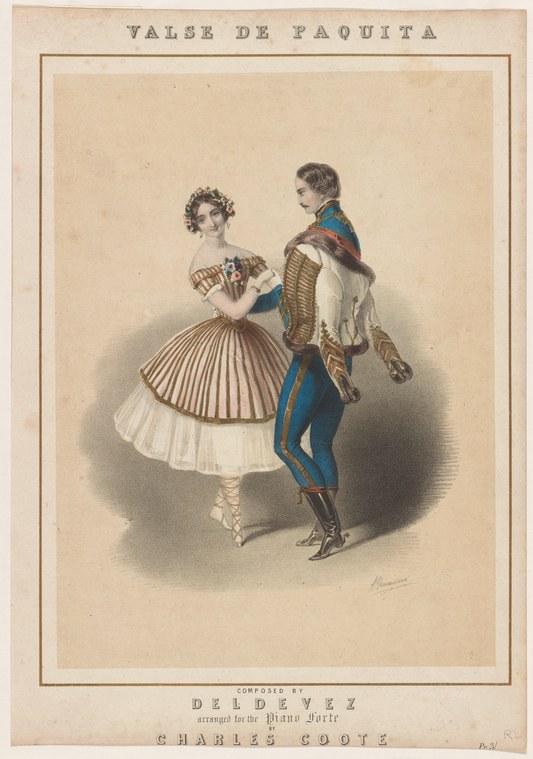
Valse de Paquita, composed by Deldevez, arranged for the piano forte by Charles Coole
Unknown artist
- Collection:
- Prints depicting dance
- Source:
- New York Public Library
- Rights:
- Public domain — free to use, share and adapt.
- Recorded as:
- Public Domain
The *Valse de Paquita* was one of the most widely performed and imitated waltzes of the nineteenth century, and this image is one of the few surviving visual records of how it appeared on stage. For historians of Romantic ballet and ballroom dance, the engraving preserves details of costume construction, posture, and partnering that choreographic notation cannot capture. The image also reveals the intersection of theatrical and social dance: this waltz was performed in ballet, copied in ballrooms, and circulated in prints—a single choreography with multiple lives.
What you are looking at
A young woman in a white pleated tulle skirt and fitted bodice with puffed sleeves stands at the center, crowned with flowers in her hair. She holds the hand of a uniformed military officer in a blue coat with gold braiding and white breeches, who faces her in three-quarter profile. The pair are posed in an intimate moment of courtship or invitation to dance, set against a neutral background with subtle shadow modeling. The woman's full skirt, rendered with fine gradations of tone to show its volume and delicate pleating, dominates the composition. The engraving captures the refined elegance of mid-nineteenth-century theatrical costume and the formal distance maintained between the dancers even in this moment of connection.
The dancing
The woman stands with her weight centered, her body angled toward the officer, left hand extended to meet his. Her right arm curves inward at her side. The officer bends slightly forward at the waist in a courtly gesture, his weight on his back leg, his gaze directed downward toward the woman's face. Their bodies are poised but not yet in motion—this is the moment before the dance begins. The formal posture and the careful maintenance of separation between their bodies reflects the ballroom decorum of the era.
The dance depicted
This is a *Valse de Paquita*, a theatrical waltz from the 1846 ballet *Paquita*. The work is identified in the title cartouche as composed by Deldevez and arranged for piano by Charles Cooke. The image captures not a moment of active dancing but the opening gesture of courtship that precedes the waltz—the invitation and acceptance. The costume identifies this as a theatrical or ballroom scene from the Romantic ballet era, when waltzes featured prominently in dramatic action and were danced in contemporary dress as well as in fantasy scenarios.
How it was made
This is a hand-colored engraving, identifiable from the precise linear work defining the officer's uniform and the delicate parallel lines used to model the tulle skirt. The color is applied selectively: the woman's dress, skin, and hair flowers receive full attention, while the background is left pale. The technique of colored engraving allowed for wide circulation as a print—this would have been sold separately, bound into periodicals, or pasted into theatrical souvenir albums. The signature visible in the lower right suggests an identified artist, though the catalogue does not record it.
About this work
This engraving documents both a dance and a social moment: the opening of a waltz as theatrical event. The *Paquita* ballet was enormously popular across Europe and America in the mid-nineteenth century, and the waltz was its most celebrated number. This print preserves the exact costume, the posture, and the gendered dynamics of the dance as performed on the Romantic stage. The image served multiple audiences—ballet enthusiasts, musicians seeking to perform the work, and the general public curious about fashionable dancing. It is simultaneously a record of choreography, fashion, and theatrical practice.
The work belongs in a dance archive because it documents a specific historical dance, not merely as a narrative scene but as a technical and social event. The careful rendering of the woman's skirt shows how the waltz was performed: in voluminous tulle that required space and momentum to move. The officer's uniform and posture establish the gender roles and formality of the dance.
How to look at it
Observe the exact moment the artist chose to freeze: not mid-step but the instant before the dance begins, the moment of agreement and readiness. The woman's skirt is shown hanging vertically but full of potential volume—the engraver has rendered the pleating to suggest how it will move. The officer's posture is formal but inclined, showing deference to the woman. The hand contact is the only point of physical connection; note how the rest of the bodies maintain distance. This reflects the ballroom waltz protocol of the era: contact only at hand and waist, and even here, before the dance, the contact is minimal.
The artist
The artist is not recorded in the catalogue. The signature visible in the lower right is legible but has not been identified here. The engraving is credited to Charles Cooke only for the musical arrangement. Mid-nineteenth-century theatrical prints of this quality were often produced by specialized engravers and colorists working from sketches or paintings by theatrical designers, but individual attribution was frequently lost or withheld.
The period
The *Paquita* ballet premiered in 1846 and became a staple of the Romantic ballet repertory. The waltz, then still relatively new to the concert stage, was becoming the dominant form of theatrical dance music. This engraving dates from the height of the Romantic era, when ballets increasingly featured contemporary European settings and costumes alongside fantasy scenarios. The theatrical waltz was distinct from the social waltz: faster, more showy, and often featuring the woman's skirt as a central visual element. Prints of theatrical dances were mass-produced during this period and sold to a broad audience, making them one of the primary ways non-theater-goers encountered choreography.
Where it lives
The print is held in the New York Public Library's collection of prints depicting dance. It is catalogued with minimal metadata, reflecting the historical practice of treating such prints as ephemeral or secondary theatrical documents rather than significant artworks. The print was likely sold individually or as part of a collection of theatrical engravings.
Dance in this work
Questions about this work
Who was Paquita and why was this ballet so famous?
*Paquita* premiered in Paris in 1846 with a libretto by Joseph Mazilier. The title role was created for the Spanish dancer María de los Ángeles Pérez García, known as Paquita. The ballet combined Spanish and exotic elements with Romantic conventions and became celebrated across Europe and America. The *Valse de Paquita* was its most famous number and remained in the repertory well into the twentieth century.
What is the difference between a theatrical waltz and a ballroom waltz?
Theatrical waltzes were faster, more elaborate, and designed for visual spectacle on stage, with large skirts and showy arm movements. Ballroom waltzes maintained basic three-beat timing and a closed frame but were danced more simply and soberly in social settings. The same basic step could be performed in both contexts, but the theatrical version prioritized display.
Why is the woman wearing a tulle skirt?
Tulle was the standard material for mid-nineteenth-century ballet skirts because it was lightweight, would hold its shape when starched, and created a romantic silhouette that emphasized the woman's movement. The pleating visible in this engraving would allow the skirt to move fluidly while waltzing, creating the visual spectacle that was central to Romantic ballet.
What does the officer's uniform tell us?
The uniform indicates that this waltz is set in a contemporary or semi-contemporary social context—a ballroom, a military scene, or a theatrical fantasy of European courtship. His rank and nationality are not specified in the print, suggesting a generic European officer type rather than a historically specific character.
More dance artwork





