49 works in this view — arrow keys or swipe to move between them.
Dance in Art
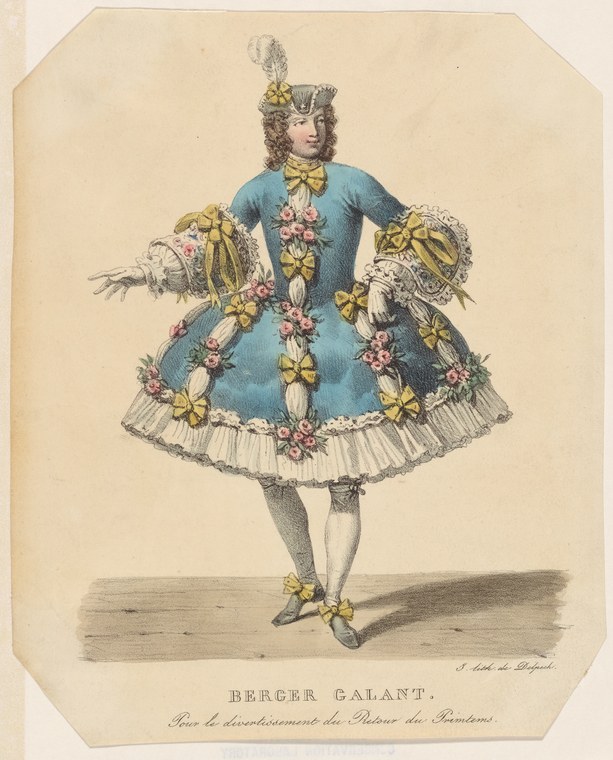
Berger galant pour le divertissement du Retour du printems
Unknown artist
- Collection:
- Prints depicting dance
- Source:
- New York Public Library
- Rights:
- Public domain — free to use, share and adapt.
- Recorded as:
- Public Domain
This print documents the visual and performative conventions of 18th-century French theatrical dance and the crucial role of costume and presentation in defining a character and role. For historians of dance, fashion, and court culture, it offers precise visual evidence of how allegorical and pastoral characters were costumed and posed, revealing the gap between the 'shepherd' concept and the aristocratic reality of the performance. The hand-coloured engraving itself is a primary document of how theatrical dance was circulated, marketed, and consumed among the French elite.
What you are looking at
A single figure in aristocratic dress stands alone against a neutral ground, posed in a formal frontal stance with arms extended outward at shoulder height. The dancer wears an elaborate blue silk dress with a full skirt, decorated with large golden bows down the front and at the hem, interspersed with pink floral garlands. The skirt is gathered into deep pleats and trimmed with white lace ruffles. A matching golden bow adorns the chest, and the hair is styled in long ringlets crowned with a tall white feathered headdress with a golden ornament. The figure wears white stockings and golden heeled shoes. The pose suggests a moment of presentation or salutation rather than active movement—the weight is evenly distributed and the body is upright, as if displaying the costume and bearing of a court entertainer. The hand-coloured engraving technique renders every decorative detail of the dress with precision, and the careful symmetry of the composition emphasizes the figure as an object of visual admiration.
The dancing
A single dancer stands in an upright, frontal pose with arms held at shoulder height, palms generally open or relaxed. The posture is static and presentational rather than dynamic, with weight centered and legs straight. The extended arms and open hand position suggest a gesture of address or flourish typical of court entertainment, but there is no suggestion of weight transfer, turning, or the active musculature of sustained movement. The body is arranged to display the costume fully and symmetrically.
The dance depicted
The title identifies this as a 'galant shepherd' (berger galant) performing 'for the entertainment of the return of spring.' This locates the work within the pastoral entertainment tradition of 18th-century French court and commercial theatre, where allegorical and rustic characters performed elaborate spectacles. Despite the shepherd designation, the costuming is entirely aristocratic and courtly rather than rustic—the character is a theatrical fiction, a courtier performing shepherdhood. The pose and presentation suggest a static tableau or salutation moment rather than a step sequence; this may be a portrait of a performer in costume, or a design image showing how the role should be presented. The exact dance form is unclear from the image alone, though the context points to baroque court dance conventions or mixed-media spectacle dancing (danse in a theatrical divertissement).
How it was made
This is a hand-coloured engraving, likely French, from the 18th century. The linear precision of the engraved line and the careful hatching for shadow are visible in the figure's hair, stockings, and body contours, while watercolour or gouache has been applied to render the vivid blues, golds, and pinks of the costume. The technique allowed for mass production and circulation among collectors and theatregoers interested in court fashion and theatrical costume. The combination of engraving and hand colouring suggests this was a luxury print, likely from a series documenting fashionable entertainments or theatrical innovations of the period.
About this work
This hand-coloured engraving depicts a performer in 'galant shepherd' costume from an 18th-century French theatrical divertissement celebrating the return of spring. The figure is presented in a static, frontal pose that emphasizes the lavish costume—a blue silk dress laden with golden bows and floral ornaments—rather than active choreography. The image belongs to a tradition of theatrical costume prints that documented both the visual spectacle and the social fantasy of ancien régime entertainment, where aristocratic performers took on pastoral personae as a form of courtly amusement. It represents the visual culture of court dance and spectacle at a moment when printed fashion and theatrical imagery were central to how these entertainments were disseminated and consumed.
How to look at it
Observe the extreme care taken to render every element of the costume—the specific placement of each bow, the texture of the lace trim, the style of the headdress. The frontal, static pose is not accidental but conventional for a costume print; it allows the viewer to assess the complete design and the performer's bearing. The golden ornaments against the blue silk, the contrast of the white lace, and the pale stockings create a visual hierarchy meant to display wealth and refinement. Note also how the figure's symmetry and centering—even the placement of the arms—reinforce a sense of presentation and display rather than narrative action or emotional expression. This is how a role was 'shown' to potential patrons or admirers.
The artist
The artist is not recorded. The print is signed only with a barely legible inscription at bottom left. The style and execution are consistent with mid-to-late 18th-century French theatrical costume prints, a genre produced by both named and anonymous engravers working for print publishers catering to courtly and wealthy urban audiences. The professional execution and careful hand colouring suggest a workshop production rather than an isolated work.
The period
In the 18th century, the pastoral mode was a dominant convention of court entertainment and commercial spectacle across Europe, but especially in France. Aristocrats and professional performers alike adopted the costumes and personae of shepherds and shepherdesses in ballets, divertissements, and theatrical comedies as a form of refined play and social fantasy. The 'return of spring' theme was a perennial subject for seasonal spectacles. At the same time, theatrical costume prints became a major commercial genre, allowing audiences who had not attended a performance to own a visual record of celebrated roles and fashionable dress. This print sits at the intersection of court culture, theatrical commerce, and print collecting.
Where it lives
The work is held in the New York Public Library's collection of prints depicting dance. It is catalogued as a hand-coloured engraving of unknown date and artist, identified only by its printed title and a signature that remains unclear.
Dance in this work
Questions about this work
Was this costume worn by an actual performer, or is it a fantasy design?
The print likely documents both. It may record an actual costume seen in performance, or it may be a design proposal or idealized version for a known role. The precision of the rendering and the theatrical provenance suggest connection to a real production, but the print itself serves as a template or advertisement for how the role should look, regardless of whether every dancer wore exactly this version.
Why is a 'shepherd' wearing such expensive, aristocratic clothing?
In 18th-century court entertainment, the pastoral mode was pure fantasy—a game in which aristocrats and courtiers performed refined, allegorical versions of rural life. The elaborate costume is itself the joke and the luxury. A 'shepherd' in this context is a courtier playing at simplicity, and the visual display of silk, gold, and jewels is essential to the entertainment. It advertises both the wealth of the patron and the wit of the performance.
What kind of dance did this performer do?
Based on the date, costume, and theatrical context, this performer likely engaged in some combination of baroque court dance steps (minuet, courante, gavotte), pantomime, and social or theatrical gestures. The static pose in the print does not show active dancing, but rather the presentational moment—how the character appeared when acknowledging the audience or beginning a scene.
More dance artwork





