49 works in this view — arrow keys or swipe to move between them.
Dance in Art
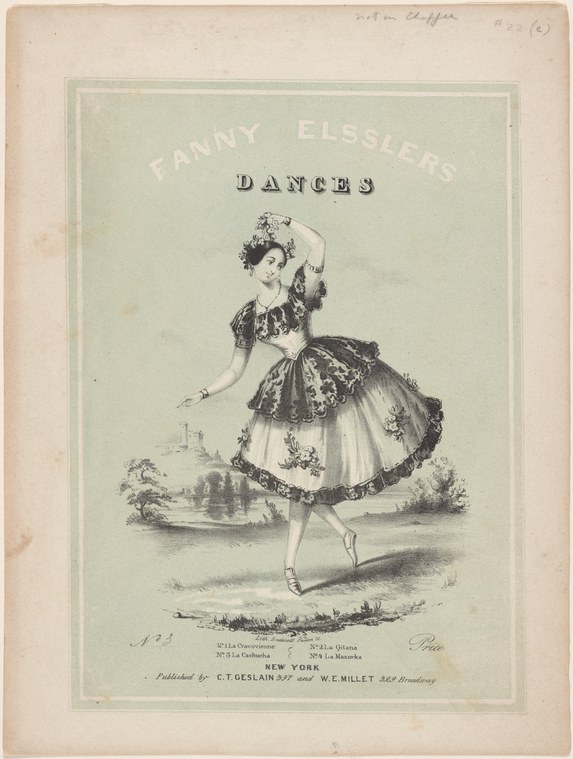
Fanny Elssler's dances: No. 1, La cracovienne, no. 2, La gitana, no. 3, La cachucha, no. 4, La mazurka
Unknown artist
- Collection:
- Prints depicting dance
- Source:
- New York Public Library
- Rights:
- Public domain — free to use, share and adapt.
- Recorded as:
- Public Domain
Fanny Elssler was one of the two most famous ballerinas of the Romantic period (alongside Marie Taglioni), and her specialty—incorporating character and folk dances into classical ballet—distinguished her artistic identity and influenced the direction of theatrical dance. This print is evidence of how 19th-century dance stardom was built and marketed through image and publicity, and it documents the costume, pose, and aesthetic ideals of one of the era's greatest performers. For historians of dance, costume, and theatrical practice, it offers concrete visual evidence of how Romantic-era ballerinas were trained, dressed, and presented to audiences.
What you are looking at
A single female dancer in a romantic-era theatrical costume dominates the composition, posed mid-performance against a pale green background. She wears a white tulle skirt with dark embroidered or patterned overlay, a fitted dark bodice with short sleeves, and an ornamental headdress. Her right arm is raised gracefully at shoulder height with palm upward; her left arm extends to the side with hand open. She stands en relevé on her right leg, her left leg bent with knee raised, capturing a moment of elevation and balletic poise. Behind her, a faint landscape sketch suggests either a theatrical backdrop or setting—trees and possibly a distant structure—rendered in light grey wash. The overall composition is framed by a simple rectangular border with pale green edges, and text at top reads "FANNY ELSSLER'S DANCES" with four numbered dances listed below: "No. 1 La cracovienne, no. 2 La gitana, no. 3 La cachucha, no. 4 La mazurka." Publication information at the bottom indicates C. T. Geslain as publisher.
The dancing
The dancer stands in a classical balletic frame with high port de bras, her arms positioned in a pose suggesting restraint and elegance characteristic of the Romantic ballet aesthetic. Her torso is upright and aligned, her weight lifted through an extended supporting leg. The raised left leg, held in a bent position rather than fully extended, suggests a moment of movement rather than a static position—possibly mid-pirouette or during a traveling step. Her face is turned slightly, adding a sense of direction and narrative to the pose. The posture demonstrates formal training in the academic ballet vocabulary of the mid-19th century.
The dance depicted
This is a theatrical print advertising the four celebrated dances performed by Fanny Elssler, the Austrian prima ballerina of the Romantic era. The image itself appears to represent a generic or composite portrait of the dancer rather than depicting any single dance, though the costume—white tulle skirt with decorative overlay—is consistent with Romantic ballet aesthetics of the 1830s–1840s. The four numbered dances listed were Elssler's signature roles: La Cracovienne (a Polish folk-inspired piece), La Gitana (Spanish-inflected), La Cachucha (a Spanish dance), and La Mazurka (based on Polish folk form). All four blend theatrical ballet vocabulary with popular national or ethnic dance forms, a hallmark of Romantic-era choreography and Elssler's particular fame.
How it was made
This is a hand-colored engraving or lithograph, as evidenced by the fine line work defining the dancer's figure and costume, the delicate rendering of the tulle skirt through parallel hatching and wash, and the text integration typical of theatrical prints of the period. The pale green background and flesh tones appear to be applied by hand or in a color printing process. The technique allowed for relatively rapid mass production of theatrical publicity, and the work's style, composition, and format are consistent with the popular theatrical print trade of the 1830s–1840s. Publication by C. T. Geslain (a known Parisian music and theatrical publisher) and W. Emiliet in London indicates dual distribution, reflecting Elssler's international fame.
About this work
This is a promotional theatrical print of Fanny Elssler, one of the most celebrated ballet dancers of the Romantic era, advertising four of her signature dances. Rather than depicting a single performance, it presents an idealized image of the dancer in costume, posed in a graceful classical ballet frame. The four dances listed—La Cracovienne, La Gitana, La Cachucha, and La Mazurka—represent a defining feature of Romantic ballet: the incorporation of popular, folk, and national dance forms into the academic ballet vocabulary, performed by a virtuoso soloist. The print is both a work of art and a commercial advertisement, circulated in Paris and London to promote Elssler's performances and celebrity.
How to look at it
The print captures the dancer in a moment of control and grace, posed en relevé with her arm raised—a gesture of classical restraint and refinement. Note the attention to the costume's details: the embroidered overlay on the skirt, the fitted bodice, the headdress. The faint landscape background is deliberately vague, allowing the figure to dominate. Observe the rendering of the tulle skirt—the artist has used parallel lines and subtle shading to suggest the fabric's translucency and movement. The pose itself is neither a frozen still nor an extreme moment of virtuosity, but rather a composed, dignified presentation of the dancer as a cultivated performer.
The artist
The artist is not recorded. The print was published by C. T. Geslain (Paris) and W. Emiliet (London), established theatrical print publishers of the period. The work is consistent with the commercial portrait and theatrical publicity prints produced in France and England during the 1830s–1840s, a booming market for dance imagery driven by the Romantic ballet craze and the international stardom of dancers like Elssler.
The period
This work dates to the height of the Romantic ballet era (approximately 1830–1850), when ballet had shifted from court spectacle to popular theatrical entertainment, and when the ballerina—rather than the danseur—became the central figure of ballet. This was the era of pointe work, the rise of the supernatural and exotic in choreography (sylphs, spirits, foreign lands), and the cult of the prima ballerina as celebrity. Fanny Elssler's particular fame rested on her skill in character dances—Spanish, Polish, and other folk forms adapted for the stage—which offered an alternative to the ethereal, otherworldly aesthetic associated with her rival Marie Taglioni. Theatrical prints like this were a major medium for disseminating images of dancers to an increasingly broad, urban, middle-class audience.
Where it lives
This work is held in the New York Public Library's collection of prints depicting dance (nypl). It is a commercial theatrical print, one of thousands produced in Paris and London during the Romantic era to advertise and celebrate famous dancers.
Dance in this work
Questions about this work
Who was Fanny Elssler?
Fanny Elssler (1810–1884) was an Austrian prima ballerina and one of the most celebrated dancers of the Romantic ballet era. She was known for her technical skill, her dramatic presence, and especially for her expertise in character dances—Spanish, Polish, and other folk forms adapted for the theatrical stage. She was a major rival to Marie Taglioni and had an international career spanning Europe and the Americas.
What are the four dances listed?
La Cracovienne is a Polish dance; La Gitana is a Spanish-inflected piece (gitana means 'gypsy'); La Cachucha is a Spanish dance; and La Mazurka is based on the Polish folk form of that name. All four blend classical ballet vocabulary with popular or national dance forms, which was Elssler's specialty and a hallmark of Romantic-era choreography.
Is this a portrait of an actual performance?
No. This is a composite or idealized theatrical portrait, advertising all four of Elssler's famous dances in a single image. The costume and pose are consistent with the Romantic-era aesthetic, but the image serves as promotion rather than documentation of a specific moment in a specific performance.
What does 'en relevé' mean?
En relevé means rising onto the balls of the feet—a fundamental position in ballet that creates the illusion of height, grace, and weightlessness. In this print, the dancer is posed on one supporting leg en relevé, which was a signature moment in Romantic-era choreography.
More dance artwork





