49 works in this view — arrow keys or swipe to move between them.
Dance in Art
Dance prints from L'Illustration
Unknown artist
- Collection:
- Prints depicting dance
- Source:
- New York Public Library
- Rights:
- Public domain — free to use, share and adapt.
- Recorded as:
- Public Domain
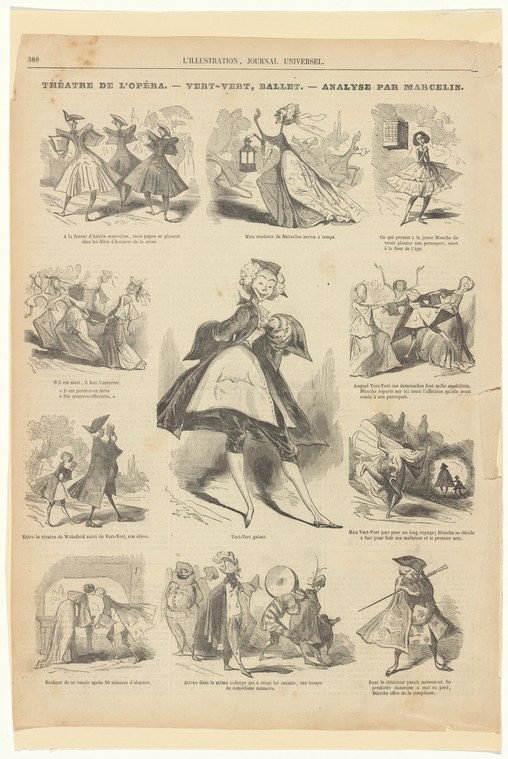
This work documents the emergence of theatrical dance as popular entertainment and visual spectacle for a mass audience, distributed through print media. It shows the vocabulary of physical comedy and transgression that would become central to modern performance, and it demonstrates how the illustrated newspaper made dance visible to readers who might never attend a theater. For historians of dance, popular culture, and print media, this page is evidence of how the body on stage was understood, sexualized, and made laughable in the mid-19th century.
What you are looking at
This is a page of satirical theatrical dance scenes, rendered as wood or steel engravings with the characteristic line work and tonal variation of 19th-century print reproduction. The page contains twelve separate vignettes arranged in a grid, each depicting a moment from what appears to be comic opera or vaudeville performance. The scenes show dancers—mostly women in elaborate skirts, some in men's dress—caught in exaggerated postures: a woman with her skirt blown upward by the wind or lifted in motion; couples in awkward embraces; a figure balanced on one leg in an improbable attitude; performers tumbling or falling. The costumes are recognizably mid-to-late 19th century: full skirts with crinolines, tight bodices, bonnets, and period coats. The settings are minimal—a few scenes include simple interior furnishings or landscape elements—but the focus throughout is on the body in motion and the comic potential of theatrical gesture. The whole effect is one of irreverent humor about theatrical performance and the female body on stage.
The dancing
The dancers throughout display exaggerated, unbalanced postures that emphasize comedy over technical precision. Multiple figures show weight distributed asymmetrically, legs extended or kicked at extreme angles, arms thrown outward for comic effect. Several scenes show couples in loose or sliding holds rather than the formal closed positions of ballroom dance. One central figure appears to be executing a pirouette or turn with one leg extended, skirt splayed, in a moment of deliberate instability. The bodies are rendered with anatomical awareness but deliberately distorted for satirical effect—elongated limbs, contorted spines, exaggerated facial expressions. This is not classical ballet technique but rather the physical vocabulary of stage comedy and music-hall performance.
The dance depicted
These appear to be scenes from opéra comique or vaudeville entertainment of the Second Empire or early Third Republic era, possibly illustrations of a specific production or a generic collection of theatrical types. The costumes and the satirical treatment suggest a French source and audience. The dances depicted are not named or codified styles but rather the stock physical gags and movements of popular theater: the inadvertent revealing of a woman's legs, the awkward pas de deux between mismatched partners, the tumble and recovery. These are dances of social performance and transgression—moments where the body breaks decorum. The publication in L'Illustration, a major French illustrated newspaper, indicates these were meant for a broad educated audience familiar with Paris theater.
How it was made
These are engravings or steel engravings, likely wood-engraved reproductions, printed in the pages of L'Illustration. The line-work is precise and economical: the artist conveys form, fabric, and movement through parallel hatching, cross-hatching, and the strategic use of white paper. The technique allowed rapid, economical reproduction of multiple scenes and was standard for newspaper and magazine illustration from the 1840s through the early 20th century. The fineness of the line and the density of the composition suggest these are original designs meant specifically for this format, not reproductions of larger paintings. This was a medium of broad circulation and immediate currency—the illustrations were ephemeral, meant to comment on current performances and fashions.
About this work
This is a page of satirical engravings from L'Illustration showing theatrical dance and performance from mid-19th-century Paris. The twelve scenes depict moments of comic transgression and physical exuberance—women's skirts caught mid-twirl, dancers tumbling or in awkward embrace—drawn with the precise, economical line-work of steel engraving. The subjects are not classical ballet or formal ballroom dance but the knockabout comedy of opéra comique and popular theater, rendered with both anatomical sophistication and deliberate distortion for satirical effect. The work belongs in a gallery of dance in art because it documents a crucial moment when dance moved from the concert stage into the wider world of popular entertainment, and when the human body in motion became a subject for humor, social commentary, and the new medium of mass-circulation illustrated journalism.
How to look at it
Attend first to the moment of instability in each scene: the artist has chosen the instant when the body is most unbalanced, most exposed, most ridiculous. Notice how the line-work conveys not just form but the speed and direction of movement—the skirt follows a curve that implies upward motion, the extended leg catches the body in the middle of a gesture. Observe how the costumes, rendered in fine detail, are themselves part of the comedy: the bulk of the crinoline, the tightness of the bodice, the elaborate bonnet—all designed for a body at rest—are made absurd by motion. Finally, consider what the choice of these particular moments tells us about the 19th-century viewer's relationship to the female body and to theatrical performance: these are scenes of transgression rendered as entertainment.
The period
These engravings date from the era of the Second Empire or early Third Republic in France (roughly 1850s–1870s), when L'Illustration was at the height of its influence and when opéra comique was a dominant form of public entertainment. This was the age of Offenbach and the rise of operetta—theater that mixed music, dance, and comedy for a popular audience. The illustrated newspaper was itself a new technology of cultural mediation; L'Illustration, founded in 1843, made visual culture accessible to the educated middle class for the first time. Dance in this context was not primarily a concert art (though Romantic ballet was still performed) but an element of theatrical spectacle and social satire. The exaggerated physicality and transgressive humor of these scenes—especially the repeated motif of the woman's lifted or exposed skirt—reflect both the visual excitement and the anxieties about female sexuality and propriety that characterized the period.
Where it lives
This page is from L'Illustration, the French illustrated newspaper founded in 1843. L'Illustration was a primary vehicle for visual journalism and cultural commentary in 19th-century France, reaching a broad educated audience. The work is part of the New York Public Library's collection of prints and illustrated periodicals.
Dance in this work
Questions about this work
What is opéra comique and why is it important to dance history?
Opéra comique was a form of French theatrical entertainment, popular from the 18th century onward, that combined spoken dialogue, song, and dance in comic or lighthearted stories. It was not "comic" in the sense of humorous (though many were) but rather "comic opera" in the sense of not being grand opera. It was hugely popular with broad audiences and was a primary venue for theatrical dance outside the concert ballet stage. For dance history, opéra comique is significant because it kept dance alive as a popular and participatory art form, and because it influenced how dance was understood and represented in visual culture.
Why are these images satirical?
The engravings are satirical because they present theatrical dance and performance as inherently comic and physically absurd. The exaggerated postures, the repeated motif of the exposed or billowing skirt, the ungainly couples—all are designed to laugh at both the performers and the conventions of theatrical spectacle. This satirical treatment reflects a tension in the 19th century between the prestige of ballet as a high art form and the role of dance in popular entertainment, which was often viewed with suspicion or mockery, especially regarding female performers and their bodies.
How does the medium of engraving affect what we see?
Steel or wood engraving, the medium used here, is an art of precise, economical line-work. The artist conveys form, texture, and movement through the density and direction of parallel lines. This technique was ideal for newspaper reproduction and allowed rapid distribution to a mass audience—these images could be printed thousands of times without degradation. The sharpness and clarity of engraving also lends itself to satirical exaggeration: the clean line can render the grotesque or the comic with equal precision as the dignified. For a viewer in the 1860s, these images would have appeared in the pages of a weekly newspaper, offered as commentary on current theatrical events.
More dance artwork





