49 works in this view — arrow keys or swipe to move between them.
Dance in Art
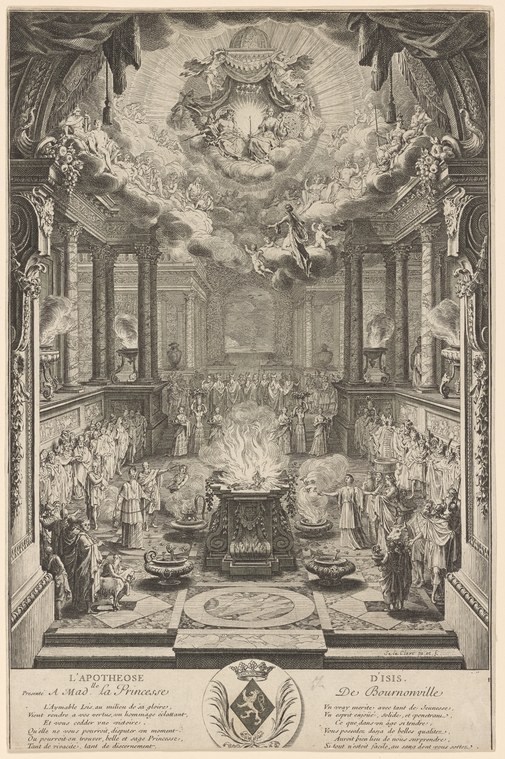
L'apotheose d'Isis presenté a Madlle. La Princesse de Bournonville
Unknown artist
- Collection:
- Prints depicting dance
- Source:
- New York Public Library
- Rights:
- Public domain — free to use, share and adapt.
- Recorded as:
- Public Domain
This is a primary document of the ballet de cour, the ritualized courtly spectacle that was the direct ancestor of theatrical ballet. It shows how 'dance' in the 17th–18th-century court was structured around allegory, heraldry, and ceremony rather than technical virtuosity, and it reveals the performative context in which early ballet evolved. For dance historians, it is invaluable evidence of the aesthetic priorities and social functions of courtly movement before the ballet tradition became professionalized.
What you are looking at
This is an engraved representation of a grand theatrical apotheosis, likely commemorating a performance or honoring a royal personage. The composition is vertically organized in three distinct zones. At the top, within a radiant sunburst halo, sits an enthroned figure (presumably the goddess Isis, or a personage identified with her) attended by winged celestial beings and swags of draped fabric. Below, the middle distance shows a palatial interior with monumental Corinthian columns receding in perspective, their shafts adorned with sculptural reliefs. The foreground depicts a ceremonial assembly: crowds of figures in 17th- or 18th-century court dress stand in formal arrangement around a central altar or ceremonial vessel from which rises a plume of smoke or incense. The figures are organized into distinct groups—some kneeling, some standing—with clear bilateral symmetry. The lighting is rendered through fine crosshatching that emphasizes the grandeur of the architecture and the spiritual elevation of the scene. The entire composition is framed by decorative architectural elements, swags, and heraldic emblems at top and bottom.
The dancing
The figures are rendered in a formal, processional arrangement rather than dynamic dance movement. Those in the foreground are depicted kneeling or in attitudes of reverence and homage; none show the extended limbs, pointed feet, or turned-out positions characteristic of trained dance. The figures are dressed in contemporary court costume—long coats, breeches, and heeled shoes for men; long gowns for women—and are positioned as supplicants or witnesses rather than as dancers executing steps. The bilateral symmetry and static poses suggest ceremony and ritual rather than choreography. Some figures carry torches or ritual objects, and their arrangements create formal processions rather than interlocking dance partnerships.
The dance depicted
Despite its theatrical context and the dedication 'presenté à Madlle. La Princesse de Bournonville,' this engraving does not depict social or theatrical dance in the modern sense. Rather, it represents a court ballet or grand spectacle in the mode of the ballet de cour tradition—an allegorical, processional, and tableaux-based form where costumed courtiers and professional performers assumed poses and moved in formal patterns to celebrate a patron or commemorate an event. The 'dance' here would consist of slow, dignified movements, geometric groupings, and symbolic gestures organized around a narrative (the apotheosis of Isis). The participants likely executed simple traveling steps (promenades, processionals) rather than the complex footwork of later theatrical ballet. This appears to document a single moment of tableau or ceremonial assembly within a longer spectacle, emphasizing spectacle and allegory over technical skill.
How it was made
This is an engraving, recognizable by the fine parallel lines (hatching and crosshatching) used to build tone and shadow, the crisp linear definition of architectural detail, and the precise linear perspective. Engraving was the premium reproductive medium of the 17th and 18th centuries, requiring skilled hand-engraving of a copper plate; its expense and technical refinement indicate this was a significant commemorative or documentary work intended for educated viewers and likely circulated among the nobility and wealthy patrons. The level of architectural detail and heraldic ornament suggests this was produced by or under the supervision of a court artist, and the existence of French text and a dedication to the Bournonville family indicates it was created for a French court context, likely during the reign of Louis XIV or later.
About this work
This engraving documents or commemorates a court ballet or grand allegorical spectacle dedicated to the Bournonville family, probably in the late 17th or early 18th century. It shows not naturalistic dance but a formal ceremonial assembly—an apotheosis, a moment of symbolic elevation—rendered in the elaborate architectural and processional language of French court spectacle. The work belongs in a dance archive because it is a primary source for understanding the aesthetic and social context of the ballet de cour, the ritualized theatrical form that preceded the development of modern ballet. It reveals how 'dance' in the court context was inseparable from allegory, architecture, costume, and royal ceremony.
For historians of dance, this engraving is valuable precisely because it does not show what we would recognize as dance today. It demonstrates that the performers in court ballet were organized into formal tableau and ceremonial procession, that the spectacle was as much visual and architectural as kinetic, and that the purpose was allegorical glorification rather than technical display. The print itself—as an engraved record—is evidence of how significant such events were to the French aristocracy and how actively they were documented and circulated among the elite.
How to look at it
Attend to the architectural frame and the formal symmetry of the composition: the work emphasizes order, hierarchy, and grandeur rather than individual expressiveness or technical display. Notice how the figures are arranged in bilateral symmetry around the central altar and how they are separated into distinct zones (kneeling, standing, witnessing) rather than interacting as dance partners. The engraver has frozen a moment of ceremonial assembly rather than a moment of vigorous movement; the bodies are statuesque and posed. Look at the inscribed text panels at the bottom—they identify the spectacle as an allegorical apotheosis and ground it in a specific courtly and heraldic context. The extreme detail of the architectural setting—the Corinthian columns, the coffered ceiling, the swags and emblems—tells you that this spectacle was as much a display of architectural magnificence and courtly symbolism as it was movement.
The period
This engraving dates to the era of the ballet de cour, the dominant courtly theatrical form in France from the early 16th century through the reign of Louis XIV and into the 18th century. In this tradition, nobles and royal family members participated in elaborate multimedia spectacles combining music, poetry, costume, and choreographed movement within an allegorical framework. The apotheosis—the elevation of a mortal or the veneration of a deity—was a common theme, used to flatter and honor patrons. By the time this engraving was made, the professional ballet d'action was beginning to emerge, but the court ballet remained the dominant form and the training ground for what would become classical ballet. The dedication to the Bournonville family is historically significant: the Bournonville family was a prominent Danish-French ballet dynasty, and Auguste Bournonville, who would become the dominant choreographer of the 19th century, was born in 1805—which suggests this engraving predates his lifetime but may commemorate an ancestor or family event.
Where it lives
The print is held in the New York Public Library's collection of prints depicting dance and comes from the NYPL's general print collection. It is catalogued by title and general subject matter, with minimal metadata; the artist is not recorded, nor are the date, medium, or printing history documented in the record provided.
Dance in this work
Questions about this work
Is this actually a dance?
Yes, but not in the modern sense. This depicts a ballet de cour, a form of courtly spectacle that combined music, poetry, costume, and movement in a highly formalized, allegorical mode. The 'dance' consisted of slow processionals, geometric groupings, and symbolic gestures—not the steps and technique we associate with classical ballet. For nobles and courtiers, performing in such spectacles was a primary form of dance.
Who were the Bournonville family?
The Bournonville family was a prominent Danish-French family closely associated with ballet history. The most famous member was Auguste Bournonville (1805–79), who became the dominant choreographer of the Royal Danish Ballet and created many of the Romantic ballets still performed today. This engraving predates Auguste's birth and may commemorate an earlier family member or event.
Why is there so much architecture and so few dancers?
In court ballet, the spectacle was as much visual and spatial as it was kinetic. The grand architectural setting, the elaborate costumes, the heraldic symbols, and the formal arrangement of bodies were all part of the aesthetic and the message. The purpose was to honor a patron or celebrate an event through allegory and magnificence, not to showcase individual technical skill.
What is the smoke rising from the altar?
It is likely incense or a ritual flame, indicating that this is a sacred or ceremonial moment. The scene represents an apotheosis—the elevation or deification of a figure or the veneration of a deity. The incense, like the symmetrical arrangement of figures and the heavenly vision at the top of the composition, is part of the allegorical language used to convey the spiritual significance of the moment.
More dance artwork





